Aufgabe HT 2 - Aufgabe 3.1 · Abitur NRW Englisch GK · Haupttermin 2021
Thema: Stellungnahme und Erörterung (Comment / Discuss / Assess) · Aus der Prüfung GK · Haupttermin (2021)
Aufgabenstellung
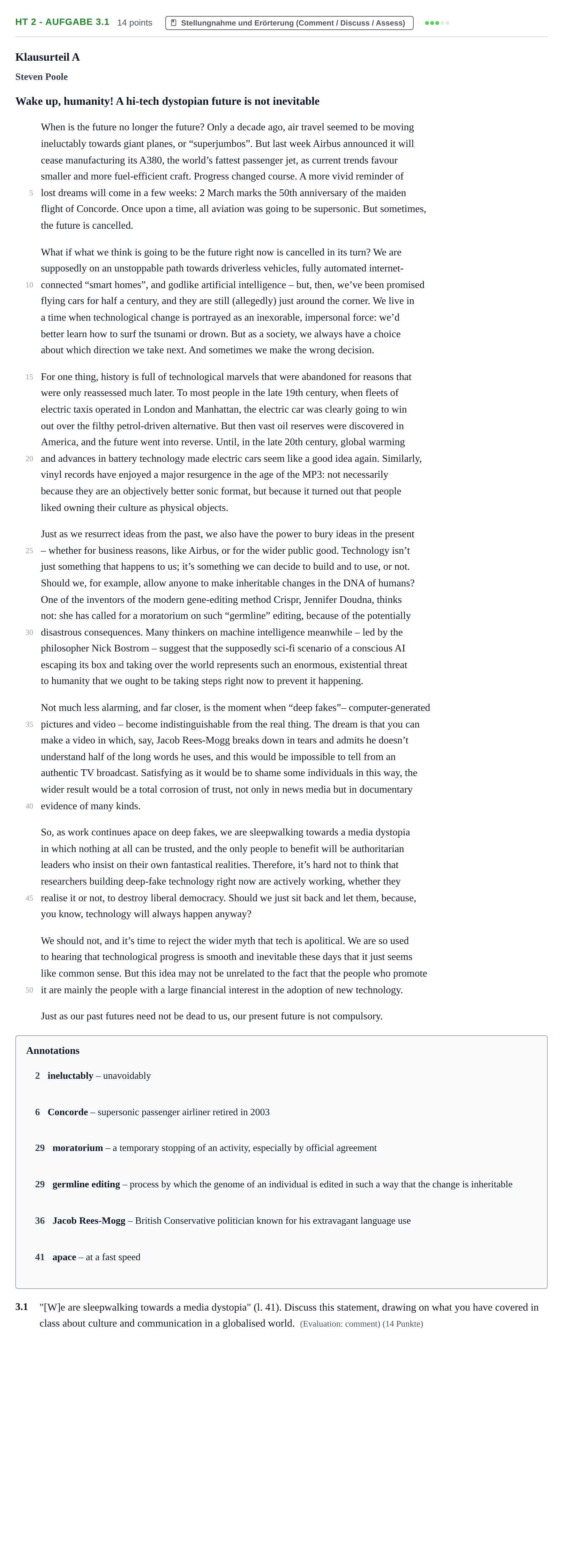
Klausurteil A
Steven Poole
Wake up, humanity! A hi-tech dystopian future is not inevitable
When is the future no longer the future? Only a decade ago, air travel seemed to be moving
ineluctably towards giant planes, or “superjumbos”. But last week Airbus announced it will
cease manufacturing its A380, the world’s fattest passenger jet, as current trends favour
smaller and more fuel-efficient craft. Progress changed course. A more vivid reminder of
5 lost dreams will come in a few weeks: 2 March marks the 50th anniversary of the maiden
flight of Concorde. Once upon a time, all aviation was going to be supersonic. But sometimes,
the future is cancelled.
What if what we think is going to be the future right now is cancelled in its turn? We are
supposedly on an unstoppable path towards driverless vehicles, fully automated internet-
10 connected “smart homes”, and godlike artificial intelligence – but, then, we’ve been promised
flying cars for half a century, and they are still (allegedly) just around the corner. We live in
a time when technological change is portrayed as an inexorable, impersonal force: we’d
better learn how to surf the tsunami or drown. But as a society, we always have a choice
about which direction we take next. And sometimes we make the wrong decision.
15 For one thing, history is full of technological marvels that were abandoned for reasons that
were only reassessed much later. To most people in the late 19th century, when fleets of
electric taxis operated in London and Manhattan, the electric car was clearly going to win
out over the filthy petrol-driven alternative. But then vast oil reserves were discovered in
America, and the future went into reverse. Until, in the late 20th century, global warming
20 and advances in battery technology made electric cars seem like a good idea again. Similarly,
vinyl records have enjoyed a major resurgence in the age of the MP3: not necessarily
because they are an objectively better sonic format, but because it turned out that people
liked owning their culture as physical objects.
Just as we resurrect ideas from the past, we also have the power to bury ideas in the present
25 – whether for business reasons, like Airbus, or for the wider public good. Technology isn’t
just something that happens to us; it’s something we can decide to build and to use, or not.
Should we, for example, allow anyone to make inheritable changes in the DNA of humans?
One of the inventors of the modern gene-editing method Crispr, Jennifer Doudna, thinks
not: she has called for a moratorium on such “germline” editing, because of the potentially
30 disastrous consequences. Many thinkers on machine intelligence meanwhile – led by the
philosopher Nick Bostrom – suggest that the supposedly sci-fi scenario of a conscious AI
escaping its box and taking over the world represents such an enormous, existential threat
to humanity that we ought to be taking steps right now to prevent it happening.
Not much less alarming, and far closer, is the moment when “deep fakes”– computer-generated
35 pictures and video – become indistinguishable from the real thing. The dream is that you can
make a video in which, say, Jacob Rees-Mogg breaks down in tears and admits he doesn’t
understand half of the long words he uses, and this would be impossible to tell from an
authentic TV broadcast. Satisfying as it would be to shame some individuals in this way, the
wider result would be a total corrosion of trust, not only in news media but in documentary
40 evidence of many kinds.
So, as work continues apace on deep fakes, we are sleepwalking towards a media dystopia
in which nothing at all can be trusted, and the only people to benefit will be authoritarian
leaders who insist on their own fantastical realities. Therefore, it’s hard not to think that
researchers building deep-fake technology right now are actively working, whether they
45 realise it or not, to destroy liberal democracy. Should we just sit back and let them, because,
you know, technology will always happen anyway?
We should not, and it’s time to reject the wider myth that tech is apolitical. We are so used
to hearing that technological progress is smooth and inevitable these days that it just seems
like common sense. But this idea may not be unrelated to the fact that the people who promote
50 it are mainly the people with a large financial interest in the adoption of new technology.
Just as our past futures need not be dead to us, our present future is not compulsory.
Annotations
2
ineluctably – unavoidably
6
Concorde – supersonic passenger airliner retired in 2003
29
moratorium – a temporary stopping of an activity, especially by official agreement
29
germline editing – process by which the genome of an individual is edited in such a way that the change is inheritable
36
Jacob Rees-Mogg – British Conservative politician known for his extravagant language use
41
apace – at a fast speed
3.1
"[W]e are sleepwalking towards a media dystopia" (l. 41). Discuss this statement, drawing on what you have covered in class about culture and communication in a globalised world. (Evaluation: comment) (14 Punkte)
Lösung
Nach den offiziellen Korrekturhinweisen
3.1 "[W]e are sleepwalking towards a media dystopia" (l. 41). Discuss this statement, drawing on what you have covered in class about culture and communication in a globalised world. (Evaluation: comment) (14 Punkte)
Lösung: A well-structured comment discussing the statement from multiple perspectives: 1. Interpretation of the quotation (2 points): - Explaining Poole's warning: society is passively, uncritically ('sleepwalking') accepting developments that lead to a media landscape dominated by fake news, manipulative deep fakes, and eroded trust. 2. Arguments supporting Poole's dystopian view (4 points): - Manipulation, disinformation, and echo chambers/filter bubbles distorting public debate. - Tendencies of alienation and isolation caused by omnipresent digital media. - Mass data collection, surveillance capitalism, and loss of privacy. - Naive or gullible public handling of digital platforms paired with lagging legal regulations. 3. Arguments challenging or qualifying Poole's position (6 points): - Unprecedented possibilities for global networking, cultural exchange, and borderless solidarity. - Instant, democratic access to information and educational resources worldwide. - Growing public and institutional awareness regarding cyber-threats, fake news, and algorithmic bias. - Initiatives for stricter legal frameworks, fact-checking mechanisms, and regulation of tech giants. - Importance of social media in mobilizing grassroots political movements and holding power to account. 4. Conclusion and personal judgment (2 points): - A nuanced, well-founded synthesis, such as an appeal for greater media literacy/individual responsibility or a call for regulations that protect democratic debate without infringing on civil liberties.
Die ausführliche Erklärung Schritt für Schritt (mit KI) gibt es mit Premium. Premium
Löse sie direkt hier: automatische Korrektur, Hinweise und Lösung Schritt für Schritt.
‹ Aufgabe HT 1 - Aufgabe 3.1 · GK · Haupttermin 2021 · Aufgabe HT 3 - Aufgabe 3.1 · GK · Haupttermin 2021 ›
Mehr Aufgaben zu Stellungnahme und Erörterung (Comment / Discuss / Assess)
- Aufgabe NT 2 - Aufgabe 3.1 · LK · Nachtermin 2022
- Aufgabe NT 3 - Aufgabe 3.1 · LK · Nachtermin 2022
- Aufgabe 3.2 · LK · Rutherford: DNA ancestry tests may 2022
- Aufgabe 3.1 · LK · Senior: Teen Fiction and the Perils 2022
- Aufgabe HT 1 - Aufgabe 3.1 · GK · Haupttermin 2021
- Aufgabe HT 3 - Aufgabe 3.1 · GK · Haupttermin 2021
- Aufgabe HT 1 - 3.1 · GK · Haupttermin · Weiterbildungskolleg 2021
- Aufgabe HT 2 - 3.1 · GK · Haupttermin · Weiterbildungskolleg 2021
- Aufgabe HT 3 - 3.1 · GK · Haupttermin · Weiterbildungskolleg 2021
- Aufgabe HT 1 - Aufgabe 3.1 · GK · Haupttermin · Weiterbildungskolleg 2021