Aufgabe HT 1 - Aufgabe 3.1 · Abitur NRW Englisch GK · Haupttermin 2021
Thema: Stellungnahme und Erörterung (Comment / Discuss / Assess) · Aus der Prüfung GK · Haupttermin (2021)
Aufgabenstellung
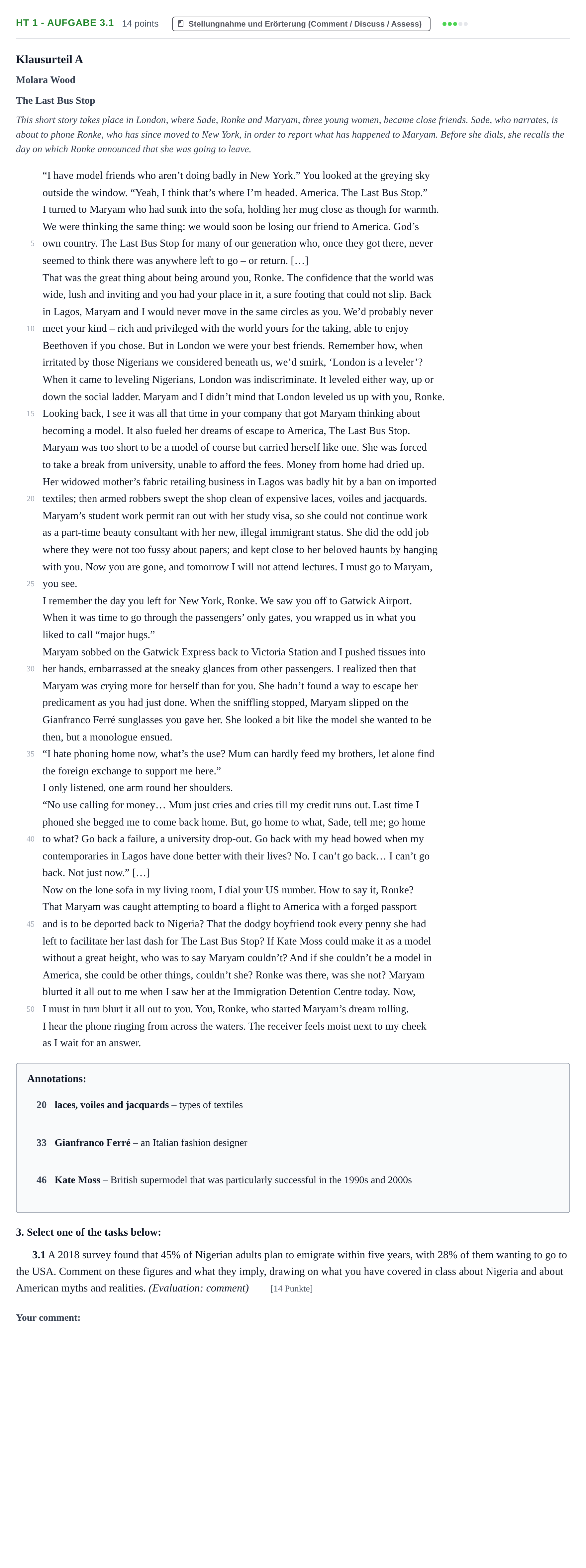
Klausurteil A
Molara Wood
The Last Bus Stop
This short story takes place in London, where Sade, Ronke and Maryam, three young women, became close friends. Sade, who narrates, is about to phone Ronke, who has since moved to New York, in order to report what has happened to Maryam. Before she dials, she recalls the day on which Ronke announced that she was going to leave.
“I have model friends who aren’t doing badly in New York.” You looked at the greying sky
outside the window. “Yeah, I think that’s where I’m headed. America. The Last Bus Stop.”
I turned to Maryam who had sunk into the sofa, holding her mug close as though for warmth.
We were thinking the same thing: we would soon be losing our friend to America. God’s
5 own country. The Last Bus Stop for many of our generation who, once they got there, never
seemed to think there was anywhere left to go – or return. […]
That was the great thing about being around you, Ronke. The confidence that the world was
wide, lush and inviting and you had your place in it, a sure footing that could not slip. Back
in Lagos, Maryam and I would never move in the same circles as you. We’d probably never
10 meet your kind – rich and privileged with the world yours for the taking, able to enjoy
Beethoven if you chose. But in London we were your best friends. Remember how, when
irritated by those Nigerians we considered beneath us, we’d smirk, ‘London is a leveler’?
When it came to leveling Nigerians, London was indiscriminate. It leveled either way, up or
down the social ladder. Maryam and I didn’t mind that London leveled us up with you, Ronke.
15 Looking back, I see it was all that time in your company that got Maryam thinking about
becoming a model. It also fueled her dreams of escape to America, The Last Bus Stop.
Maryam was too short to be a model of course but carried herself like one. She was forced
to take a break from university, unable to afford the fees. Money from home had dried up.
Her widowed mother’s fabric retailing business in Lagos was badly hit by a ban on imported
20 textiles; then armed robbers swept the shop clean of expensive laces, voiles and jacquards.
Maryam’s student work permit ran out with her study visa, so she could not continue work
as a part-time beauty consultant with her new, illegal immigrant status. She did the odd job
where they were not too fussy about papers; and kept close to her beloved haunts by hanging
with you. Now you are gone, and tomorrow I will not attend lectures. I must go to Maryam,
25 you see.
I remember the day you left for New York, Ronke. We saw you off to Gatwick Airport.
When it was time to go through the passengers’ only gates, you wrapped us in what you
liked to call “major hugs.”
Maryam sobbed on the Gatwick Express back to Victoria Station and I pushed tissues into
30 her hands, embarrassed at the sneaky glances from other passengers. I realized then that
Maryam was crying more for herself than for you. She hadn’t found a way to escape her
predicament as you had just done. When the sniffling stopped, Maryam slipped on the
Gianfranco Ferré sunglasses you gave her. She looked a bit like the model she wanted to be
then, but a monologue ensued.
35 “I hate phoning home now, what’s the use? Mum can hardly feed my brothers, let alone find
the foreign exchange to support me here.”
I only listened, one arm round her shoulders.
“No use calling for money… Mum just cries and cries till my credit runs out. Last time I
phoned she begged me to come back home. But, go home to what, Sade, tell me; go home
40 to what? Go back a failure, a university drop-out. Go back with my head bowed when my
contemporaries in Lagos have done better with their lives? No. I can’t go back… I can’t go
back. Not just now.” […]
Now on the lone sofa in my living room, I dial your US number. How to say it, Ronke?
That Maryam was caught attempting to board a flight to America with a forged passport
45 and is to be deported back to Nigeria? That the dodgy boyfriend took every penny she had
left to facilitate her last dash for The Last Bus Stop? If Kate Moss could make it as a model
without a great height, who was to say Maryam couldn’t? And if she couldn’t be a model in
America, she could be other things, couldn’t she? Ronke was there, was she not? Maryam
blurted it all out to me when I saw her at the Immigration Detention Centre today. Now,
50 I must in turn blurt it all out to you. You, Ronke, who started Maryam’s dream rolling.
I hear the phone ringing from across the waters. The receiver feels moist next to my cheek
as I wait for an answer.
Annotations:
20 laces, voiles and jacquards – types of textiles
33 Gianfranco Ferré – an Italian fashion designer
46 Kate Moss – British supermodel that was particularly successful in the 1990s and 2000s
3. Select one of the tasks below:
3.1 A 2018 survey found that 45% of Nigerian adults plan to emigrate within five years, with 28% of them wanting to go to the USA. Comment on these figures and what they imply, drawing on what you have covered in class about Nigeria and about American myths and realities. (Evaluation: comment) [14 Punkte]
Lösung
Nach den offiziellen Korrekturhinweisen
3.1 Comment on these figures and what they imply, drawing on what you have covered in class about Nigeria and about American myths and realities.
Lösung: Key elements of a convincing comment: - Push Factors & Discontent in Nigeria: * Discussion of causes: high youth unemployment, lack of social mobility and educational opportunities, corruption, and security challenges (ethnic/religious conflicts, terrorism). * Consequences: severe brain drain, demographic loss of young talent, and economic challenges for Nigeria. - Attractiveness of the USA (Pull Factors vs. Realities): * The enduring power of the American Dream (land of opportunity, equality, success through hard work). * Realities: immigration barriers, visa restrictions, risk of exploitation, systemic discrimination, and illegal status (as seen with Maryam). * Cultural connections: English as an official language in Nigeria, established Nigerian diaspora networks in the US. - Well-founded Conclusion: * Reflection on whether the trend will continue or whether governmental reforms, economic diversification, and youth empowerment in Nigeria can offer viable domestic perspectives.
Die ausführliche Erklärung Schritt für Schritt (mit KI) gibt es mit Premium. Premium
Löse sie direkt hier: automatische Korrektur, Hinweise und Lösung Schritt für Schritt.
‹ Aufgabe 3.1 · LK · Senior: Teen Fiction and the Perils 2022 · Aufgabe HT 2 - Aufgabe 3.1 · GK · Haupttermin 2021 ›
Mehr Aufgaben zu Stellungnahme und Erörterung (Comment / Discuss / Assess)
- Aufgabe NT 1 - Aufgabe 3.1 · LK · Nachtermin 2022
- Aufgabe NT 2 - Aufgabe 3.1 · LK · Nachtermin 2022
- Aufgabe NT 3 - Aufgabe 3.1 · LK · Nachtermin 2022
- Aufgabe 3.2 · LK · Rutherford: DNA ancestry tests may 2022
- Aufgabe 3.1 · LK · Senior: Teen Fiction and the Perils 2022
- Aufgabe HT 2 - Aufgabe 3.1 · GK · Haupttermin 2021
- Aufgabe HT 3 - Aufgabe 3.1 · GK · Haupttermin 2021
- Aufgabe HT 1 - 3.1 · GK · Haupttermin · Weiterbildungskolleg 2021
- Aufgabe HT 2 - 3.1 · GK · Haupttermin · Weiterbildungskolleg 2021
- Aufgabe HT 3 - 3.1 · GK · Haupttermin · Weiterbildungskolleg 2021