Aufgabe NT 2 - Task 2 · Abitur NRW Englisch GK · Nachtermin · Weiterbildungskolleg 2023
Thema: Analyse nicht-literarischer Texte (Communicative strategies) · Aus der Prüfung GK · Nachtermin · Weiterbildungskolleg (2023)
Aufgabenstellung
Klausurteil A: Leseverstehen und Schreiben integriert
Klausurteil A
Bernard Ewekia, Jakapita Kandanga, Edwin Namakanga, Maria Reyes and Farzana Faruk Jhumu
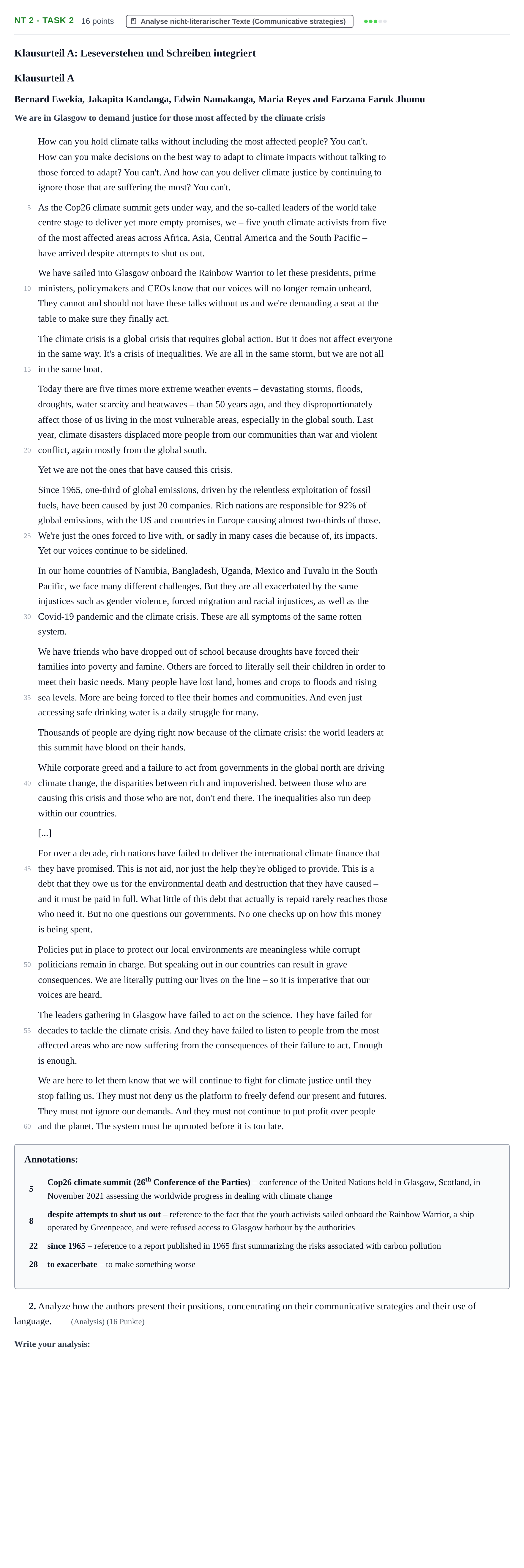
We are in Glasgow to demand justice for those most affected by the climate crisis
How can you hold climate talks without including the most affected people? You can't.
How can you make decisions on the best way to adapt to climate impacts without talking to
those forced to adapt? You can't. And how can you deliver climate justice by continuing to
ignore those that are suffering the most? You can't.
5 As the Cop26 climate summit gets under way, and the so-called leaders of the world take
centre stage to deliver yet more empty promises, we – five youth climate activists from five
of the most affected areas across Africa, Asia, Central America and the South Pacific –
have arrived despite attempts to shut us out.
We have sailed into Glasgow onboard the Rainbow Warrior to let these presidents, prime
10 ministers, policymakers and CEOs know that our voices will no longer remain unheard.
They cannot and should not have these talks without us and we're demanding a seat at the
table to make sure they finally act.
The climate crisis is a global crisis that requires global action. But it does not affect everyone
in the same way. It's a crisis of inequalities. We are all in the same storm, but we are not all
15 in the same boat.
Today there are five times more extreme weather events – devastating storms, floods,
droughts, water scarcity and heatwaves – than 50 years ago, and they disproportionately
affect those of us living in the most vulnerable areas, especially in the global south. Last
year, climate disasters displaced more people from our communities than war and violent
20 conflict, again mostly from the global south.
Yet we are not the ones that have caused this crisis.
Since 1965, one-third of global emissions, driven by the relentless exploitation of fossil
fuels, have been caused by just 20 companies. Rich nations are responsible for 92% of
global emissions, with the US and countries in Europe causing almost two-thirds of those.
25 We're just the ones forced to live with, or sadly in many cases die because of, its impacts.
Yet our voices continue to be sidelined.
In our home countries of Namibia, Bangladesh, Uganda, Mexico and Tuvalu in the South
Pacific, we face many different challenges. But they are all exacerbated by the same
injustices such as gender violence, forced migration and racial injustices, as well as the
30 Covid-19 pandemic and the climate crisis. These are all symptoms of the same rotten
system.
We have friends who have dropped out of school because droughts have forced their
families into poverty and famine. Others are forced to literally sell their children in order to
meet their basic needs. Many people have lost land, homes and crops to floods and rising
35 sea levels. More are being forced to flee their homes and communities. And even just
accessing safe drinking water is a daily struggle for many.
Thousands of people are dying right now because of the climate crisis: the world leaders at
this summit have blood on their hands.
While corporate greed and a failure to act from governments in the global north are driving
40 climate change, the disparities between rich and impoverished, between those who are
causing this crisis and those who are not, don't end there. The inequalities also run deep
within our countries.
[...]
For over a decade, rich nations have failed to deliver the international climate finance that
45 they have promised. This is not aid, nor just the help they're obliged to provide. This is a
debt that they owe us for the environmental death and destruction that they have caused –
and it must be paid in full. What little of this debt that actually is repaid rarely reaches those
who need it. But no one questions our governments. No one checks up on how this money
is being spent.
Policies put in place to protect our local environments are meaningless while corrupt
50 politicians remain in charge. But speaking out in our countries can result in grave
consequences. We are literally putting our lives on the line – so it is imperative that our
voices are heard.
The leaders gathering in Glasgow have failed to act on the science. They have failed for
55 decades to tackle the climate crisis. And they have failed to listen to people from the most
affected areas who are now suffering from the consequences of their failure to act. Enough
is enough.
We are here to let them know that we will continue to fight for climate justice until they
stop failing us. They must not deny us the platform to freely defend our present and futures.
They must not ignore our demands. And they must not continue to put profit over people
60 and the planet. The system must be uprooted before it is too late.
Annotations:
5 · Cop26 climate summit (26 th Conference of the Parties) – conference of the United Nations held in Glasgow, Scotland, in November 2021 assessing the worldwide progress in dealing with climate change
8 · despite attempts to shut us out – reference to the fact that the youth activists sailed onboard the Rainbow Warrior, a ship operated by Greenpeace, and were refused access to Glasgow harbour by the authorities
22 · since 1965 – reference to a report published in 1965 first summarizing the risks associated with carbon pollution
28 · to exacerbate – to make something worse
2. Analyze how the authors present their positions, concentrating on their communicative strategies and their use of language. (Analysis) (16 Punkte)
Lösung
Nach den offiziellen Korrekturhinweisen
2. Analyze how the authors present their positions, concentrating on their communicative strategies and their use of language. (Analysis) (16 Punkte)
Lösung: Key analytical points: 1. Core purpose: Denouncing the failure of industrialized nations to address the climate crisis and provide support, while demanding justice and immediate action including vulnerable nations' voices. 2. Communicative strategies: Emotional involvement of readers; contrasting actors ('we' vs. 'they' / global north vs. global south / victims vs. polluters); vivid personal anecdotes and authentic testimony; direct and indirect appeals. 3. Linguistic devices: Strongly evaluative/emotive vocabulary ('rotten system', 'blood on their hands'); vivid imagery and metaphors ('all in the same storm, but we are not all in the same boat'); repetition, parallel structures, and enumerations ('How can you... You can't'); rhetorical questions opening the text to challenge the moral legitimacy of exclusive climate summits.
Die ausführliche Erklärung Schritt für Schritt (mit KI) gibt es mit Premium. Premium
Löse sie direkt hier: automatische Korrektur, Hinweise und Lösung Schritt für Schritt.
‹ Aufgabe HT 2 - 2 · GK · Haupttermin (2) 2023 · Aufgabe 2 · GK · Suggs: Remembering the Rev. Joseph 2023 ›
Mehr Aufgaben zu Analyse nicht-literarischer Texte (Communicative strategies)
- Aufgabe 2 · GK · Renkl: Student Journalists Reveal a 2025
- Aufgabe 2 · LK · Kern: It’s not all coffee shops and 2025
- Aufgabe HT 2 - Klausurteil A - 2 · GK · Haupttermin 2023
- Aufgabe HT 2 - Task 2 · GK · Haupttermin · Weiterbildungskolleg 2023
- Aufgabe HT 2 - 2 · GK · Haupttermin (2) 2023
- Aufgabe 2 · GK · Suggs: Remembering the Rev. Joseph 2023
- Aufgabe 2 · GK · Thorpe: Successful African-American 2023
- Aufgabe HT 2 - Aufgabe 2 · LK · Haupttermin 2023
- Aufgabe HT 2 - Task 2 · LK · Haupttermin · Weiterbildungskolleg 2023
- Aufgabe 2 · LK · Hunter: Don’t Believe the Lie That 2023