Aufgabe HT 2 - 2 · Abitur NRW Englisch GK · Haupttermin (2) 2023
Thema: Analyse nicht-literarischer Texte (Communicative strategies) · Aus der Prüfung GK · Haupttermin (2) (2023)
Aufgabenstellung
Klausurteil A
Ernie Suggs
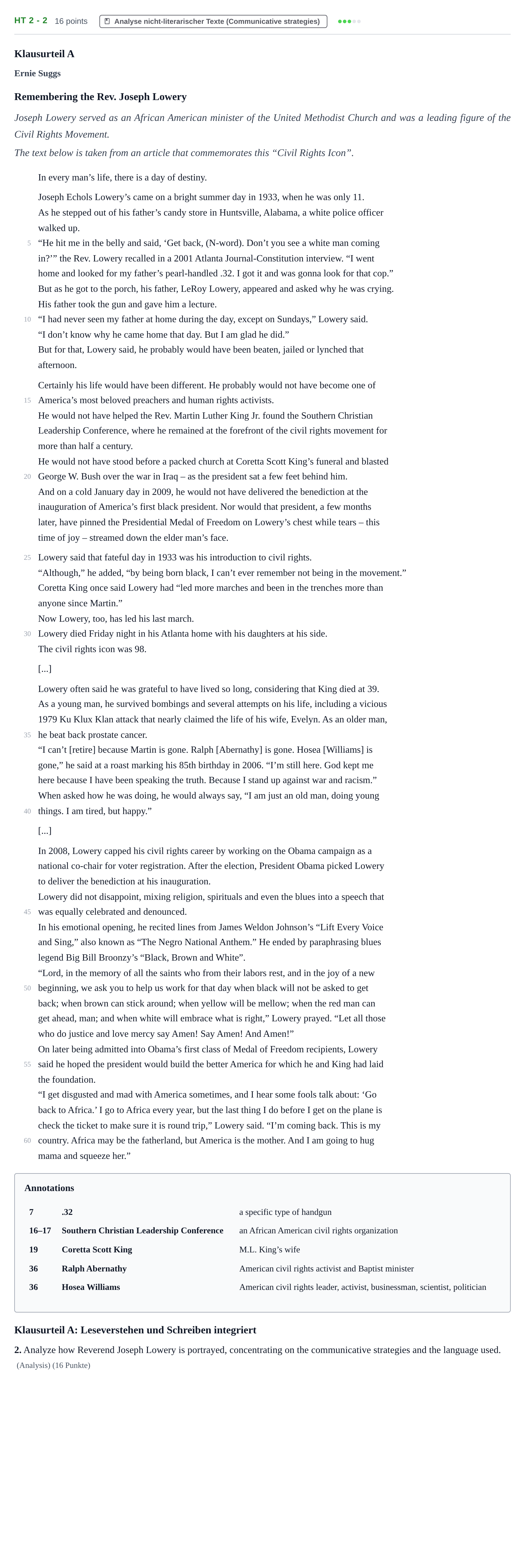
Remembering the Rev. Joseph Lowery
Joseph Lowery served as an African American minister of the United Methodist Church and was a leading figure of the Civil Rights Movement.
The text below is taken from an article that commemorates this “Civil Rights Icon”.
In every man’s life, there is a day of destiny.
Joseph Echols Lowery’s came on a bright summer day in 1933, when he was only 11.
As he stepped out of his father’s candy store in Huntsville, Alabama, a white police officer
walked up.
5 “He hit me in the belly and said, ‘Get back, (N-word). Don’t you see a white man coming
in?’” the Rev. Lowery recalled in a 2001 Atlanta Journal-Constitution interview. “I went
home and looked for my father’s pearl-handled.32. I got it and was gonna look for that cop.”
But as he got to the porch, his father, LeRoy Lowery, appeared and asked why he was crying.
His father took the gun and gave him a lecture.
10 “I had never seen my father at home during the day, except on Sundays,” Lowery said.
“I don’t know why he came home that day. But I am glad he did.”
But for that, Lowery said, he probably would have been beaten, jailed or lynched that
afternoon.
Certainly his life would have been different. He probably would not have become one of
15 America’s most beloved preachers and human rights activists.
He would not have helped the Rev. Martin Luther King Jr. found the Southern Christian
Leadership Conference, where he remained at the forefront of the civil rights movement for
more than half a century.
He would not have stood before a packed church at Coretta Scott King’s funeral and blasted
20 George W. Bush over the war in Iraq – as the president sat a few feet behind him.
And on a cold January day in 2009, he would not have delivered the benediction at the
inauguration of America’s first black president. Nor would that president, a few months
later, have pinned the Presidential Medal of Freedom on Lowery’s chest while tears – this
time of joy – streamed down the elder man’s face.
25 Lowery said that fateful day in 1933 was his introduction to civil rights.
“Although,” he added, “by being born black, I can’t ever remember not being in the movement.”
Coretta King once said Lowery had “led more marches and been in the trenches more than
anyone since Martin.”
Now Lowery, too, has led his last march.
30 Lowery died Friday night in his Atlanta home with his daughters at his side.
The civil rights icon was 98.
[...]
Lowery often said he was grateful to have lived so long, considering that King died at 39.
As a young man, he survived bombings and several attempts on his life, including a vicious
1979 Ku Klux Klan attack that nearly claimed the life of his wife, Evelyn. As an older man,
35 he beat back prostate cancer.
“I can’t [retire] because Martin is gone. Ralph [Abernathy] is gone. Hosea [Williams] is
gone,” he said at a roast marking his 85th birthday in 2006. “I’m still here. God kept me
here because I have been speaking the truth. Because I stand up against war and racism.”
When asked how he was doing, he would always say, “I am just an old man, doing young
40 things. I am tired, but happy.”
[...]
In 2008, Lowery capped his civil rights career by working on the Obama campaign as a
national co-chair for voter registration. After the election, President Obama picked Lowery
to deliver the benediction at his inauguration.
Lowery did not disappoint, mixing religion, spirituals and even the blues into a speech that
45 was equally celebrated and denounced.
In his emotional opening, he recited lines from James Weldon Johnson’s “Lift Every Voice
and Sing,” also known as “The Negro National Anthem.” He ended by paraphrasing blues
legend Big Bill Broonzy’s “Black, Brown and White”.
“Lord, in the memory of all the saints who from their labors rest, and in the joy of a new
50 beginning, we ask you to help us work for that day when black will not be asked to get
back; when brown can stick around; when yellow will be mellow; when the red man can
get ahead, man; and when white will embrace what is right,” Lowery prayed. “Let all those
who do justice and love mercy say Amen! Say Amen! And Amen!”
On later being admitted into Obama’s first class of Medal of Freedom recipients, Lowery
55 said he hoped the president would build the better America for which he and King had laid
the foundation.
“I get disgusted and mad with America sometimes, and I hear some fools talk about: ‘Go
back to Africa.’ I go to Africa every year, but the last thing I do before I get on the plane is
check the ticket to make sure it is round trip,” Lowery said. “I’m coming back. This is my
60 country. Africa may be the fatherland, but America is the mother. And I am going to hug
mama and squeeze her.”
Annotations
7 ·.32 · a specific type of handgun
16–17 · Southern Christian Leadership Conference · an African American civil rights organization
19 · Coretta Scott King · M.L. King’s wife
36 · Ralph Abernathy · American civil rights activist and Baptist minister
36 · Hosea Williams · American civil rights leader, activist, businessman, scientist, politician
Klausurteil A: Leseverstehen und Schreiben integriert
2. Analyze how Reverend Joseph Lowery is portrayed, concentrating on the communicative strategies and the language used. (Analysis) (16 Punkte)
Lösung
Nach den offiziellen Korrekturhinweisen
2. Analyze how Reverend Joseph Lowery is portrayed, concentrating on the communicative strategies and the language used.
Lösung: Analysis of the presentation of Reverend Joseph Lowery: 1. Core Message & Characterization (4 points): - Suggs presents Lowery as an unwavering fighter and hero of the American Civil Rights Movement, paying tribute to him as a major historical icon and moral authority. 2. Communicative Strategies (6 points): - Chronological / Narrative structure: Traces his life path from a key childhood incident ("day of destiny", 1933) through major historical climaxes (SCLC founding, civil rights marches, Coretta Scott King's funeral) to Obama's inauguration (2009) and his death at age 98. - Association with central civil rights figures: Frequent comparisons and connections with Dr. Martin Luther King Jr. and Coretta Scott King elevate his status ("led more marches and been in the trenches more than anyone since Martin"). - Hagiographic / Eulogistic tone: Unconditionally appreciative portrayal emphasizing resilience, moral clarity, humor, and fearlessness. - Integration of direct quotes: Uses vivid quotations from Lowery and contemporaries to render him authentic, approachable, energetic ("an old man, doing young things"), and deeply principled. 3. Linguistic and Stylistic Means (6 points): - Imagery and Metaphors: Metaphorical expressions such as "day of destiny", "in the trenches", "led his last march" emphasize the heroic, battlefield-like nature of the civil rights struggle. - Evaluative / Emphatic diction: Positive and admiring word choice ("beloved preachers", "civil rights icon", "capped his civil rights career", "tears of joy"). - Parallelisms and Repetitions: Use of parallel syntax, especially the conditional sequence of "He would not have..." (lines 15–23), underscoring how fate shaped his historic legacy. - Parataxis and direct speech: Clear, punchy sentences and authentic colloquialisms in Lowery's quotes (e.g., personification of Africa as fatherland and America as mother: "hug mama and squeeze her").
Die ausführliche Erklärung Schritt für Schritt (mit KI) gibt es mit Premium. Premium
Löse sie direkt hier: automatische Korrektur, Hinweise und Lösung Schritt für Schritt.
‹ Aufgabe HT 2 - Task 2 · GK · Haupttermin · Weiterbildungskolleg 2023 · Aufgabe NT 2 - Task 2 · GK · Nachtermin · Weiterbildungskolleg 2023 ›
Mehr Aufgaben zu Analyse nicht-literarischer Texte (Communicative strategies)
- Aufgabe 2 · GK · Green: A Native American faces tear 2025
- Aufgabe 2 · GK · Renkl: Student Journalists Reveal a 2025
- Aufgabe 2 · LK · Kern: It’s not all coffee shops and 2025
- Aufgabe HT 2 - Klausurteil A - 2 · GK · Haupttermin 2023
- Aufgabe HT 2 - Task 2 · GK · Haupttermin · Weiterbildungskolleg 2023
- Aufgabe NT 2 - Task 2 · GK · Nachtermin · Weiterbildungskolleg 2023
- Aufgabe 2 · GK · Suggs: Remembering the Rev. Joseph 2023
- Aufgabe 2 · GK · Thorpe: Successful African-American 2023
- Aufgabe HT 2 - Aufgabe 2 · LK · Haupttermin 2023
- Aufgabe HT 2 - Task 2 · LK · Haupttermin · Weiterbildungskolleg 2023