Aufgabe NT 2 - 2 · Abitur NRW Englisch LK · Nachtermin · Weiterbildungskolleg 2021
Thema: Analyse nicht-literarischer Texte (Communicative strategies) · Aus der Prüfung LK · Nachtermin · Weiterbildungskolleg (2021)
Aufgabenstellung
Klausurteil A
Philip Pullman
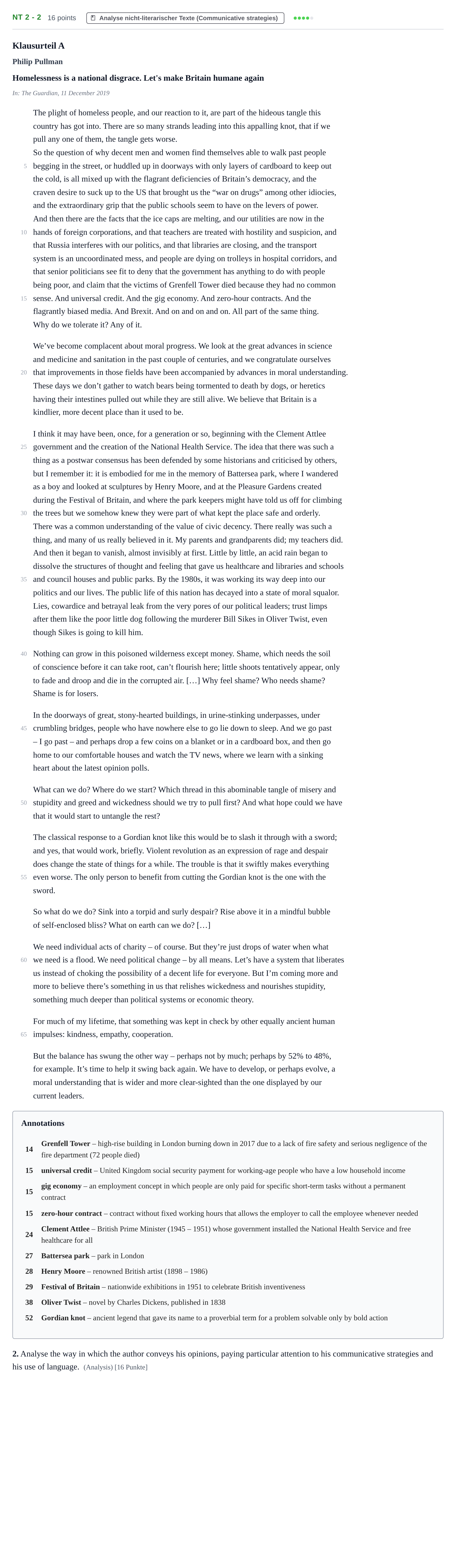
Homelessness is a national disgrace. Let's make Britain humane again
In: The Guardian, 11 December 2019
The plight of homeless people, and our reaction to it, are part of the hideous tangle this
country has got into. There are so many strands leading into this appalling knot, that if we
pull any one of them, the tangle gets worse.
So the question of why decent men and women find themselves able to walk past people
5 begging in the street, or huddled up in doorways with only layers of cardboard to keep out
the cold, is all mixed up with the flagrant deficiencies of Britain’s democracy, and the
craven desire to suck up to the US that brought us the “war on drugs” among other idiocies,
and the extraordinary grip that the public schools seem to have on the levers of power.
And then there are the facts that the ice caps are melting, and our utilities are now in the
10 hands of foreign corporations, and that teachers are treated with hostility and suspicion, and
that Russia interferes with our politics, and that libraries are closing, and the transport
system is an uncoordinated mess, and people are dying on trolleys in hospital corridors, and
that senior politicians see fit to deny that the government has anything to do with people
being poor, and claim that the victims of Grenfell Tower died because they had no common
15 sense. And universal credit. And the gig economy. And zero-hour contracts. And the
flagrantly biased media. And Brexit. And on and on and on. All part of the same thing.
Why do we tolerate it? Any of it.
We’ve become complacent about moral progress. We look at the great advances in science
and medicine and sanitation in the past couple of centuries, and we congratulate ourselves
20 that improvements in those fields have been accompanied by advances in moral understanding.
These days we don’t gather to watch bears being tormented to death by dogs, or heretics
having their intestines pulled out while they are still alive. We believe that Britain is a
kindlier, more decent place than it used to be.
I think it may have been, once, for a generation or so, beginning with the Clement Attlee
25 government and the creation of the National Health Service. The idea that there was such a
thing as a postwar consensus has been defended by some historians and criticised by others,
but I remember it: it is embodied for me in the memory of Battersea park, where I wandered
as a boy and looked at sculptures by Henry Moore, and at the Pleasure Gardens created
during the Festival of Britain, and where the park keepers might have told us off for climbing
30 the trees but we somehow knew they were part of what kept the place safe and orderly.
There was a common understanding of the value of civic decency. There really was such a
thing, and many of us really believed in it. My parents and grandparents did; my teachers did.
And then it began to vanish, almost invisibly at first. Little by little, an acid rain began to
dissolve the structures of thought and feeling that gave us healthcare and libraries and schools
35 and council houses and public parks. By the 1980s, it was working its way deep into our
politics and our lives. The public life of this nation has decayed into a state of moral squalor.
Lies, cowardice and betrayal leak from the very pores of our political leaders; trust limps
after them like the poor little dog following the murderer Bill Sikes in Oliver Twist, even
though Sikes is going to kill him.
40 Nothing can grow in this poisoned wilderness except money. Shame, which needs the soil
of conscience before it can take root, can’t flourish here; little shoots tentatively appear, only
to fade and droop and die in the corrupted air. […] Why feel shame? Who needs shame?
Shame is for losers.
In the doorways of great, stony-hearted buildings, in urine-stinking underpasses, under
45 crumbling bridges, people who have nowhere else to go lie down to sleep. And we go past
– I go past – and perhaps drop a few coins on a blanket or in a cardboard box, and then go
home to our comfortable houses and watch the TV news, where we learn with a sinking
heart about the latest opinion polls.
What can we do? Where do we start? Which thread in this abominable tangle of misery and
50 stupidity and greed and wickedness should we try to pull first? And what hope could we have
that it would start to untangle the rest?
The classical response to a Gordian knot like this would be to slash it through with a sword;
and yes, that would work, briefly. Violent revolution as an expression of rage and despair
does change the state of things for a while. The trouble is that it swiftly makes everything
55 even worse. The only person to benefit from cutting the Gordian knot is the one with the
sword.
So what do we do? Sink into a torpid and surly despair? Rise above it in a mindful bubble
of self-enclosed bliss? What on earth can we do? […]
We need individual acts of charity – of course. But they’re just drops of water when what
60 we need is a flood. We need political change – by all means. Let’s have a system that liberates
us instead of choking the possibility of a decent life for everyone. But I’m coming more and
more to believe there’s something in us that relishes wickedness and nourishes stupidity,
something much deeper than political systems or economic theory.
For much of my lifetime, that something was kept in check by other equally ancient human
65 impulses: kindness, empathy, cooperation.
But the balance has swung the other way – perhaps not by much; perhaps by 52% to 48%,
for example. It’s time to help it swing back again. We have to develop, or perhaps evolve, a
moral understanding that is wider and more clear-sighted than the one displayed by our
current leaders.
Annotations
14 · Grenfell Tower – high-rise building in London burning down in 2017 due to a lack of fire safety and serious negligence of the fire department (72 people died)
15 · universal credit – United Kingdom social security payment for working-age people who have a low household income
15 · gig economy – an employment concept in which people are only paid for specific short-term tasks without a permanent contract
15 · zero-hour contract – contract without fixed working hours that allows the employer to call the employee whenever needed
24 · Clement Attlee – British Prime Minister (1945 – 1951) whose government installed the National Health Service and free healthcare for all
27 · Battersea park – park in London
28 · Henry Moore – renowned British artist (1898 – 1986)
29 · Festival of Britain – nationwide exhibitions in 1951 to celebrate British inventiveness
38 · Oliver Twist – novel by Charles Dickens, published in 1838
52 · Gordian knot – ancient legend that gave its name to a proverbial term for a problem solvable only by bold action
2. Analyse the way in which the author conveys his opinions, paying particular attention to his communicative strategies and his use of language. (Analysis) [16 Punkte]
Lösung
Nach den offiziellen Korrekturhinweisen
2. Analyse the way in which the author conveys his opinions, paying particular attention to his communicative strategies and his use of language.
Lösung: An analysis covering: - Author's intention: sharply criticising and condemning the current socio-political condition of British society and convincing readers of the urgent need for fundamental political and moral change. - Communicative strategies: one-sided depiction using drastic examples/facts, provocative and sarcastic/ironic tone, referring to personal childhood memories (Battersea Park, post-war consensus), inclusive pronouns ('we', 'our', 'us') to create a sense of shared responsibility, direct and indirect appeals. - Linguistic and stylistic devices: vivid and figurative imagery/metaphors (e.g., 'hideous tangle', 'acid rain', 'poisoned wilderness', 'drops of water vs flood'), parallel sentence structures, repetitive polysyndetic enumerations ('And... and...'), pointed and highly evaluative diction ('craven', 'moral squalor', 'wickedness'), and rhetorical questions engaging the reader.
Die ausführliche Erklärung Schritt für Schritt (mit KI) gibt es mit Premium. Premium
Löse sie direkt hier: automatische Korrektur, Hinweise und Lösung Schritt für Schritt.
‹ Aufgabe NT 3 - Aufgabe 2 · LK · Nachtermin 2021 · Aufgabe NT 3 - 2 · LK · Nachtermin · Weiterbildungskolleg 2021 ›
Mehr Aufgaben zu Analyse nicht-literarischer Texte (Communicative strategies)
- Aufgabe HT 3 - 2 · LK · Haupttermin 2021
- Aufgabe HT 2 - Aufgabe 2 · LK · Haupttermin · Weiterbildungskolleg 2021
- Aufgabe HT 3 - Aufgabe 2 · LK · Haupttermin · Weiterbildungskolleg 2021
- Aufgabe NT 2 - Aufgabe 2 · LK · Nachtermin 2021
- Aufgabe NT 3 - Aufgabe 2 · LK · Nachtermin 2021
- Aufgabe NT 3 - 2 · LK · Nachtermin · Weiterbildungskolleg 2021
- Aufgabe 2 · GK · Vick: Where Did America's Summer Jo 2020
- Aufgabe 2 · LK · Landrieu: Speech on the Removal of 2020