Aufgabe NT 3 - Aufgabe 2 · Abitur NRW Englisch LK · Nachtermin 2021
Thema: Analyse nicht-literarischer Texte (Communicative strategies) · Aus der Prüfung LK · Nachtermin (2021)
Aufgabenstellung
Klausurteil A
Rose Eveleth
The biggest lie tech people tell themselves – and the rest of us
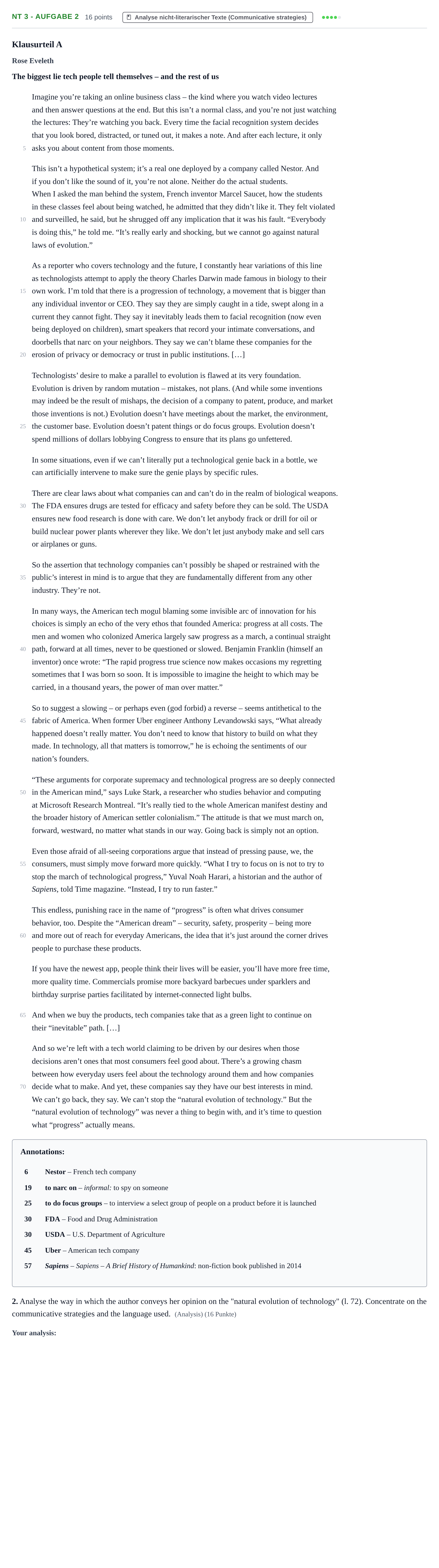
Imagine you’re taking an online business class – the kind where you watch video lectures
and then answer questions at the end. But this isn’t a normal class, and you’re not just watching
the lectures: They’re watching you back. Every time the facial recognition system decides
that you look bored, distracted, or tuned out, it makes a note. And after each lecture, it only
5 asks you about content from those moments.
This isn’t a hypothetical system; it’s a real one deployed by a company called Nestor. And
if you don’t like the sound of it, you’re not alone. Neither do the actual students.
When I asked the man behind the system, French inventor Marcel Saucet, how the students
in these classes feel about being watched, he admitted that they didn’t like it. They felt violated
10 and surveilled, he said, but he shrugged off any implication that it was his fault. “Everybody
is doing this,” he told me. “It’s really early and shocking, but we cannot go against natural
laws of evolution.”
As a reporter who covers technology and the future, I constantly hear variations of this line
as technologists attempt to apply the theory Charles Darwin made famous in biology to their
15 own work. I’m told that there is a progression of technology, a movement that is bigger than
any individual inventor or CEO. They say they are simply caught in a tide, swept along in a
current they cannot fight. They say it inevitably leads them to facial recognition (now even
being deployed on children), smart speakers that record your intimate conversations, and
doorbells that narc on your neighbors. They say we can’t blame these companies for the
20 erosion of privacy or democracy or trust in public institutions. […]
Technologists’ desire to make a parallel to evolution is flawed at its very foundation.
Evolution is driven by random mutation – mistakes, not plans. (And while some inventions
may indeed be the result of mishaps, the decision of a company to patent, produce, and market
those inventions is not.) Evolution doesn’t have meetings about the market, the environment,
25 the customer base. Evolution doesn’t patent things or do focus groups. Evolution doesn’t
spend millions of dollars lobbying Congress to ensure that its plans go unfettered.
In some situations, even if we can’t literally put a technological genie back in a bottle, we
can artificially intervene to make sure the genie plays by specific rules.
There are clear laws about what companies can and can’t do in the realm of biological weapons.
30 The FDA ensures drugs are tested for efficacy and safety before they can be sold. The USDA
ensures new food research is done with care. We don’t let anybody frack or drill for oil or
build nuclear power plants wherever they like. We don’t let just anybody make and sell cars
or airplanes or guns.
So the assertion that technology companies can’t possibly be shaped or restrained with the
35 public’s interest in mind is to argue that they are fundamentally different from any other
industry. They’re not.
In many ways, the American tech mogul blaming some invisible arc of innovation for his
choices is simply an echo of the very ethos that founded America: progress at all costs. The
men and women who colonized America largely saw progress as a march, a continual straight
40 path, forward at all times, never to be questioned or slowed. Benjamin Franklin (himself an
inventor) once wrote: “The rapid progress true science now makes occasions my regretting
sometimes that I was born so soon. It is impossible to imagine the height to which may be
carried, in a thousand years, the power of man over matter.”
So to suggest a slowing – or perhaps even (god forbid) a reverse – seems antithetical to the
45 fabric of America. When former Uber engineer Anthony Levandowski says, “What already
happened doesn’t really matter. You don’t need to know that history to build on what they
made. In technology, all that matters is tomorrow,” he is echoing the sentiments of our
nation’s founders.
“These arguments for corporate supremacy and technological progress are so deeply connected
50 in the American mind,” says Luke Stark, a researcher who studies behavior and computing
at Microsoft Research Montreal. “It’s really tied to the whole American manifest destiny and
the broader history of American settler colonialism.” The attitude is that we must march on,
forward, westward, no matter what stands in our way. Going back is simply not an option.
Even those afraid of all-seeing corporations argue that instead of pressing pause, we, the
55 consumers, must simply move forward more quickly. “What I try to focus on is not to try to
stop the march of technological progress,” Yuval Noah Harari, a historian and the author of
Sapiens, told Time magazine. “Instead, I try to run faster.”
This endless, punishing race in the name of “progress” is often what drives consumer
behavior, too. Despite the “American dream” – security, safety, prosperity – being more
60 and more out of reach for everyday Americans, the idea that it’s just around the corner drives
people to purchase these products.
If you have the newest app, people think their lives will be easier, you’ll have more free time,
more quality time. Commercials promise more backyard barbecues under sparklers and
birthday surprise parties facilitated by internet-connected light bulbs.
65 And when we buy the products, tech companies take that as a green light to continue on
their “inevitable” path. […]
And so we’re left with a tech world claiming to be driven by our desires when those
decisions aren’t ones that most consumers feel good about. There’s a growing chasm
between how everyday users feel about the technology around them and how companies
70 decide what to make. And yet, these companies say they have our best interests in mind.
We can’t go back, they say. We can’t stop the “natural evolution of technology.” But the
“natural evolution of technology” was never a thing to begin with, and it’s time to question
what “progress” actually means.
Annotations:
6 · Nestor – French tech company
19 · to narc on – informal: to spy on someone
25 · to do focus groups – to interview a select group of people on a product before it is launched
30 · FDA – Food and Drug Administration
30 · USDA – U.S. Department of Agriculture
45 · Uber – American tech company
57 · Sapiens – Sapiens – A Brief History of Humankind: non-fiction book published in 2014
2. Analyse the way in which the author conveys her opinion on the "natural evolution of technology" (l. 72). Concentrate on the communicative strategies and the language used.
(Analysis) (16 Punkte)
Lösung
Nach den offiziellen Korrekturhinweisen
2. Analyse the way in which the author conveys her opinion on the "natural evolution of technology" (l. 72). Concentrate on the communicative strategies and the language used.
Lösung: A comprehensive analysis addresses: 1. Core thesis and intention (4 pts): - Unmasking the idea of an "inevitable natural evolution" as an excuse/pretext used by tech corporations to avoid accountability. - Calling on readers to critically re-evaluate progress. 2. Communicative strategies (6 pts): - Direct reader address and relatable opening scenario (e-learning facial recognition software). - Concrete vivid examples (Nestor, smart speakers, doorbells that narc on neighbours). - Contrasting corporate perspectives with the reality of consumers. - Strategic use of quotations (inventor Marcel Saucet, historical quotes like Benjamin Franklin, tech figures like Levandowski, critics/scholars like Luke Stark and Yuval Noah Harari). - Connecting tech ideology to cultural myths (Manifest Destiny, settler colonialism, the American Dream). 3. Use of language (6 pts): - Metaphorical language / imagery (water imagery: "caught in a tide", "swept along in a current"; "technological genie back in a bottle"; "march, a continual straight path"). - Emotive and evaluative diction ("violated", "surveilled", "flawed at its very foundation", "lie"). - Inclusive vs exclusive pronouns ("we"/"us" uniting consumers and readers against "they" representing corporations). - Repetition, parallel sentence structures, and anaphora ("Evolution doesn't have meetings... Evolution doesn't patent... Evolution doesn't spend millions...").
Die ausführliche Erklärung Schritt für Schritt (mit KI) gibt es mit Premium. Premium
Löse sie direkt hier: automatische Korrektur, Hinweise und Lösung Schritt für Schritt.
‹ Aufgabe NT 2 - Aufgabe 2 · LK · Nachtermin 2021 · Aufgabe NT 2 - 2 · LK · Nachtermin · Weiterbildungskolleg 2021 ›
Mehr Aufgaben zu Analyse nicht-literarischer Texte (Communicative strategies)
- Aufgabe HT 2 - 2 · LK · Haupttermin 2021
- Aufgabe HT 3 - 2 · LK · Haupttermin 2021
- Aufgabe HT 2 - Aufgabe 2 · LK · Haupttermin · Weiterbildungskolleg 2021
- Aufgabe HT 3 - Aufgabe 2 · LK · Haupttermin · Weiterbildungskolleg 2021
- Aufgabe NT 2 - Aufgabe 2 · LK · Nachtermin 2021
- Aufgabe NT 2 - 2 · LK · Nachtermin · Weiterbildungskolleg 2021
- Aufgabe NT 3 - 2 · LK · Nachtermin · Weiterbildungskolleg 2021
- Aufgabe 2 · GK · Vick: Where Did America's Summer Jo 2020
- Aufgabe 2 · LK · Landrieu: Speech on the Removal of 2020