Aufgabe 2 · Abitur NRW Englisch LK · Cohen: Nelson Mandela’s Stolen Spoo 2021
Thema: Analyse nicht-literarischer Texte (Communicative strategies) · Aus der Prüfung LK · Cohen: Nelson Mandela’s Stolen Spoon (2021)
Aufgabenstellung
Material
Roger Cohen: Nelson Mandela’s Stolen Spoon (2018)
Thank you, Madiba 1, for pardoning my family, me, the whites of South Africa. You’re 100, so let’s celebrate your example.
CAPE TOWN — I go out to Robben Island on a bright clear day with my daughter, Adele, who
chose to do her semester abroad at the University of Cape Town. Full circle: My family,
Lithuanian Jews, stepped onto the teeming dock at Cape Town in June 1895, with their bundles
borne from Europe.
5 Sunshine, the surf sparkling, Table Mountain tracing a line so flat it seems an apparition. The
island, where Nelson Mandela spent 18 of his 27 years in prison, looms. A guide, himself once
imprisoned here, tells us we are permitted to look into but not to enter it.
“Visitors are no longer allowed in because somebody stole Mandela’s spoon,” he says.
The bowl, the cup (but no spoon), a sleeping mat, a rectangle of blue sky visible through the
10 window — here, in this tiny space, Mandela maintained the captaincy of his soul. Anyone
harboring the dangerous illusion of humanity’s perfectibility should remember: A tourist stole
Nelson Mandela’s spoon.
It’s the 100 th anniversary of Mandela’s birth this month. Celebrations unfurl across the world.
He was the master of his fate. The white man’s arsenal could not touch him. It was over. As
15 with Mahatma Gandhi 2, the riveting inner force prevails.
The spoon-stealers are out there. Sometimes it seems these thieves […] are taking over the
world.
They are not. Other forces are at work, raising people up rather than casting them down,
uniting, not dividing. Mandela chose to confront humanity in its iniquity and vanquish violence
20 in the name of hope.
The 27 years stolen from Mandela by people with white skins, the suffering inflicted on tens of
millions of black South Africans over decades, would not be repaid in blood.
Perhaps white South Africans, like my family, got off too lightly. Theirs was a “picnic in a
beautiful graveyard,” as Nadine Gordimer 3 wrote.
25 Then, when it was over, sanctions lifted, they joined the economic world, the sporting world.
Suddenly a South African passport was a great thing. They could say, “I never voted for
torture!” and forget their complicity in South African policing by pigment — the segregated
schools, the forced removal of blacks from their homes, the banishment of blacks to invisible
townships of dust and drudgery.
30 Today, there is a black middle class, but inequality is entrenched. A cry rises from young blacks
directed at whites — “Expropriation without compensation!” 4 It’s popular enough to have an
acronym, “EWC.” […]
For Jews, South Africa was liberation from pogrom, first, lifesaving distance from the Holocaust
later. Yet most Jews went along with apartheid — by no means all, however, including several
35 of Mandela’s lawyers. There are more bystanders than heroes in times of oppression. That’s
part of the survival gene — even if humanity’s ultimate survival depends on the few who will
resist.
South Africa was as good a place as any for a Jew to live in the 20 th century. If you’re busy
persecuting millions of blacks you don’t have much time left for tens of thousands of Jews.
40 That’s what I heard when I was old enough to hear it.
Thank you, Madiba, for pardoning my family, me, the whites of South Africa, the spoon thieves,
today’s political infants, all humanity for its iniquity and tribal stupidity. Thank you for lifting our
gaze.
I fly to Johannesburg and go out to Soweto 5 one day. There, I meet Macdonald Maanda Muhali,
45 age 30. He’s been out of a job for more than a year. He used to work as a security guard doing
perimeter patrols. Now he watches “Breaking Bad” or “Prison Break” all day on the TV he
bought when he had a job. He lives in a single room. The toilet is outside. Job applications go
unanswered. Sometimes he washes cars or lays a pipe for cash. His ear is perforated but he
says he’s too old now for an earring.
50 “Do your best,” says a sign on his wall. “God will do the rest.”
I ask this young black South African, raised in the post-apartheid era, if life is getting better.
“As long as you are not working, things are not getting better,” he says. Then I ask him if whites
got off too easily.
“Mandela forgave them,” he says. “We must trust him. If the people who suffered most forgave,
55 why shouldn’t we?” You feel no anger? “None whatsoever.”
We go out. Garbage skitters across a square. Idle young men chat and smirk. Girls in purple
sweaters and gray skirts emerge from school. A woman sells the brooms, rakes and dusters
arranged on her head. I buy sausages at a butcher. Muhali, using half a raw onion, scrapes a
grill clean. We eat. We laugh.
60 Thank you, Madiba, for the power of your example. Don't worry, you're 100, we'll find that
spoon thief. Their kind will not inherit the earth.
Cohen, R. (2018). Nelson Mandela's Stolen Spoon. The New York Times. 27 July, 2018.
803 words
Annotations
1 Madiba – Nelson Mandela’s clan name, used as a sign of respect and affection
2 Mahatma Gandhi – an Indian activist (1869 – 1948), who helped guide India to independence in 1947, renowned for his policy of nonviolent protest
3 Nadine Gordimer – a white South African writer active in the anti-apartheid movement, who received the Nobel Prize in literature
4 “Expropriation without compensation” – policy that means taking land from white farmers without paying them
5 Soweto – a township of the City of Johannesburg, known for mass protests against Apartheid in 1976
2
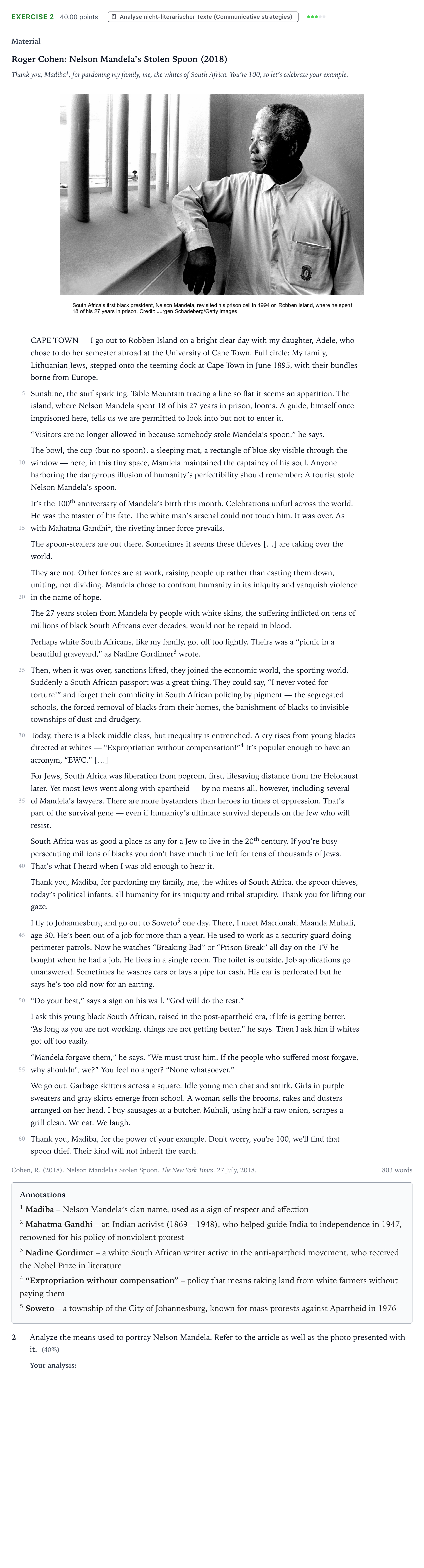
Analyze the means used to portray Nelson Mandela. Refer to the article as well as the photo presented with it.
(40%)
Lösung
Nach den offiziellen Korrekturhinweisen
Analyze the means used to portray Nelson Mandela. Refer to the article as well as the photo presented with it.
Lösung: Key aspects according to the official expectations: Nelson Mandela presented as an outstanding father figure * How it is conveyed in the text: - Framing of the text with direct address to Mandela using his clan name and thanking him (subheading, l. 41, l. 60) stresses his role as father of the South African nation, his influence on every single South African including the author; prayerlike expression of gratitude. - Use of formal, poetic vocabulary, alliteration: "master of his fate" (l. 14), "riveting inner force prevails" (l. 15), "vanquish violence in the name of hope" (ll. 19-20), "lifting our gaze" (l. 43) emphasizes Mandela's extraordinary strength of character. - Contrast between evil and good: "iniquity and [...] violence" (l. 19) vs. "hope" (l. 20); "bystanders" vs. "heroes" (l. 35) proves that humans are not perfect, stressing Mandela's presentation as a hero and superhuman figure. - Comparison to another outstanding personality, Mahatma Gandhi (l. 15) shows his historical importance. - Exemplary portrayal of a young black man (ll. 44-59) illustrates Mandela's lasting influence on South Africans. * How it is conveyed in the photo: - Window bars indicate prison, his grey hair indicates old age, but the light on his face makes him appear a shining figure underlines the text's statement that "[t]he white man's arsenal could not touch him" (l. 14). - Relaxed posture conveys the impression that he is reconciled with the past. - Relaxed facial expression, almost smiling; his look directed at the world beyond the bars not looking back but into a hopeful future.
Die ausführliche Erklärung Schritt für Schritt (mit KI) gibt es mit Premium. Premium
Löse sie direkt hier: automatische Korrektur, Hinweise und Lösung Schritt für Schritt.
‹ Aufgabe NT 3 - Aufgabe 2 · GK · Nachtermin · Weiterbildungskolleg 2021 · Aufgabe HT 2 - 2 · LK · Haupttermin 2021 ›
Mehr Aufgaben zu Analyse nicht-literarischer Texte (Communicative strategies)
- Aufgabe HT 3 - Aufgabe 2 · GK · Haupttermin · Weiterbildungskolleg 2021
- Aufgabe NT 2 - Teilaufgabe 2 · GK · Nachtermin 2021
- Aufgabe NT 3 - Teilaufgabe 2 · GK · Nachtermin 2021
- Aufgabe NT 2 - Aufgabe 2 · GK · Nachtermin · Weiterbildungskolleg 2021
- Aufgabe NT 3 - Aufgabe 2 · GK · Nachtermin · Weiterbildungskolleg 2021
- Aufgabe HT 2 - 2 · LK · Haupttermin 2021
- Aufgabe HT 3 - 2 · LK · Haupttermin 2021
- Aufgabe HT 2 - Aufgabe 2 · LK · Haupttermin · Weiterbildungskolleg 2021
- Aufgabe HT 3 - Aufgabe 2 · LK · Haupttermin · Weiterbildungskolleg 2021
- Aufgabe NT 2 - Aufgabe 2 · LK · Nachtermin 2021