Aufgabe NT 2 - Teilaufgabe 2 · Abitur NRW Englisch GK · Nachtermin 2021
Thema: Analyse nicht-literarischer Texte (Communicative strategies) · Aus der Prüfung GK · Nachtermin (2021)
Aufgabenstellung
Klausurteil A
Jane Setter
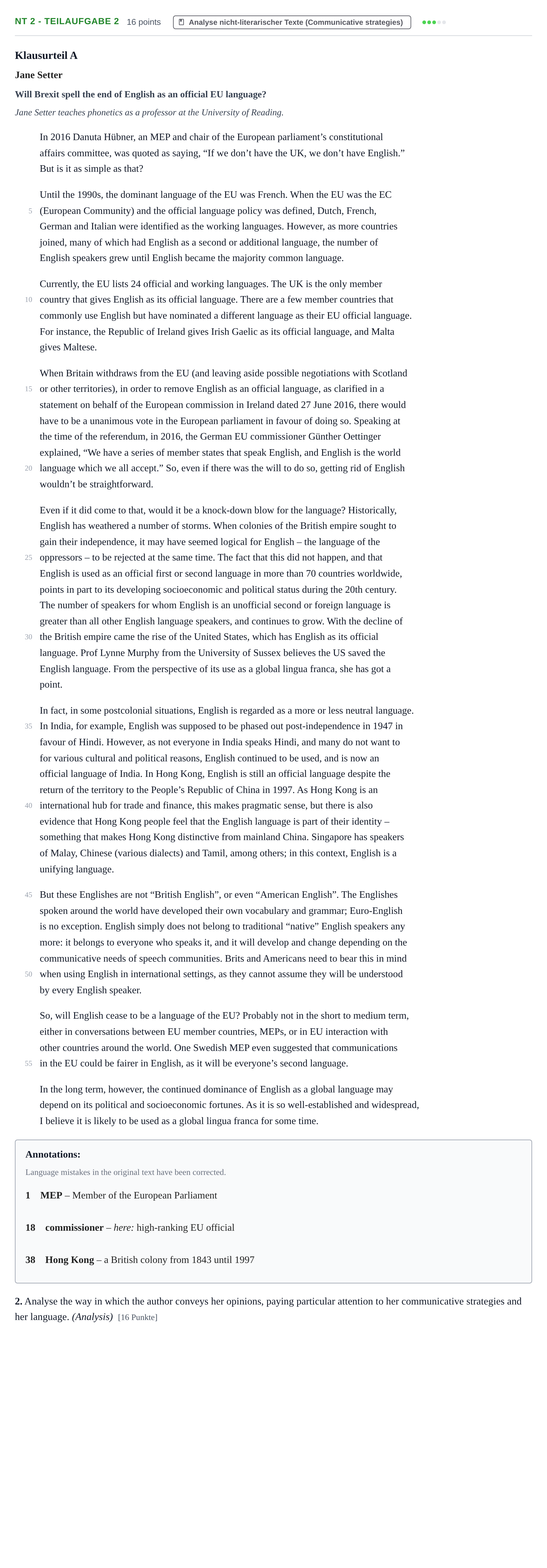
Will Brexit spell the end of English as an official EU language?
Jane Setter teaches phonetics as a professor at the University of Reading.
In 2016 Danuta Hübner, an MEP and chair of the European parliament’s constitutional
affairs committee, was quoted as saying, “If we don’t have the UK, we don’t have English.”
But is it as simple as that?
Until the 1990s, the dominant language of the EU was French. When the EU was the EC
5 (European Community) and the official language policy was defined, Dutch, French,
German and Italian were identified as the working languages. However, as more countries
joined, many of which had English as a second or additional language, the number of
English speakers grew until English became the majority common language.
Currently, the EU lists 24 official and working languages. The UK is the only member
10 country that gives English as its official language. There are a few member countries that
commonly use English but have nominated a different language as their EU official language.
For instance, the Republic of Ireland gives Irish Gaelic as its official language, and Malta
gives Maltese.
When Britain withdraws from the EU (and leaving aside possible negotiations with Scotland
15 or other territories), in order to remove English as an official language, as clarified in a
statement on behalf of the European commission in Ireland dated 27 June 2016, there would
have to be a unanimous vote in the European parliament in favour of doing so. Speaking at
the time of the referendum, in 2016, the German EU commissioner Günther Oettinger
explained, “We have a series of member states that speak English, and English is the world
20 language which we all accept.” So, even if there was the will to do so, getting rid of English
wouldn’t be straightforward.
Even if it did come to that, would it be a knock-down blow for the language? Historically,
English has weathered a number of storms. When colonies of the British empire sought to
gain their independence, it may have seemed logical for English – the language of the
25 oppressors – to be rejected at the same time. The fact that this did not happen, and that
English is used as an official first or second language in more than 70 countries worldwide,
points in part to its developing socioeconomic and political status during the 20th century.
The number of speakers for whom English is an unofficial second or foreign language is
greater than all other English language speakers, and continues to grow. With the decline of
30 the British empire came the rise of the United States, which has English as its official
language. Prof Lynne Murphy from the University of Sussex believes the US saved the
English language. From the perspective of its use as a global lingua franca, she has got a
point.
In fact, in some postcolonial situations, English is regarded as a more or less neutral language.
35 In India, for example, English was supposed to be phased out post-independence in 1947 in
favour of Hindi. However, as not everyone in India speaks Hindi, and many do not want to
for various cultural and political reasons, English continued to be used, and is now an
official language of India. In Hong Kong, English is still an official language despite the
return of the territory to the People’s Republic of China in 1997. As Hong Kong is an
40 international hub for trade and finance, this makes pragmatic sense, but there is also
evidence that Hong Kong people feel that the English language is part of their identity –
something that makes Hong Kong distinctive from mainland China. Singapore has speakers
of Malay, Chinese (various dialects) and Tamil, among others; in this context, English is a
unifying language.
45 But these Englishes are not “British English”, or even “American English”. The Englishes
spoken around the world have developed their own vocabulary and grammar; Euro-English
is no exception. English simply does not belong to traditional “native” English speakers any
more: it belongs to everyone who speaks it, and it will develop and change depending on the
communicative needs of speech communities. Brits and Americans need to bear this in mind
50 when using English in international settings, as they cannot assume they will be understood
by every English speaker.
So, will English cease to be a language of the EU? Probably not in the short to medium term,
either in conversations between EU member countries, MEPs, or in EU interaction with
other countries around the world. One Swedish MEP even suggested that communications
55 in the EU could be fairer in English, as it will be everyone’s second language.
In the long term, however, the continued dominance of English as a global language may
depend on its political and socioeconomic fortunes. As it is so well-established and widespread,
I believe it is likely to be used as a global lingua franca for some time.
Annotations:
Language mistakes in the original text have been corrected.
1
MEP – Member of the European Parliament
18
commissioner – here: high-ranking EU official
38
Hong Kong – a British colony from 1843 until 1997
2. Analyse the way in which the author conveys her opinions, paying particular attention to her communicative strategies and her language. (Analysis) [16 Punkte]
Lösung
Nach den offiziellen Korrekturhinweisen
2. Analyse the way in which the author conveys her opinions, paying particular attention to her communicative strategies and her language.
Lösung: An in-depth analysis focusing on the communicative strategies and linguistic devices employed by Jane Setter: 1. Underlying Intention and Overall Structure (4 points): - Setter aims to convince the readership of the current and future indispensability of English as a global lingua franca. - Clear guiding of the reader through topical questions that structure the argument. - Factual, informative, and vivid presentation of historical context and present-day reality. 2. Communicative Strategies (6 points): - Facts, figures, and historical data (e.g. over 70 countries, growth since 1990s, Indian independence in 1947, HK handover in 1997). - Vivid contemporary and historical case studies (EU language shift, India, Hong Kong, Singapore). - Direct engagement of the reader via rhetorical and leading questions (e.g. 'But is it as simple as that?', '...would it be a knock-down blow for the language?'). - Appeal to authority and expertise: quoting prominent politicians and academics (Danuta Hübner, Günther Oettinger, Prof. Lynne Murphy). 3. Use of Language and Style (6 points): - Predominantly formal, academic, and journalistic register lending objective credibility. - Selective use of colloquialisms and idioms to make arguments engaging and relatable (e.g. 'getting rid of English', 'she has got a point'). - Figurative expressions and metaphors (e.g. 'knock-down blow', 'weathered a number of storms', 'language of the oppressors'). - Clear enumerations and parallel structures emphasizing diversity and geopolitical distribution.
Die ausführliche Erklärung Schritt für Schritt (mit KI) gibt es mit Premium. Premium
Löse sie direkt hier: automatische Korrektur, Hinweise und Lösung Schritt für Schritt.
‹ Aufgabe HT 3 - Aufgabe 2 · GK · Haupttermin · Weiterbildungskolleg 2021 · Aufgabe NT 3 - Teilaufgabe 2 · GK · Nachtermin 2021 ›
Mehr Aufgaben zu Analyse nicht-literarischer Texte (Communicative strategies)
- Aufgabe HT 3 - Aufgabe 2 · GK · Haupttermin 2021
- Aufgabe HT 2 - 2 · GK · Haupttermin · Weiterbildungskolleg 2021
- Aufgabe HT 3 - 2 · GK · Haupttermin · Weiterbildungskolleg 2021
- Aufgabe HT 2 - Aufgabe 2 · GK · Haupttermin · Weiterbildungskolleg 2021
- Aufgabe HT 3 - Aufgabe 2 · GK · Haupttermin · Weiterbildungskolleg 2021
- Aufgabe NT 3 - Teilaufgabe 2 · GK · Nachtermin 2021
- Aufgabe NT 2 - Aufgabe 2 · GK · Nachtermin · Weiterbildungskolleg 2021
- Aufgabe NT 3 - Aufgabe 2 · GK · Nachtermin · Weiterbildungskolleg 2021
- Aufgabe 2 · LK · Cohen: Nelson Mandela’s Stolen Spoo 2021
- Aufgabe HT 2 - 2 · LK · Haupttermin 2021