Aufgabe 3.1 · Abitur NRW Englisch GK · Renkl: Student Journalists Reveal a 2025
Thema: Adressatenbezogenes Schreiben: Artikel, Rede, Blog, Leserbrief · Aus der Prüfung GK · Renkl: Student Journalists Reveal a Changing World. Let Them. (2025)
Aufgabenstellung
Material
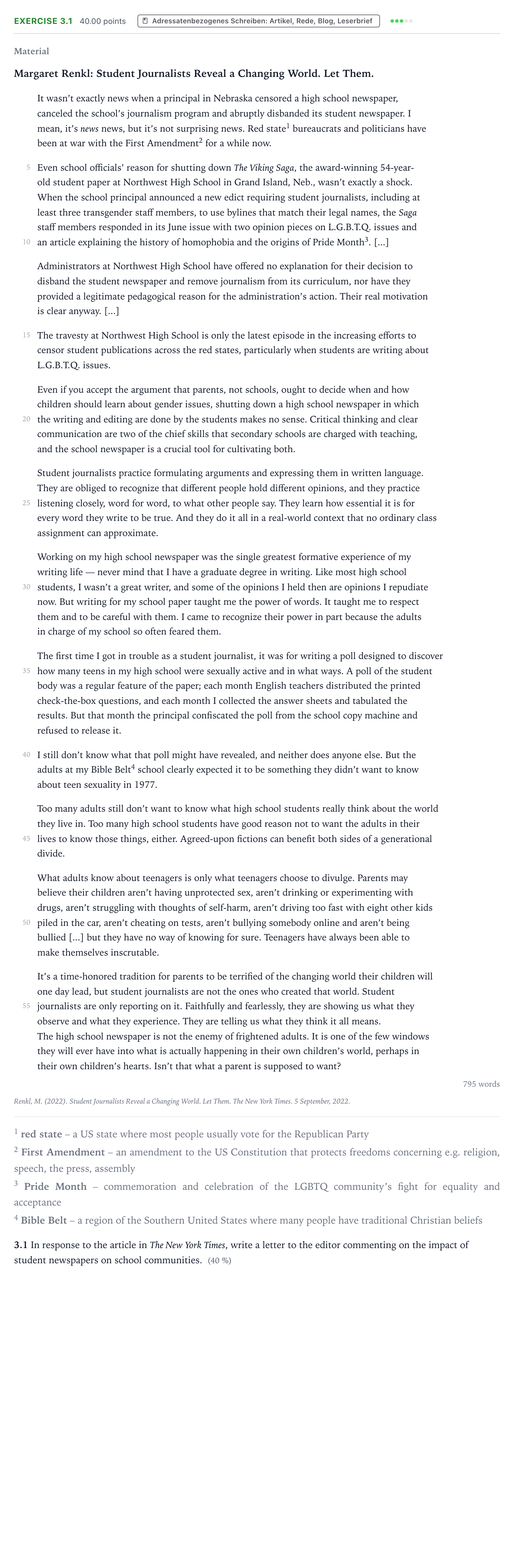
Margaret Renkl: Student Journalists Reveal a Changing World. Let Them.
It wasn’t exactly news when a principal in Nebraska censored a high school newspaper,
canceled the school’s journalism program and abruptly disbanded its student newspaper. I
mean, it’s news news, but it’s not surprising news. Red state 1 bureaucrats and politicians have
been at war with the First Amendment 2 for a while now.
5 Even school officials’ reason for shutting down The Viking Saga, the award-winning 54-year-
old student paper at Northwest High School in Grand Island, Neb., wasn’t exactly a shock.
When the school principal announced a new edict requiring student journalists, including at
least three transgender staff members, to use bylines that match their legal names, the Saga
staff members responded in its June issue with two opinion pieces on L.G.B.T.Q. issues and
10 an article explaining the history of homophobia and the origins of Pride Month 3. [...]
Administrators at Northwest High School have offered no explanation for their decision to
disband the student newspaper and remove journalism from its curriculum, nor have they
provided a legitimate pedagogical reason for the administration’s action. Their real motivation
is clear anyway. [...]
15 The travesty at Northwest High School is only the latest episode in the increasing efforts to
censor student publications across the red states, particularly when students are writing about
L.G.B.T.Q. issues.
Even if you accept the argument that parents, not schools, ought to decide when and how
children should learn about gender issues, shutting down a high school newspaper in which
20 the writing and editing are done by the students makes no sense. Critical thinking and clear
communication are two of the chief skills that secondary schools are charged with teaching,
and the school newspaper is a crucial tool for cultivating both.
Student journalists practice formulating arguments and expressing them in written language.
They are obliged to recognize that different people hold different opinions, and they practice
25 listening closely, word for word, to what other people say. They learn how essential it is for
every word they write to be true. And they do it all in a real-world context that no ordinary class
assignment can approximate.
Working on my high school newspaper was the single greatest formative experience of my
writing life — never mind that I have a graduate degree in writing. Like most high school
30 students, I wasn’t a great writer, and some of the opinions I held then are opinions I repudiate
now. But writing for my school paper taught me the power of words. It taught me to respect
them and to be careful with them. I came to recognize their power in part because the adults
in charge of my school so often feared them.
The first time I got in trouble as a student journalist, it was for writing a poll designed to discover
35 how many teens in my high school were sexually active and in what ways. A poll of the student
body was a regular feature of the paper; each month English teachers distributed the printed
check-the-box questions, and each month I collected the answer sheets and tabulated the
results. But that month the principal confiscated the poll from the school copy machine and
refused to release it.
40 I still don’t know what that poll might have revealed, and neither does anyone else. But the
adults at my Bible Belt 4 school clearly expected it to be something they didn’t want to know
about teen sexuality in 1977.
Too many adults still don’t want to know what high school students really think about the world
they live in. Too many high school students have good reason not to want the adults in their
45 lives to know those things, either. Agreed-upon fictions can benefit both sides of a generational
divide.
What adults know about teenagers is only what teenagers choose to divulge. Parents may
believe their children aren’t having unprotected sex, aren’t drinking or experimenting with
drugs, aren’t struggling with thoughts of self-harm, aren’t driving too fast with eight other kids
50 piled in the car, aren’t cheating on tests, aren’t bullying somebody online and aren’t being
bullied [...] but they have no way of knowing for sure. Teenagers have always been able to
make themselves inscrutable.
It’s a time-honored tradition for parents to be terrified of the changing world their children will
one day lead, but student journalists are not the ones who created that world. Student
55 journalists are only reporting on it. Faithfully and fearlessly, they are showing us what they
observe and what they experience. They are telling us what they think it all means.
The high school newspaper is not the enemy of frightened adults. It is one of the few windows
they will ever have into what is actually happening in their own children’s world, perhaps in
their own children’s hearts. Isn’t that what a parent is supposed to want?
795 words
Renkl, M. (2022). Student Journalists Reveal a Changing World. Let Them. The New York Times. 5 September, 2022.
1 red state – a US state where most people usually vote for the Republican Party
2 First Amendment – an amendment to the US Constitution that protects freedoms concerning e.g. religion, speech, the press, assembly
3 Pride Month – commemoration and celebration of the LGBTQ community’s fight for equality and acceptance
4 Bible Belt – a region of the Southern United States where many people have traditional Christian beliefs
3.1 In response to the article in The New York Times, write a letter to the editor commenting on the impact of student newspapers on school communities. (40 %)
Lösung
Nach den offiziellen Korrekturhinweisen
3.1 In response to the article in The New York Times, write a letter to the editor commenting on the impact of student newspapers on school communities.
Lösung: A successful letter to the editor should meet formal genre conventions and present a well-reasoned stance on the impact of student newspapers on school communities: Format & Conventions: - Appropriate opening / salutation (e.g., *To the Editor,*). - Clear reference to Margaret Renkl's article ("Student Journalists Reveal a Changing World. Let Them.", *The New York Times*, Sept. 5, 2022). - Coherent argumentative structure with clear paragraphs. - Polite and persuasive conclusion with appropriate sign-off (e.g., name, city). Possible Arguments & Perspectives: - Positive academic and social impacts: - Practical learning environment teaching critical thinking, ethical reporting, and writing skills. - Fostering media literacy, research capabilities, and civic engagement. - Giving students a voice, building self-confidence, and empowering diverse student viewpoints. - Strengthening school spirit and community identity by reporting on school events and issues. - Serving as a crucial communication bridge between students, staff, and parents. - Limitations and challenges: - Resource constraints (limited budget, outdated equipment, reliance on volunteer teacher advisors). - Risk of non-representative editorial teams (predominantly high-achieving or homogenous student groups). - Declining interest in traditional print formats among teenagers who prefer social media. - Potential for conflict with administrators over sensitive or controversial topics.
Die ausführliche Erklärung Schritt für Schritt (mit KI) gibt es mit Premium. Premium
Löse sie direkt hier: automatische Korrektur, Hinweise und Lösung Schritt für Schritt.
‹ Aufgabe 3.2 · GK · Green: A Native American faces tear 2025 · Aufgabe 3.1 · LK · Kern: It’s not all coffee shops and 2025 ›
Mehr Aufgaben zu Adressatenbezogenes Schreiben: Artikel, Rede, Blog, Leserbrief
- Aufgabe 3.2 · LK · First-Arai: How the oil and gas ind 2026
- Aufgabe 3.2 · LK · Gorman: An Ode We Owe 2026
- Aufgabe 3.2 · LK · Jones: Live Today Always 2026
- Aufgabe 3.2 · LK · Xie: Holding Pattern 2026
- Aufgabe 3.2 · GK · Green: A Native American faces tear 2025
- Aufgabe 3.1 · LK · Kern: It’s not all coffee shops and 2025
- Aufgabe HT 2 - Klausurteil A - 3.2 · GK · Haupttermin 2023
- Aufgabe HT 2 - Task 3.2 · GK · Haupttermin · Weiterbildungskolleg 2023
- Aufgabe HT 2 - 3.2 · GK · Haupttermin (2) 2023
- Aufgabe NT 2 - Task 3.2 · GK · Nachtermin · Weiterbildungskolleg 2023