Aufgabe 3.2 · Abitur NRW Englisch GK · Green: A Native American faces tear 2025
Thema: Adressatenbezogenes Schreiben: Artikel, Rede, Blog, Leserbrief · Aus der Prüfung GK · Green: A Native American faces tear gas, baton charges and rubber bullets – Camille Seaman’s best photograph (2025)
Aufgabenstellung
Material
Graeme Green: A Native American faces tear gas, baton charges and rubber bullets – Camille Seaman’s best photograph
Graeme Green based this article on an interview with photographer Camille Seaman in which she talks about the context of her best picture.
In the United States, there have been hundreds of treaties made with Native peoples and not one – not a single one – has ever been upheld. Reservations were created, and it was said: “This land will be yours for time immemorial”, but then it always shrinks and shrinks.
In 2016, there was a massive protest against the Dakota Access pipeline. The original plan was for this pipeline to run from the oil fields up in the north-west corner of North Dakota through Bismarck, the wealthy state capital, and then down to wherever it was going. But someone in Bismarck said, “That won’t do. That’s dangerous,” because they knew it’s not a question of if, but when a pipeline will leak.
So the course of the pipeline was changed to go through Standing Rock reservation and across the Missouri river. Standing Rock belongs to the Hunkpapa Lakota tribe, or Sioux. This is the land of Sitting Bull 1 people, and the Missouri river gives clean drinking water to more than 80 million people in the US.
One woman, LaDonna Brave Bull Allard, put out a call on social media, saying: “Please come and stand with us to protect the water.” I don’t think she had any idea how big it would become.
At one point, there were over 30,000 people. They came from Africa, the Maori came from New Zealand, the indigenous Japanese came from Hokkaido, and there were Sami 2 people and Tibetan monks. People came from all over the world to say: “Enough is enough.” They came to protect nature and water and indigenous people’s rights, and to protest that another treaty was not being upheld. It was about not poisoning our water.
The protest was also about trying to physically keep work from being done on the pipeline. When the protests began I was working on We Are Still Here, a series of photographs of Native Americans. I heard about Standing Rock and knew I had to go and record it. I knew it was a historic moment. My mother is part African American, descended from slaves, and my father is Shinnecock Montaukett, a small whaling tribe from the tip of Long Island. I didn’t participate in the actual protests but I was documenting what was happening. I thought it was important, as an indigenous person, to have the opportunity to tell the story through an indigenous lens.
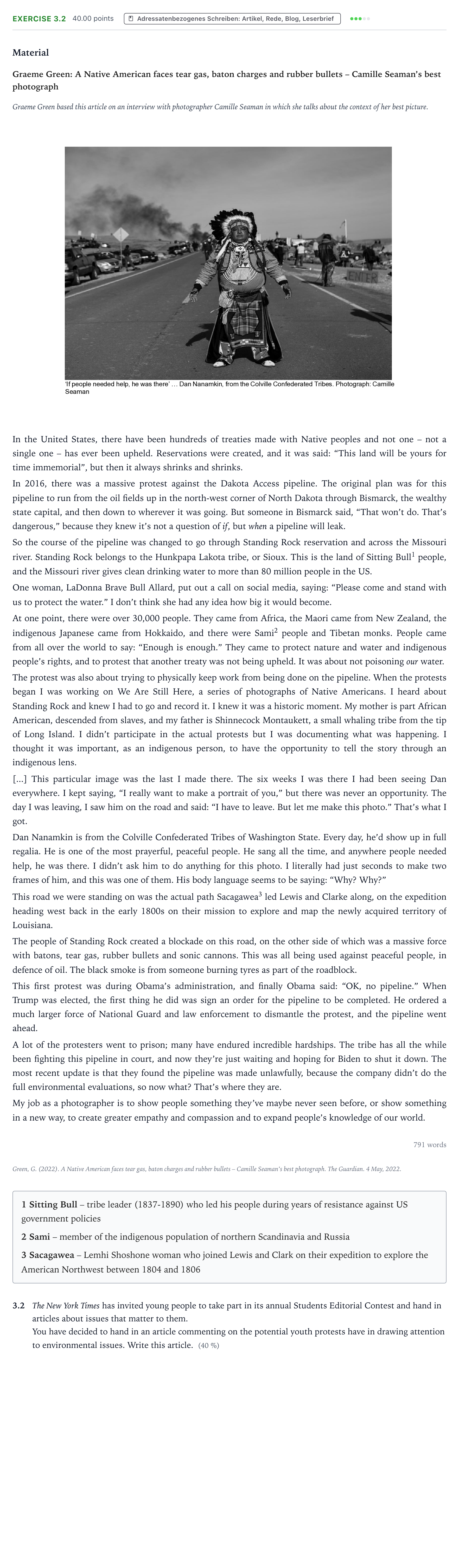
[...] This particular image was the last I made there. The six weeks I was there I had been seeing Dan everywhere. I kept saying, “I really want to make a portrait of you,” but there was never an opportunity. The day I was leaving, I saw him on the road and said: “I have to leave. But let me make this photo.” That’s what I got.
Dan Nanamkin is from the Colville Confederated Tribes of Washington State. Every day, he’d show up in full regalia. He is one of the most prayerful, peaceful people. He sang all the time, and anywhere people needed help, he was there. I didn’t ask him to do anything for this photo. I literally had just seconds to make two frames of him, and this was one of them. His body language seems to be saying: “Why? Why?”
This road we were standing on was the actual path Sacagawea 3 led Lewis and Clarke along, on the expedition heading west back in the early 1800s on their mission to explore and map the newly acquired territory of Louisiana.
The people of Standing Rock created a blockade on this road, on the other side of which was a massive force with batons, tear gas, rubber bullets and sonic cannons. This was all being used against peaceful people, in defence of oil. The black smoke is from someone burning tyres as part of the roadblock.
This first protest was during Obama’s administration, and finally Obama said: “OK, no pipeline.” When Trump was elected, the first thing he did was sign an order for the pipeline to be completed. He ordered a much larger force of National Guard and law enforcement to dismantle the protest, and the pipeline went ahead.
A lot of the protesters went to prison; many have endured incredible hardships. The tribe has all the while been fighting this pipeline in court, and now they’re just waiting and hoping for Biden to shut it down. The most recent update is that they found the pipeline was made unlawfully, because the company didn’t do the full environmental evaluations, so now what? That’s where they are.
My job as a photographer is to show people something they’ve maybe never seen before, or show something in a new way, to create greater empathy and compassion and to expand people’s knowledge of our world.
791 words
Green, G. (2022). A Native American faces tear gas, baton charges and rubber bullets – Camille Seaman’s best photograph. The Guardian. 4 May, 2022.
1 Sitting Bull – tribe leader (1837-1890) who led his people during years of resistance against US government policies
2 Sami – member of the indigenous population of northern Scandinavia and Russia
3 Sacagawea – Lemhi Shoshone woman who joined Lewis and Clark on their expedition to explore the American Northwest between 1804 and 1806
3.2
The New York Times has invited young people to take part in its annual Students Editorial Contest and hand in articles about issues that matter to them.
You have decided to hand in an article commenting on the potential youth protests have in drawing attention to environmental issues. Write this article. (40 %)
Lösung
Nach den offiziellen Korrekturhinweisen
Write an article commenting on the potential youth protests have in drawing attention to environmental issues.
Lösung: An article fulfilling genre conventions (headline, introduction, body paragraphs, balanced view, conclusion): Headline: Beyond the Pickets: Can Youth Protests Truly Turn the Climate Tide? Key Aspects covered: - Great potential of youth protests: * Young people act as moral leaders, challenging older generations and policymakers free from corporate or short-term political baggage. * Creative, flexible protest methods that gain high visibility in traditional and digital media. * Mastery of social media allows rapid global networking, mobilization, and coalition building (e.g. Fridays for Future). * Inspires lifestyle shifts and raises environmental awareness among peers. - Limitations and drawbacks: * Difficulties translating public attention into concrete political legislation; political systems move slowly due to economic lobbies and electoral cycles. * Controversial or disruptive protest tactics (e.g., blocking traffic, targeting artworks) can alienate the public and dilute the core environmental message. * Protests often point out crises without presenting ready-to-implement technological or economic policy solutions. - Conclusion: Youth protests are indispensable catalysts that thrust ecological crises onto the global agenda, though lasting impact requires working in tandem with institutional reform.
Die ausführliche Erklärung Schritt für Schritt (mit KI) gibt es mit Premium. Premium
Löse sie direkt hier: automatische Korrektur, Hinweise und Lösung Schritt für Schritt.
‹ Aufgabe 3.2 · LK · Xie: Holding Pattern 2026 · Aufgabe 3.1 · GK · Renkl: Student Journalists Reveal a 2025 ›
Mehr Aufgaben zu Adressatenbezogenes Schreiben: Artikel, Rede, Blog, Leserbrief
- Aufgabe 3.2 · GK · Elliott: The planet heats, the worl 2026
- Aufgabe 3.2 · LK · First-Arai: How the oil and gas ind 2026
- Aufgabe 3.2 · LK · Gorman: An Ode We Owe 2026
- Aufgabe 3.2 · LK · Jones: Live Today Always 2026
- Aufgabe 3.2 · LK · Xie: Holding Pattern 2026
- Aufgabe 3.1 · GK · Renkl: Student Journalists Reveal a 2025
- Aufgabe 3.1 · LK · Kern: It’s not all coffee shops and 2025
- Aufgabe HT 2 - Klausurteil A - 3.2 · GK · Haupttermin 2023
- Aufgabe HT 2 - Task 3.2 · GK · Haupttermin · Weiterbildungskolleg 2023
- Aufgabe HT 2 - 3.2 · GK · Haupttermin (2) 2023