Aufgabe 2 - Teilaufgabe 1 · Abitur NRW Biologie GK · Haupttermin · bilingual Englisch 2022
Thema: Umweltfaktoren und ökologische Nische · Aus der Prüfung GK · Haupttermin · bilingual Englisch (2022)
Aufgabenstellung
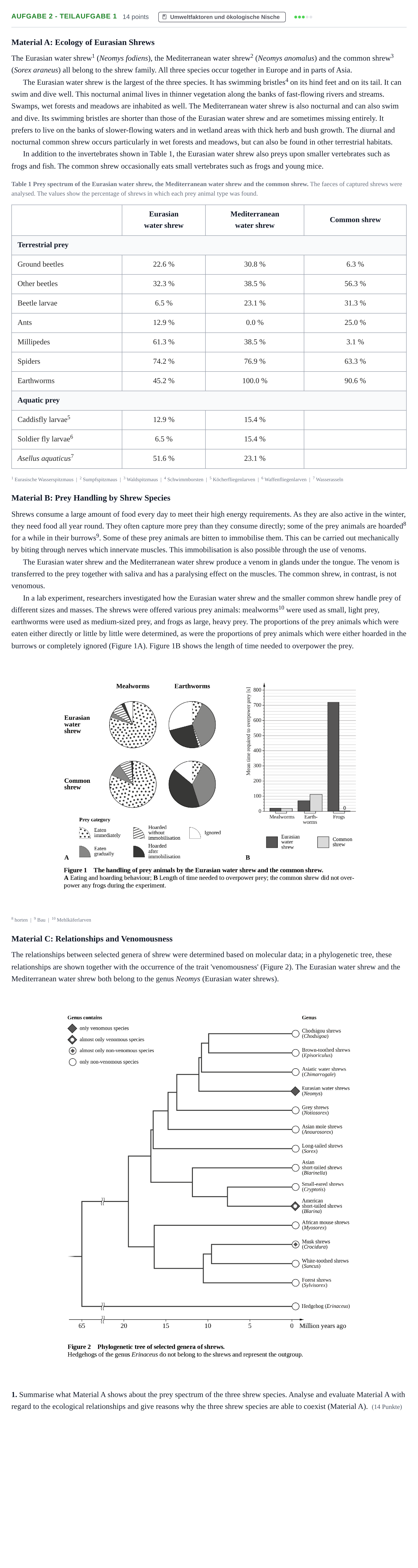
Material A: Ecology of Eurasian Shrews
The Eurasian water shrew 1 ( Neomys fodiens), the Mediterranean water shrew 2 ( Neomys anomalus) and the common shrew 3 ( Sorex araneus) all belong to the shrew family. All three species occur together in Europe and in parts of Asia.
The Eurasian water shrew is the largest of the three species. It has swimming bristles 4 on its hind feet and on its tail. It can swim and dive well. This nocturnal animal lives in thinner vegetation along the banks of fast-flowing rivers and streams. Swamps, wet forests and meadows are inhabited as well. The Mediterranean water shrew is also nocturnal and can also swim and dive. Its swimming bristles are shorter than those of the Eurasian water shrew and are sometimes missing entirely. It prefers to live on the banks of slower-flowing waters and in wetland areas with thick herb and bush growth. The diurnal and nocturnal common shrew occurs particularly in wet forests and meadows, but can also be found in other terrestrial habitats.
In addition to the invertebrates shown in Table 1, the Eurasian water shrew also preys upon smaller vertebrates such as frogs and fish. The common shrew occasionally eats small vertebrates such as frogs and young mice.
Table 1 Prey spectrum of the Eurasian water shrew, the Mediterranean water shrew and the common shrew. The faeces of captured shrews were analysed. The values show the percentage of shrews in which each prey animal type was found.
· Eurasian
water shrew · Mediterranean
water shrew · Common shrew
Terrestrial prey
Ground beetles · 22.6 % · 30.8 % · 6.3 %
Other beetles · 32.3 % · 38.5 % · 56.3 %
Beetle larvae · 6.5 % · 23.1 % · 31.3 %
Ants · 12.9 % · 0.0 % · 25.0 %
Millipedes · 61.3 % · 38.5 % · 3.1 %
Spiders · 74.2 % · 76.9 % · 63.3 %
Earthworms · 45.2 % · 100.0 % · 90.6 %
Aquatic prey
Caddisfly larvae 5 · 12.9 % · 15.4 %
Soldier fly larvae 6 · 6.5 % · 15.4 %
Asellus aquaticus 7 · 51.6 % · 23.1 %
1 Eurasische Wasserspitzmaus | 2 Sumpfspitzmaus | 3 Waldspitzmaus | 4 Schwimmborsten | 5 Köcherfliegenlarven | 6 Waffenfliegenlarven | 7 Wasserasseln
Material B: Prey Handling by Shrew Species
Shrews consume a large amount of food every day to meet their high energy requirements. As they are also active in the winter, they need food all year round. They often capture more prey than they consume directly; some of the prey animals are hoarded 8 for a while in their burrows 9. Some of these prey animals are bitten to immobilise them. This can be carried out mechanically by biting through nerves which innervate muscles. This immobilisation is also possible through the use of venoms.
The Eurasian water shrew and the Mediterranean water shrew produce a venom in glands under the tongue. The venom is transferred to the prey together with saliva and has a paralysing effect on the muscles. The common shrew, in contrast, is not venomous.
In a lab experiment, researchers investigated how the Eurasian water shrew and the smaller common shrew handle prey of different sizes and masses. The shrews were offered various prey animals: mealworms 10 were used as small, light prey, earthworms were used as medium-sized prey, and frogs as large, heavy prey. The proportions of the prey animals which were eaten either directly or little by little were determined, as were the proportions of prey animals which were either hoarded in the burrows or completely ignored (Figure 1A). Figure 1B shows the length of time needed to overpower the prey.
8 horten | 9 Bau | 10 Mehlkäferlarven
Material C: Relationships and Venomousness
The relationships between selected genera of shrew were determined based on molecular data; in a phylogenetic tree, these relationships are shown together with the occurrence of the trait 'venomousness' (Figure 2). The Eurasian water shrew and the Mediterranean water shrew both belong to the genus Neomys (Eurasian water shrews).
1. Summarise what Material A shows about the prey spectrum of the three shrew species. Analyse and evaluate Material A with regard to the ecological relationships and give reasons why the three shrew species are able to coexist (Material A). (14 Punkte)
Lösung
Nach den offiziellen Korrekturhinweisen
1. Summarise what Material A shows about the prey spectrum of the three shrew species. Analyse and evaluate Material A with regard to the ecological relationships and give reasons why the three shrew species are able to coexist (Material A).
Lösung: 1. Summary of prey spectra (Material A): - Eurasian water shrew (*Neomys fodiens*): Feeds on various invertebrate animals. Preferred prey includes terrestrial beetles, millipedes, spiders, and earthworms, as well as aquatic fly larvae and water lice (*Asellus aquaticus*). Smaller vertebrates such as frogs and fish are also eaten. - Mediterranean water shrew (*Neomys anomalus*): Prefers earthworms and spiders, but also eats other terrestrial invertebrates like beetles, beetle larvae, and millipedes. Aquatic fly larvae and *Asellus aquaticus* are also part of its diet. - Common shrew (*Sorex araneus*): Feeds exclusively on terrestrial prey, primarily earthworms and beetles, but also beetle larvae, ants, and occasionally small vertebrates. 2. Ecological relationships: - All three species are carnivorous predators feeding on terrestrial invertebrates (predator-prey relationships). - Broad prey spectra with substantial overlap among the three species, plus overlap in aquatic prey between *N. fodiens* and *N. anomalus*. - Overlapping ecological niches regarding preferred moist/wet habitats. - Results in interspecific competition between the three shrew species. 3. Coexistence of the three species: - *Temporal niche differentiation:* The common shrew is diurnal and nocturnal, whereas the water shrews are strictly nocturnal. - *Spatial niche differentiation:* Preferences differ regarding running water (e.g. *N. fodiens* on fast-flowing streams with thinner vegetation; *N. anomalus* on slower-flowing waters with thick vegetation; *S. araneus* in wet forests/meadows and other terrestrial habitats). - *Trophic niche differentiation:* Distinct differences in specific prey items (e.g. aquatic organisms vs. purely terrestrial). - These differences weaken interspecific competition (resource partitioning / competition avoidance), enabling stable coexistence.
Die ausführliche Erklärung Schritt für Schritt (mit KI) gibt es mit Premium. Premium
Löse sie direkt hier: automatische Korrektur, Hinweise und Lösung Schritt für Schritt.
‹ Aufgabe 3 - Teilaufgaben 2 und 3: Angepasstheiten… · LK · Nachtermin · Weiterbildungskolleg 2023 · Aufgabe HT 2 - 1: Umweltfaktoren und ökologische Nische · GK · Haupttermin · Weiterbildungskolleg 2022 ›
Mehr Aufgaben zu Umweltfaktoren und ökologische Nische
- Aufgabe 1 - Umweltfaktoren und ökologische Nische · LK · Haupttermin · Weiterbildungskolleg 2023
- Aufgabe 1 - Umweltfaktoren und ökologische Nische · LK · Nachtermin 2023
- Aufgabe 3 - Umweltfaktoren und ökologische Nische · LK · Nachtermin 2023
- Aufgabe 1 - Teilaufgaben 1 und 2: Ökologische Nis… · LK · Nachtermin · Weiterbildungskolleg 2023
- Aufgabe 3 - Teilaufgaben 2 und 3: Angepasstheiten… · LK · Nachtermin · Weiterbildungskolleg 2023
- Aufgabe HT 2 - 1: Umweltfaktoren und ökologische Nische · GK · Haupttermin · Weiterbildungskolleg 2022
- Aufgabe 1 - Umweltfaktoren und ökologische Nische · GK · Haupttermin · Weiterbildungskolleg 2022
- Aufgabe 2 - Teilaufgabe 1: Umweltfaktoren und öko… · GK · Nachtermin 2022
- Aufgabe 3 (Teilaufgabe 2) - Umweltfaktoren und ök… · LK · Haupttermin 2022
- Aufgabe 3 - Teilaufgabe 2: Umweltfaktoren und öko… · LK · Haupttermin · Weiterbildungskolleg 2022