Aufgabe Vorschlag D · Abitur Hessen Politik und Wirtschaft GK · bilingual Englisch 2022
Thema: Interessenverbände und Lobbyismus · Aus der Prüfung GK · bilingual Englisch (2022)
Aufgabenstellung
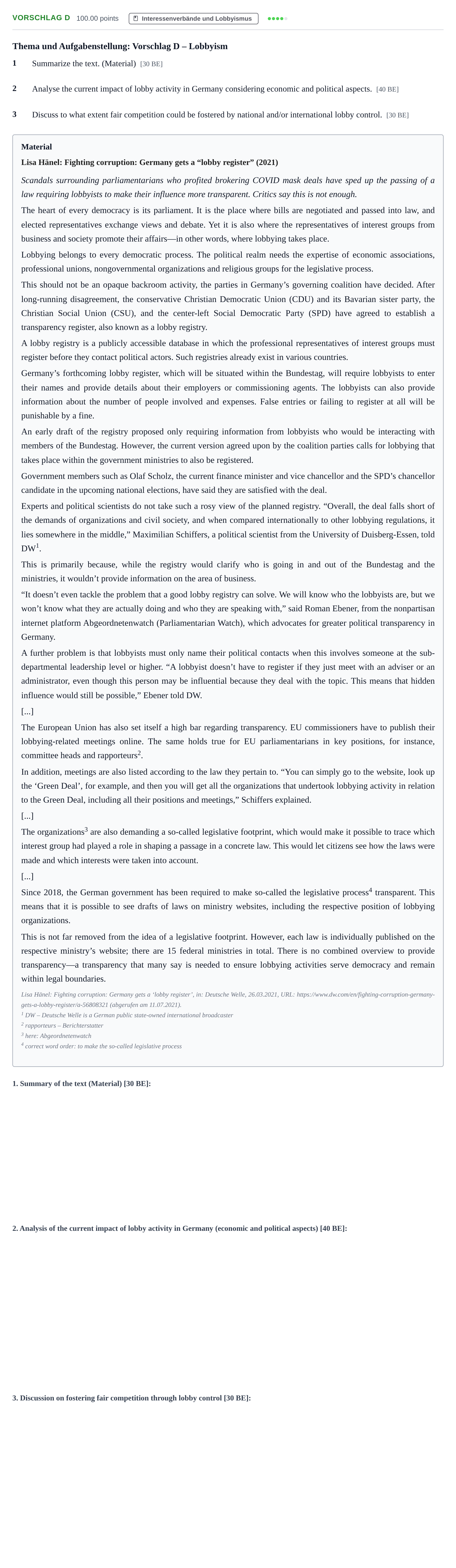
Thema und Aufgabenstellung: Vorschlag D – Lobbyism
1
Summarize the text. (Material) [30 BE]
2
Analyse the current impact of lobby activity in Germany considering economic and political aspects. [40 BE]
3
Discuss to what extent fair competition could be fostered by national and/or international lobby control. [30 BE]
Material
Lisa Hänel: Fighting corruption: Germany gets a “lobby register” (2021)
Scandals surrounding parliamentarians who profited brokering COVID mask deals have sped up the passing of a law requiring lobbyists to make their influence more transparent. Critics say this is not enough.
The heart of every democracy is its parliament. It is the place where bills are negotiated and passed into law, and elected representatives exchange views and debate. Yet it is also where the representatives of interest groups from business and society promote their affairs—in other words, where lobbying takes place.
Lobbying belongs to every democratic process. The political realm needs the expertise of economic associations, professional unions, nongovernmental organizations and religious groups for the legislative process.
This should not be an opaque backroom activity, the parties in Germany’s governing coalition have decided. After long-running disagreement, the conservative Christian Democratic Union (CDU) and its Bavarian sister party, the Christian Social Union (CSU), and the center-left Social Democratic Party (SPD) have agreed to establish a transparency register, also known as a lobby registry.
A lobby registry is a publicly accessible database in which the professional representatives of interest groups must register before they contact political actors. Such registries already exist in various countries.
Germany’s forthcoming lobby register, which will be situated within the Bundestag, will require lobbyists to enter their names and provide details about their employers or commissioning agents. The lobbyists can also provide information about the number of people involved and expenses. False entries or failing to register at all will be punishable by a fine.
An early draft of the registry proposed only requiring information from lobbyists who would be interacting with members of the Bundestag. However, the current version agreed upon by the coalition parties calls for lobbying that takes place within the government ministries to also be registered.
Government members such as Olaf Scholz, the current finance minister and vice chancellor and the SPD’s chancellor candidate in the upcoming national elections, have said they are satisfied with the deal.
Experts and political scientists do not take such a rosy view of the planned registry. “Overall, the deal falls short of the demands of organizations and civil society, and when compared internationally to other lobbying regulations, it lies somewhere in the middle,” Maximilian Schiffers, a political scientist from the University of Duisberg-Essen, told DW 1.
This is primarily because, while the registry would clarify who is going in and out of the Bundestag and the ministries, it wouldn’t provide information on the area of business.
“It doesn’t even tackle the problem that a good lobby registry can solve. We will know who the lobbyists are, but we won’t know what they are actually doing and who they are speaking with,” said Roman Ebener, from the nonpartisan internet platform Abgeordnetenwatch (Parliamentarian Watch), which advocates for greater political transparency in Germany.
A further problem is that lobbyists must only name their political contacts when this involves someone at the sub-departmental leadership level or higher. “A lobbyist doesn’t have to register if they just meet with an adviser or an administrator, even though this person may be influential because they deal with the topic. This means that hidden influence would still be possible,” Ebener told DW.
[...]
The European Union has also set itself a high bar regarding transparency. EU commissioners have to publish their lobbying-related meetings online. The same holds true for EU parliamentarians in key positions, for instance, committee heads and rapporteurs 2.
In addition, meetings are also listed according to the law they pertain to. “You can simply go to the website, look up the ‘Green Deal’, for example, and then you will get all the organizations that undertook lobbying activity in relation to the Green Deal, including all their positions and meetings,” Schiffers explained.
[...]
The organizations 3 are also demanding a so-called legislative footprint, which would make it possible to trace which interest group had played a role in shaping a passage in a concrete law. This would let citizens see how the laws were made and which interests were taken into account.
[...]
Since 2018, the German government has been required to make so-called the legislative process 4 transparent. This means that it is possible to see drafts of laws on ministry websites, including the respective position of lobbying organizations.
This is not far removed from the idea of a legislative footprint. However, each law is individually published on the respective ministry’s website; there are 15 federal ministries in total. There is no combined overview to provide transparency—a transparency that many say is needed to ensure lobbying activities serve democracy and remain within legal boundaries.
Lisa Hänel: Fighting corruption: Germany gets a ‘lobby register’, in: Deutsche Welle, 26.03.2021, URL: https://www.dw.com/en/fighting-corruption-germany-gets-a-lobby-register/a-56808321 (abgerufen am 11.07.2021).
1 DW – Deutsche Welle is a German public state-owned international broadcaster
2 rapporteurs – Berichterstatter
3 here: Abgeordnetenwatch
4 correct word order: to make the so-called legislative process
Lösung
Nach den offiziellen Korrekturhinweisen
1 Summarize the text. (Material)
Lösung: In einer Einleitung sollen Autor, Titel, Textsorte, Erscheinungsjahr, das Thema und ggf. der Adressat genannt werden: Im Artikel von Lisa Hänel „Fighting corruption: Germany gets a ,lobby register‘“, der auf der Website von Deutsche Welle 2021 erschienen ist, wird das neu eingeführte Lobbyregister aufgrund seiner fehlenden Offenlegung von relevanten Informationen wie der Art und Weise des Einflusses auf politische Entscheidungen kritisiert. Auf folgende Aspekte kann eingegangen werden: - Der Maskenskandal habe den Ruf nach einer Implementierung von Lobbygesetzen beschleunigt. - Im geplanten Gesetzesentwurf zum Lobbyregister würden nicht nur Kontaktaufnahmen mit Parlamentariern, sondern auch mit den Ministerien ersichtlich sein. - Experten und Politikwissenschaftler bemängelten, dass es keine Informationen zum Arbeitsbereich der Lobbyisten gebe. - Man kenne die Namen der Lobbyisten, aber es gebe keine Informationen, was sie täten und mit wem sie sprächen, so Roman Ebener von Abgeordnetenwatch. - Ein weiteres Problem sei, dass Lobbyisten sich bei Kontakt mit Mitarbeitern unterer Hierarchieebenen nicht eintragen lassen müssten, so dass versteckte Einflussnahme immer noch möglich sei. - Die EU habe höhere Transparenzvorgaben, da lobbybezogene Treffen veröffentlicht werden müssten. - Angesichts der Schwächen des deutschen Lobbyregisters sollten Anpassungen vorgenommen werden, so Abgeordnetenwatch. - Diese Organisationen verlangten einen sogenannten legislativen Fußabdruck, der eine Nachverfolgung erlaube, welche Interessengruppe welche Rolle bei einem bestimmten Gesetz gespielt habe. - Jedoch gebe es keinen umfassenden Überblick, um sicherzustellen, dass Lobbyaktivität innerhalb der Grenzen demokratischer und rechtlicher Rahmen agiere, da jedes der 15 Ministerien jedes Gesetz einzeln aufführe.
2 Analyse the current impact of lobby activity in Germany considering economic and political aspects.
Lösung: Es werden die Auswirkungen von Lobbyismus auf wirtschaftliche und politische Bereiche in Deutschland analysiert. Hierbei kann auf folgende Aspekte Bezug genommen werden: - Lobbyismus beschreibt die Aktivitäten von Interessensgruppen. Die Aktivitäten werden durch persönliche Kontakte und mediale Präsenz besonders effizient. Lobbygruppen verfügen über wichtige Expertise in Fachgebieten, die für die Entstehung von Gesetzen vorteilhaft, zum Teil sogar nötig ist. Durch Lobbyismus können verschiedene Interessen im politischen Prozess berücksichtigt werden. - Erleichterung der Informationsbeschaffung für Politiker - Experten in den jeweiligen Sachgebieten können sich einbringen - Element einer funktionierenden Demokratie - Lobbyismus als Mittler zwischen Gesellschaft und Politik - Entlastung von staatlichen Einrichtungen - Sicherung von Arbeitsplätzen durch sachkundige Einflussnahme von Unternehmen auf Wirtschaftspolitik - ungleicher politischer Einfluss aufgrund ungleicher finanzieller Ressourcen - Bürgerinteressen werden zugunsten von Unternehmensbedürfnissen ignoriert - Intransparenz als Wettbewerbsvorteil für Unternehmen, die durch große Lobbys vertreten werden - Vertrauensverlust für Politiker und Parteien - Verzögerung von nachhaltigen Entscheidungen (z. B. E-Mobilität) - zu starke Nähe politischer Entscheider zu Unternehmen, daraus resultierende Gefahr einseitiger Entscheidungen
3 Discuss to what extent fair competition could be fostered by national and/or international lobby control.
Lösung: Es wird unter Verwendung von Argumenten und Gegenargumenten abwägend hinterfragt, inwiefern fairer Wettbewerb durch mehr Lobbykontrolle gefördert werde. Es können zunächst Ziele des fairen Wettbewerbs genannt werden, z. B. Förderung gerechter Preisbildung, Qualitätssteigerungen und verbraucherorientiertes Angebot. Anschließend können folgende Aspekte ausgeführt werden: - Erhöhung der Transparenz bei Entscheidungen - Sicherung von fairem Wettbewerb - Ausgleich von Informationsdefiziten für Volkswirtschaften mit geringerem Wirtschaftsvolumen - Stärkung von Verbraucherrechten - schnellere Implementierung nachhaltiger Technologien, um den Klimawandel wirksam zu bekämpfen - gerechtere Verteilung von Subventionen - verstärkte Transparenz in der nationalen Gesetzgebung - Offenlegung des Lobbyisten-Einflusses auch auf Handelsabkommen, z. B. in der EU-Agrarpolitik. Abschließend münden die Ausführungen in ein begründetes Urteil, inwiefern Lobbykontrolle fairen Wettbewerb unterstützen kann.
Die ausführliche Erklärung Schritt für Schritt (mit KI) gibt es mit Premium. Premium
Löse sie direkt hier: automatische Korrektur, Hinweise und Lösung Schritt für Schritt.
‹ Aufgabe Vorschlag A - Aufgabe 3 · GK · bilingual Englisch 2022