Aufgabe Vorschlag B · Abitur Hessen Politik und Wirtschaft GK · bilingual Englisch 2022
Thema: Globalisierung, Welthandel und Standort Deutschland · Aus der Prüfung GK · bilingual Englisch (2022)
Aufgabenstellung
Vorschlag B: China's growing global influence and international trade
Material
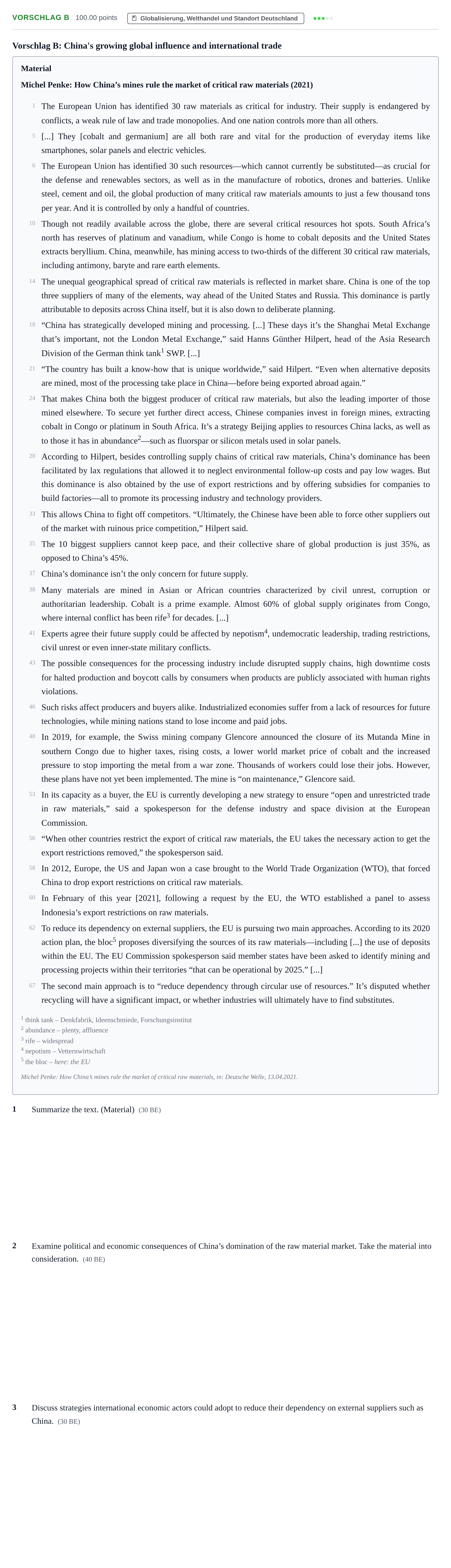
Michel Penke: How China’s mines rule the market of critical raw materials (2021)
1 The European Union has identified 30 raw materials as critical for industry. Their supply is endangered by conflicts, a weak rule of law and trade monopolies. And one nation controls more than all others.
5 [...] They [cobalt and germanium] are all both rare and vital for the production of everyday items like smartphones, solar panels and electric vehicles.
6 The European Union has identified 30 such resources—which cannot currently be substituted—as crucial for the defense and renewables sectors, as well as in the manufacture of robotics, drones and batteries. Unlike steel, cement and oil, the global production of many critical raw materials amounts to just a few thousand tons per year. And it is controlled by only a handful of countries.
10 Though not readily available across the globe, there are several critical resources hot spots. South Africa’s north has reserves of platinum and vanadium, while Congo is home to cobalt deposits and the United States extracts beryllium. China, meanwhile, has mining access to two-thirds of the different 30 critical raw materials, including antimony, baryte and rare earth elements.
14 The unequal geographical spread of critical raw materials is reflected in market share. China is one of the top three suppliers of many of the elements, way ahead of the United States and Russia. This dominance is partly attributable to deposits across China itself, but it is also down to deliberate planning.
18 “China has strategically developed mining and processing. [...] These days it’s the Shanghai Metal Exchange that’s important, not the London Metal Exchange,” said Hanns Günther Hilpert, head of the Asia Research Division of the German think tank 1 SWP. [...]
21 “The country has built a know-how that is unique worldwide,” said Hilpert. “Even when alternative deposits are mined, most of the processing take place in China—before being exported abroad again.”
24 That makes China both the biggest producer of critical raw materials, but also the leading importer of those mined elsewhere. To secure yet further direct access, Chinese companies invest in foreign mines, extracting cobalt in Congo or platinum in South Africa. It’s a strategy Beijing applies to resources China lacks, as well as to those it has in abundance 2 —such as fluorspar or silicon metals used in solar panels.
28 According to Hilpert, besides controlling supply chains of critical raw materials, China’s dominance has been facilitated by lax regulations that allowed it to neglect environmental follow-up costs and pay low wages. But this dominance is also obtained by the use of export restrictions and by offering subsidies for companies to build factories—all to promote its processing industry and technology providers.
33 This allows China to fight off competitors. “Ultimately, the Chinese have been able to force other suppliers out of the market with ruinous price competition,” Hilpert said.
35 The 10 biggest suppliers cannot keep pace, and their collective share of global production is just 35%, as opposed to China’s 45%.
37 China’s dominance isn’t the only concern for future supply.
38 Many materials are mined in Asian or African countries characterized by civil unrest, corruption or authoritarian leadership. Cobalt is a prime example. Almost 60% of global supply originates from Congo, where internal conflict has been rife 3 for decades. [...]
41 Experts agree their future supply could be affected by nepotism 4, undemocratic leadership, trading restrictions, civil unrest or even inner-state military conflicts.
43 The possible consequences for the processing industry include disrupted supply chains, high downtime costs for halted production and boycott calls by consumers when products are publicly associated with human rights violations.
46 Such risks affect producers and buyers alike. Industrialized economies suffer from a lack of resources for future technologies, while mining nations stand to lose income and paid jobs.
48 In 2019, for example, the Swiss mining company Glencore announced the closure of its Mutanda Mine in southern Congo due to higher taxes, rising costs, a lower world market price of cobalt and the increased pressure to stop importing the metal from a war zone. Thousands of workers could lose their jobs. However, these plans have not yet been implemented. The mine is “on maintenance,” Glencore said.
53 In its capacity as a buyer, the EU is currently developing a new strategy to ensure “open and unrestricted trade in raw materials,” said a spokesperson for the defense industry and space division at the European Commission.
56 “When other countries restrict the export of critical raw materials, the EU takes the necessary action to get the export restrictions removed,” the spokesperson said.
58 In 2012, Europe, the US and Japan won a case brought to the World Trade Organization (WTO), that forced China to drop export restrictions on critical raw materials.
60 In February of this year [2021], following a request by the EU, the WTO established a panel to assess Indonesia’s export restrictions on raw materials.
62 To reduce its dependency on external suppliers, the EU is pursuing two main approaches. According to its 2020 action plan, the bloc 5 proposes diversifying the sources of its raw materials—including [...] the use of deposits within the EU. The EU Commission spokesperson said member states have been asked to identify mining and processing projects within their territories “that can be operational by 2025.” [...]
67 The second main approach is to “reduce dependency through circular use of resources.” It’s disputed whether recycling will have a significant impact, or whether industries will ultimately have to find substitutes.
1 think tank – Denkfabrik, Ideenschmiede, Forschungsinstitut
2 abundance – plenty, affluence
3 rife – widespread
4 nepotism – Vetternwirtschaft
5 the bloc – here: the EU
Michel Penke: How China’s mines rule the market of critical raw materials, in: Deutsche Welle, 13.04.2021.
1
Summarize the text. (Material) (30 BE)
2
Examine political and economic consequences of China’s domination of the raw material market. Take the material into consideration. (40 BE)
3
Discuss strategies international economic actors could adopt to reduce their dependency on external suppliers such as China. (30 BE)
Lösung
Nach den offiziellen Korrekturhinweisen
1 Summarize the text. (Material) (30 BE)
Lösung: A comprehensive summary including an introductory sentence (mentioning author Michel Penke, title 'How China’s mines rule the market of critical raw materials', text type online article, publication date 13.04.2021 on Deutsche Welle, and general theme) and key points from the text: - The EU has identified 30 critical raw materials essential for high-tech industries and renewables, the production of which is concentrated in very few countries. - Through strategic long-term planning, China has achieved an undisputed predominance in mining and processing. - Factors favoring China's dominance include lax environmental regulations, low labor costs, export restrictions, and state subsidies. - Ruinous price competition has driven international competitors out of the market. - Instability, civil unrest, and corruption in mining regions (such as the DRC) pose severe risks to supply chains. - The EU pursues counter-strategies such as WTO disputes, diversification of supply, identifying domestic mining/processing projects, and promoting circular resource use.
2 Examine political and economic consequences of China’s domination of the raw material market. Take the material into consideration. (40 BE)
Lösung: Political and economic consequences: Political consequences: - Deterioration of international relations and geopolitical tensions. - Trade conflicts (particularly with the USA and EU). - Growing criticism by human rights organizations concerning working conditions and exploitation in partner/mining nations. - Geopolitical leverage and political pressure exerted by China on nations where it invests strategically. - Increasing political influence of China within international bodies and organisations. - Geopolitical leverage gained through Western corporate investments and dependence on China. Economic consequences: - Risk of monopolistic control or oligopolistic power by China with a market share of around 45%. - Very low market share left for democratic nations. - Threat of price dictation for critical resources required globally. - Wage dumping and increasing wage pressure on high-wage industrialized countries. - Excessive purchasing power of Chinese conglomerates relative to international competitors. - Increase in global ocean freight traffic and exposure to logistical choke points.
3 Discuss strategies international economic actors could adopt to reduce their dependency on external suppliers such as China. (30 BE)
Lösung: A balanced discussion of counter-strategies with arguments and counter-arguments: - Intensifying circular economy practices and recycling of high-tech products containing critical raw materials (limited by current technological viability and return volumes). - Altering consumer behavior (e.g. boycotts of Chinese goods or demand for ethically sourced electronics). - Increased industrial R&D into finding substitutes for critical materials (time-consuming and costly). - Exploring and reopening strategic raw material deposits within the EU/domestic territories (challenges regarding local environmental standards and NIMBYism). - Implementing punitive tariffs and trade remedies via the WTO. - Enhanced public and media pressure from human rights and environmental NGOs. - State-sponsored research in high-tech nations to compensate for competitive disadvantages. - Followed by a reasoned, well-supported overall judgment.
Die ausführliche Erklärung Schritt für Schritt (mit KI) gibt es mit Premium. Premium
Löse sie direkt hier: automatische Korrektur, Hinweise und Lösung Schritt für Schritt.
‹ Aufgabe Vorschlag B - Freihandel · GK 2022 · Aufgabe Vorschlag C - Aufgabe 1 · GK · bilingual Französisch 2022 ›
Mehr Aufgaben zu Globalisierung, Welthandel und Standort Deutschland
- Aufgabe Vorschlag B - Freihandel · GK 2022
- Aufgabe Vorschlag C - Aufgabe 1 · GK · bilingual Französisch 2022
- Aufgabe Vorschlag C - Aufgabe 2 · GK · bilingual Französisch 2022
- Aufgabe Vorschlag A - Globalisierung, Welthandel und Stan… · LK 2022
- Aufgabe Vorschlag B - Globalisierung, Welthandel und Stan… · LK 2022
- Aufgabe Vorschlag A - Aufgabe 3 · GK 2021
- Aufgabe Vorschlag B - Aufgabe 3 · GK 2021
- Aufgabe Vorschlag D - Aufgabe 3 · GK 2021
- Aufgabe Vorschlag B - Globalisierung, Welthandel und Stan… · GK · bilingual Englisch 2021
- Aufgabe Vorschlag A - Aufgabe 3: Inégalités sociales · GK · bilingual Französisch 2021