Aufgabe Vorschlag B3 – 2 · Abitur Hessen Englisch LK 2022
Thema: Analyse literarischer Texte (Narrative techniques, poetic devices) · Aus der Prüfung LK (2022)
Aufgabenstellung
Material
Ted Chiang: The Truth of Fact, The Truth of Feeling (excerpt from the short story, 2019)
The story is set in the near future.
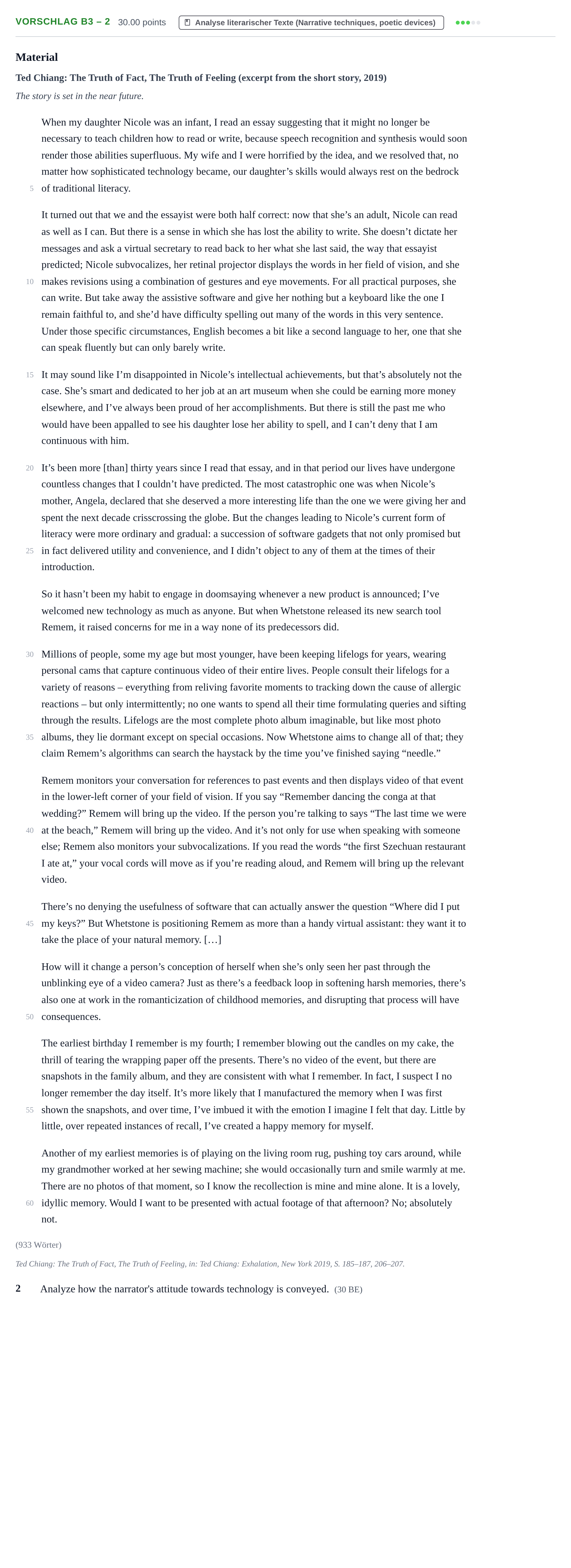
When my daughter Nicole was an infant, I read an essay suggesting that it might no longer be
necessary to teach children how to read or write, because speech recognition and synthesis would soon
render those abilities superfluous. My wife and I were horrified by the idea, and we resolved that, no
matter how sophisticated technology became, our daughter’s skills would always rest on the bedrock
5 of traditional literacy.
It turned out that we and the essayist were both half correct: now that she’s an adult, Nicole can read
as well as I can. But there is a sense in which she has lost the ability to write. She doesn’t dictate her
messages and ask a virtual secretary to read back to her what she last said, the way that essayist
predicted; Nicole subvocalizes, her retinal projector displays the words in her field of vision, and she
10 makes revisions using a combination of gestures and eye movements. For all practical purposes, she
can write. But take away the assistive software and give her nothing but a keyboard like the one I
remain faithful to, and she’d have difficulty spelling out many of the words in this very sentence.
Under those specific circumstances, English becomes a bit like a second language to her, one that she
can speak fluently but can only barely write.
15 It may sound like I’m disappointed in Nicole’s intellectual achievements, but that’s absolutely not the
case. She’s smart and dedicated to her job at an art museum when she could be earning more money
elsewhere, and I’ve always been proud of her accomplishments. But there is still the past me who
would have been appalled to see his daughter lose her ability to spell, and I can’t deny that I am
continuous with him.
20 It’s been more [than] thirty years since I read that essay, and in that period our lives have undergone
countless changes that I couldn’t have predicted. The most catastrophic one was when Nicole’s
mother, Angela, declared that she deserved a more interesting life than the one we were giving her and
spent the next decade crisscrossing the globe. But the changes leading to Nicole’s current form of
literacy were more ordinary and gradual: a succession of software gadgets that not only promised but
25 in fact delivered utility and convenience, and I didn’t object to any of them at the times of their
introduction.
So it hasn’t been my habit to engage in doomsaying whenever a new product is announced; I’ve
welcomed new technology as much as anyone. But when Whetstone released its new search tool
Remem, it raised concerns for me in a way none of its predecessors did.
30 Millions of people, some my age but most younger, have been keeping lifelogs for years, wearing
personal cams that capture continuous video of their entire lives. People consult their lifelogs for a
variety of reasons – everything from reliving favorite moments to tracking down the cause of allergic
reactions – but only intermittently; no one wants to spend all their time formulating queries and sifting
through the results. Lifelogs are the most complete photo album imaginable, but like most photo
35 albums, they lie dormant except on special occasions. Now Whetstone aims to change all of that; they
claim Remem’s algorithms can search the haystack by the time you’ve finished saying “needle.”
Remem monitors your conversation for references to past events and then displays video of that event
in the lower-left corner of your field of vision. If you say “Remember dancing the conga at that
wedding?” Remem will bring up the video. If the person you’re talking to says “The last time we were
40 at the beach,” Remem will bring up the video. And it’s not only for use when speaking with someone
else; Remem also monitors your subvocalizations. If you read the words “the first Szechuan restaurant
I ate at,” your vocal cords will move as if you’re reading aloud, and Remem will bring up the relevant
video.
There’s no denying the usefulness of software that can actually answer the question “Where did I put
45 my keys?” But Whetstone is positioning Remem as more than a handy virtual assistant: they want it to
take the place of your natural memory. […]
How will it change a person’s conception of herself when she’s only seen her past through the
unblinking eye of a video camera? Just as there’s a feedback loop in softening harsh memories, there’s
also one at work in the romanticization of childhood memories, and disrupting that process will have
50 consequences.
The earliest birthday I remember is my fourth; I remember blowing out the candles on my cake, the
thrill of tearing the wrapping paper off the presents. There’s no video of the event, but there are
snapshots in the family album, and they are consistent with what I remember. In fact, I suspect I no
longer remember the day itself. It’s more likely that I manufactured the memory when I was first
55 shown the snapshots, and over time, I’ve imbued it with the emotion I imagine I felt that day. Little by
little, over repeated instances of recall, I’ve created a happy memory for myself.
Another of my earliest memories is of playing on the living room rug, pushing toy cars around, while
my grandmother worked at her sewing machine; she would occasionally turn and smile warmly at me.
There are no photos of that moment, so I know the recollection is mine and mine alone. It is a lovely,
60 idyllic memory. Would I want to be presented with actual footage of that afternoon? No; absolutely
not.
(933 Wörter)
Ted Chiang: The Truth of Fact, The Truth of Feeling, in: Ted Chiang: Exhalation, New York 2019, S. 185–187, 206–207.
2
Analyze how the narrator's attitude towards technology is conveyed.
(30 BE)
Lösung
Nach den offiziellen Korrekturhinweisen
2 Analyze how the narrator's attitude towards technology is conveyed.
Lösung: An analytical text examining the narrator's perspective and stylistic/rhetorical devices with evidence from the excerpt.
Die ausführliche Erklärung Schritt für Schritt (mit KI) gibt es mit Premium. Premium
Löse sie direkt hier: automatische Korrektur, Hinweise und Lösung Schritt für Schritt.
‹ Aufgabe Vorschlag B1 – 2 · LK 2022