Problema 2 · Inglés PAU Valencia Ordinaria 2025
Tema: Preguntas abiertas con tus propias palabras (Answer the questions) · Del examen Ordinaria (2025)
Enunciado
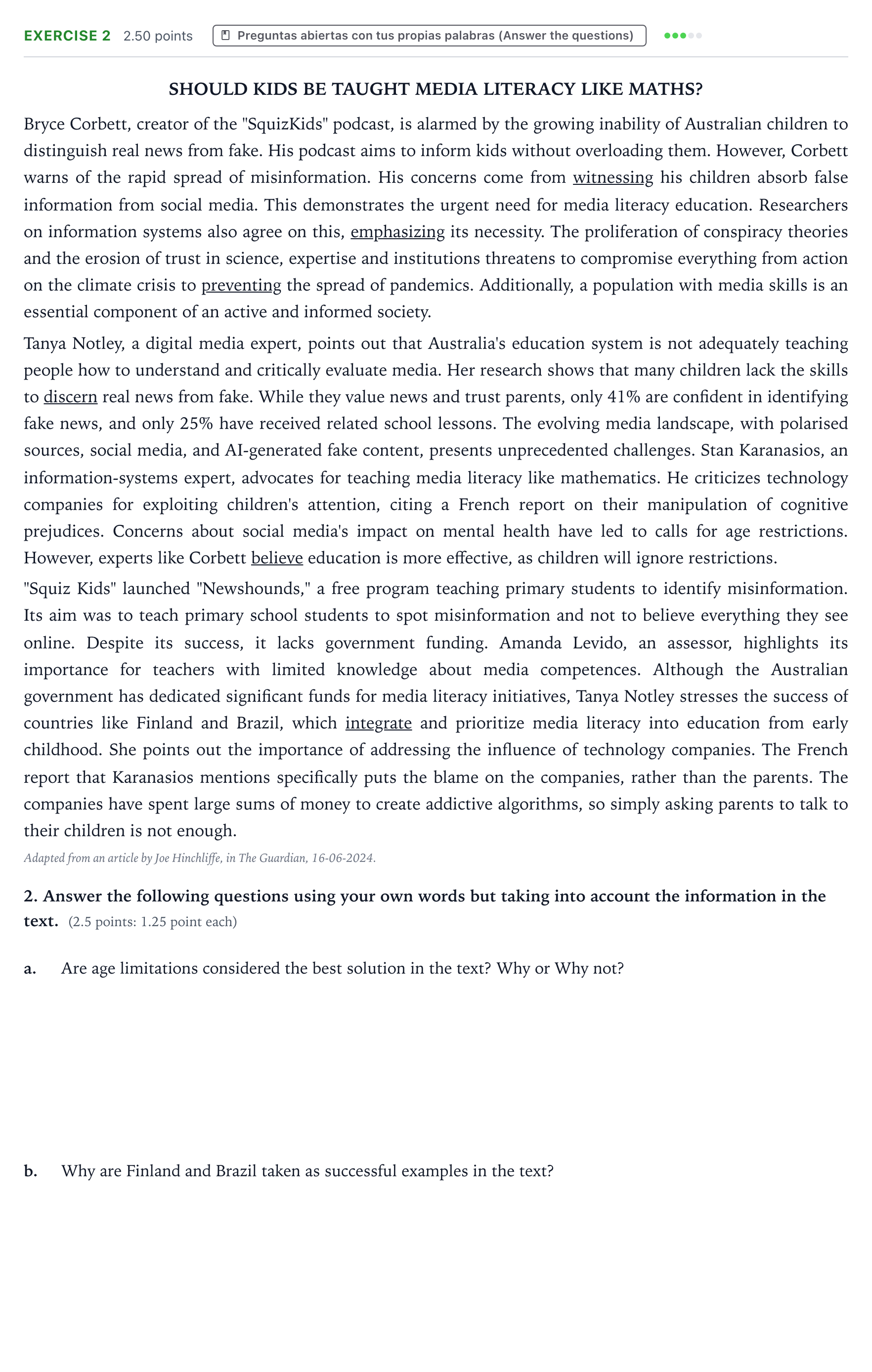
SHOULD KIDS BE TAUGHT MEDIA LITERACY LIKE MATHS?
Bryce Corbett, creator of the "SquizKids" podcast, is alarmed by the growing inability of Australian children to distinguish real news from fake. His podcast aims to inform kids without overloading them. However, Corbett warns of the rapid spread of misinformation. His concerns come from witnessing his children absorb false information from social media. This demonstrates the urgent need for media literacy education. Researchers on information systems also agree on this, emphasizing its necessity. The proliferation of conspiracy theories and the erosion of trust in science, expertise and institutions threatens to compromise everything from action on the climate crisis to preventing the spread of pandemics. Additionally, a population with media skills is an essential component of an active and informed society.
Tanya Notley, a digital media expert, points out that Australia's education system is not adequately teaching people how to understand and critically evaluate media. Her research shows that many children lack the skills to discern real news from fake. While they value news and trust parents, only 41% are confident in identifying fake news, and only 25% have received related school lessons. The evolving media landscape, with polarised sources, social media, and AI-generated fake content, presents unprecedented challenges. Stan Karanasios, an information-systems expert, advocates for teaching media literacy like mathematics. He criticizes technology companies for exploiting children's attention, citing a French report on their manipulation of cognitive prejudices. Concerns about social media's impact on mental health have led to calls for age restrictions. However, experts like Corbett believe education is more effective, as children will ignore restrictions.
"Squiz Kids" launched "Newshounds," a free program teaching primary students to identify misinformation. Its aim was to teach primary school students to spot misinformation and not to believe everything they see online. Despite its success, it lacks government funding. Amanda Levido, an assessor, highlights its importance for teachers with limited knowledge about media competences. Although the Australian government has dedicated significant funds for media literacy initiatives, Tanya Notley stresses the success of countries like Finland and Brazil, which integrate and prioritize media literacy into education from early childhood. She points out the importance of addressing the influence of technology companies. The French report that Karanasios mentions specifically puts the blame on the companies, rather than the parents. The companies have spent large sums of money to create addictive algorithms, so simply asking parents to talk to their children is not enough.
Adapted from an article by Joe Hinchliffe, in The Guardian, 16-06-2024.
2. Answer the following questions using your own words but taking into account the information in the text. (2.5 points: 1.25 point each)
a.
Are age limitations considered the best solution in the text? Why or Why not?
b.
Why are Finland and Brazil taken as successful examples in the text?
Solución
Según los criterios oficiales de corrección
a. Are age limitations considered the best solution in the text? Why or Why not?
Solución: No, they aren't. Concerns about social media's impact on mental health have led to calls for age restrictions. However, experts like Corbett believe education is more effective, as children will ignore restrictions.
b. Why are Finland and Brazil taken as successful examples in the text?
Solución: Tanya Notley stresses the success of countries like Finland and Brazil because they integrate and prioritize media literacy into education from early childhood.
La explicación paso a paso, hecha con IA, es Premium. Premium
Resuélvelo aquí mismo: corrección automática, pistas y solución paso a paso.
‹ Problema 2 · Extraordinaria solapamiento 2025 · Problema 2 · Ordinaria solapamiento 2025 ›
Más ejercicios de Preguntas abiertas con tus propias palabras (Answer the questions)
- Ejercicio 2 - Open questions · Ordinaria 2026
- Ejercicio 2 - Open questions · Ordinaria solapamiento 2026
- Problema 2 · Extraordinaria 2025
- Problema 2 · Extraordinaria DANA 2025
- Problema 2 · Extraordinaria solapamiento 2025
- Problema 2 · Ordinaria solapamiento 2025
- Ejercicio A1 · Extraordinaria 2024
- Ejercicio B1 · Extraordinaria 2024
- Ejercicio A1 · Extraordinaria solapamiento 2024
- Ejercicio B1 · Extraordinaria solapamiento 2024