Problema 2 · Inglés PAU Navarra Ordinaria 2025
Tema: Verdadero o falso con justificación textual (True/False) · Del examen Ordinaria (2025)
Enunciado
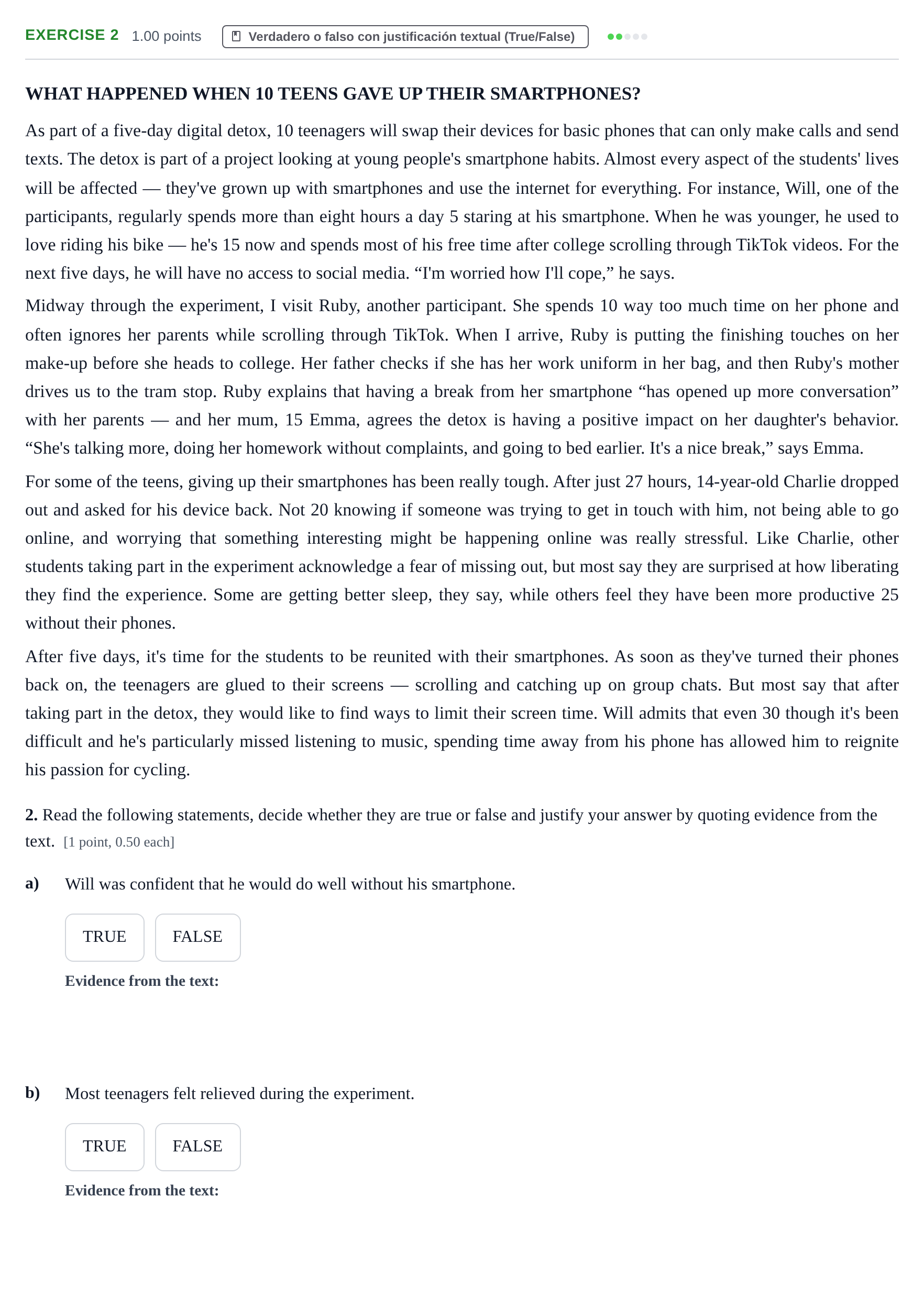
WHAT HAPPENED WHEN 10 TEENS GAVE UP THEIR SMARTPHONES?
As part of a five-day digital detox, 10 teenagers will swap their devices for basic phones that can only make calls and send texts. The detox is part of a project looking at young people's smartphone habits. Almost every aspect of the students' lives will be affected — they've grown up with smartphones and use the internet for everything. For instance, Will, one of the participants, regularly spends more than eight hours a day 5 staring at his smartphone. When he was younger, he used to love riding his bike — he's 15 now and spends most of his free time after college scrolling through TikTok videos. For the next five days, he will have no access to social media. “I'm worried how I'll cope,” he says.
Midway through the experiment, I visit Ruby, another participant. She spends 10 way too much time on her phone and often ignores her parents while scrolling through TikTok. When I arrive, Ruby is putting the finishing touches on her make-up before she heads to college. Her father checks if she has her work uniform in her bag, and then Ruby's mother drives us to the tram stop. Ruby explains that having a break from her smartphone “has opened up more conversation” with her parents — and her mum, 15 Emma, agrees the detox is having a positive impact on her daughter's behavior. “She's talking more, doing her homework without complaints, and going to bed earlier. It's a nice break,” says Emma.
For some of the teens, giving up their smartphones has been really tough. After just 27 hours, 14-year-old Charlie dropped out and asked for his device back. Not 20 knowing if someone was trying to get in touch with him, not being able to go online, and worrying that something interesting might be happening online was really stressful. Like Charlie, other students taking part in the experiment acknowledge a fear of missing out, but most say they are surprised at how liberating they find the experience. Some are getting better sleep, they say, while others feel they have been more productive 25 without their phones.
After five days, it's time for the students to be reunited with their smartphones. As soon as they've turned their phones back on, the teenagers are glued to their screens — scrolling and catching up on group chats. But most say that after taking part in the detox, they would like to find ways to limit their screen time. Will admits that even 30 though it's been difficult and he's particularly missed listening to music, spending time away from his phone has allowed him to reignite his passion for cycling.
2. Read the following statements, decide whether they are true or false and justify your answer by quoting evidence from the text.
[1 point, 0.50 each]
a)
Will was confident that he would do well without his smartphone.
TRUE
FALSE
b)
Most teenagers felt relieved during the experiment.
TRUE
FALSE
Solución
Solución de AprenAI (no es la oficial)
2. Read the following statements, decide whether they are true or false...
Solución: a) FALSE; b) TRUE
a) Evidence from the text
Solución: "I'm worried how I'll cope," he says.
La solución del apartado que falta y la explicación paso a paso son Premium. Premium
Resuélvelo aquí mismo: corrección automática, pistas y solución paso a paso.
‹ Problema 2 · Extraordinaria 2025 · Opción A - 2 · Extraordinaria 2024 ›
Más ejercicios de Verdadero o falso con justificación textual (True/False)
- Problema 2 · Extraordinaria 2026
- Problema 2 · Ordinaria 2026
- Problema 2 · Extraordinaria 2025
- Opción A - 2 · Extraordinaria 2024
- Opción B - 2 · Extraordinaria 2024
- Opción B - 2 · Ordinaria 2024
- Opción A - 2 · Ordinaria 2024
- Opción A - 2 · Extraordinaria 2023
- Opción B - 2 · Extraordinaria 2023
- Opción A - 2 · Ordinaria 2023