Ejercicio A.3 · Inglés PAU Madrid Ordinaria (2ª lengua) 2021
Tema: Vocabulario · Del examen Ordinaria (2ª lengua) (2021)
Enunciado
TEXTO A
Dog Training and the Myth of Alpha-Male Dominance
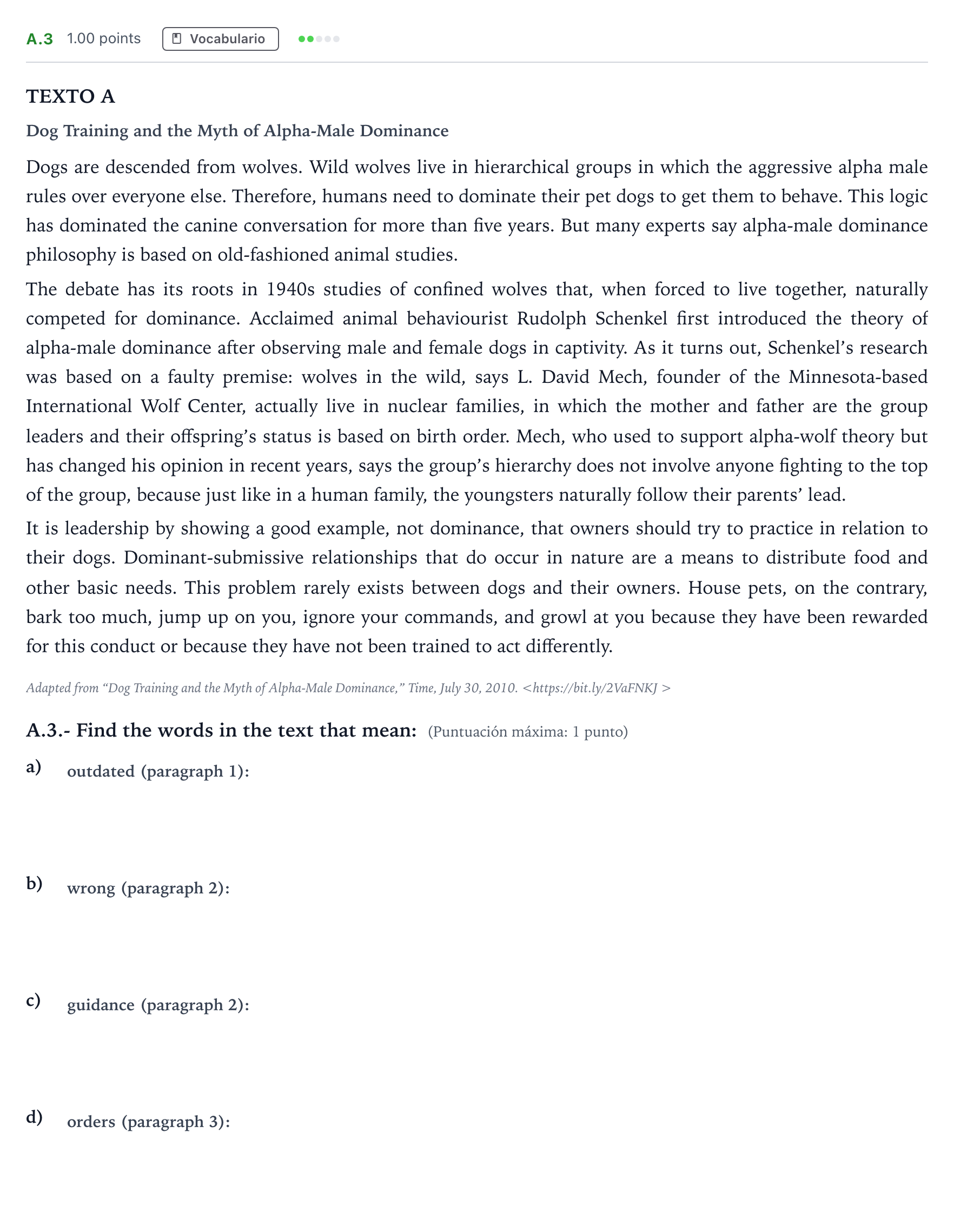
Dogs are descended from wolves. Wild wolves live in hierarchical groups in which the aggressive alpha male rules over everyone else. Therefore, humans need to dominate their pet dogs to get them to behave. This logic has dominated the canine conversation for more than five years. But many experts say alpha-male dominance philosophy is based on old-fashioned animal studies.
The debate has its roots in 1940s studies of confined wolves that, when forced to live together, naturally competed for dominance. Acclaimed animal behaviourist Rudolph Schenkel first introduced the theory of alpha-male dominance after observing male and female dogs in captivity. As it turns out, Schenkel’s research was based on a faulty premise: wolves in the wild, says L. David Mech, founder of the Minnesota-based International Wolf Center, actually live in nuclear families, in which the mother and father are the group leaders and their offspring’s status is based on birth order. Mech, who used to support alpha-wolf theory but has changed his opinion in recent years, says the group’s hierarchy does not involve anyone fighting to the top of the group, because just like in a human family, the youngsters naturally follow their parents’ lead.
It is leadership by showing a good example, not dominance, that owners should try to practice in relation to their dogs. Dominant-submissive relationships that do occur in nature are a means to distribute food and other basic needs. This problem rarely exists between dogs and their owners. House pets, on the contrary, bark too much, jump up on you, ignore your commands, and growl at you because they have been rewarded for this conduct or because they have not been trained to act differently.
Adapted from “Dog Training and the Myth of Alpha-Male Dominance,” Time, July 30, 2010. <https://bit.ly/2VaFNKJ >
A.3.- Find the words in the text that mean: (Puntuación máxima: 1 punto)
a)
b)
c)
d)
Solución
Según los criterios oficiales de corrección
a) outdated (paragraph 1)
Solución: old-fashioned
b) wrong (paragraph 2)
Solución: faulty
c) guidance (paragraph 2)
Solución: lead
d) orders (paragraph 3)
Solución: commands
La explicación paso a paso, hecha con IA, es Premium. Premium
Resuélvelo aquí mismo: corrección automática, pistas y solución paso a paso.
‹ Ejercicio B.3 · Modelo 2021 · Ejercicio B.3 · Ordinaria (2ª lengua) 2021 ›
Más ejercicios de Vocabulario
- Ejercicio B.3 · Extraordinaria 2021
- Ejercicio A.3 · Extraordinaria (2ª lengua) 2021
- Ejercicio B.3 · Extraordinaria (2ª lengua) 2021
- Ejercicio A.3 · Modelo 2021
- Ejercicio B.3 · Modelo 2021
- Ejercicio B.3 · Ordinaria (2ª lengua) 2021
- Ejercicio A.3 · Ordinaria (2ª lengua) Coincidencias 2021
- Ejercicio B.3 · Ordinaria (2ª lengua) Coincidencias 2021
- Ejercicio A.3 · Ordinaria Lunes 2021
- Ejercicio B.3 · Ordinaria Lunes 2021