Problema 1 · Inglés PAU Madrid Ordinaria 9:30 2025
Tema: Comprensión Lectora · Del examen Ordinaria 9:30 (2025)
Enunciado
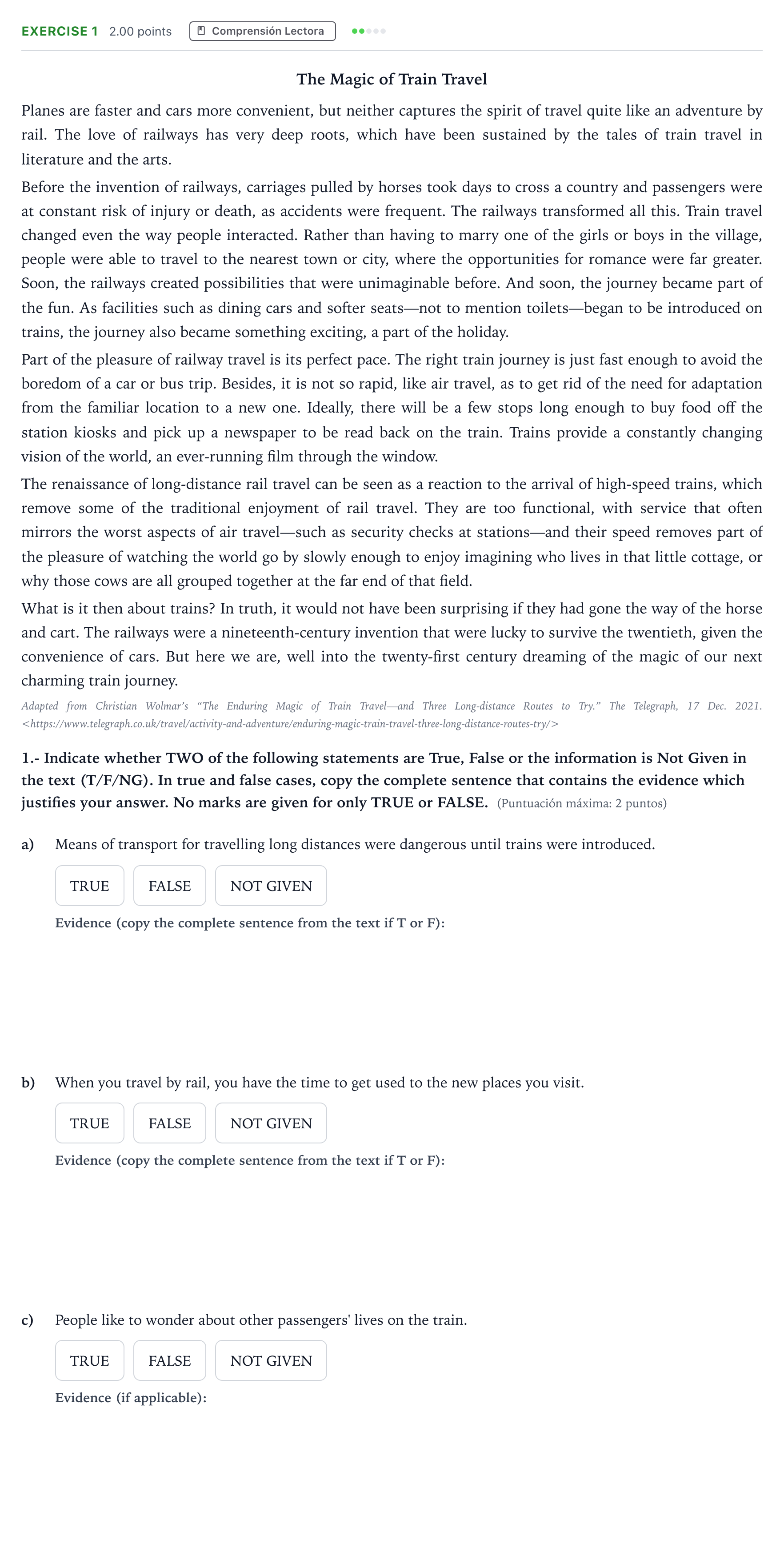
The Magic of Train Travel
Planes are faster and cars more convenient, but neither captures the spirit of travel quite like an adventure by rail. The love of railways has very deep roots, which have been sustained by the tales of train travel in literature and the arts.
Before the invention of railways, carriages pulled by horses took days to cross a country and passengers were at constant risk of injury or death, as accidents were frequent. The railways transformed all this. Train travel changed even the way people interacted. Rather than having to marry one of the girls or boys in the village, people were able to travel to the nearest town or city, where the opportunities for romance were far greater. Soon, the railways created possibilities that were unimaginable before. And soon, the journey became part of the fun. As facilities such as dining cars and softer seats—not to mention toilets—began to be introduced on trains, the journey also became something exciting, a part of the holiday.
Part of the pleasure of railway travel is its perfect pace. The right train journey is just fast enough to avoid the boredom of a car or bus trip. Besides, it is not so rapid, like air travel, as to get rid of the need for adaptation from the familiar location to a new one. Ideally, there will be a few stops long enough to buy food off the station kiosks and pick up a newspaper to be read back on the train. Trains provide a constantly changing vision of the world, an ever-running film through the window.
The renaissance of long-distance rail travel can be seen as a reaction to the arrival of high-speed trains, which remove some of the traditional enjoyment of rail travel. They are too functional, with service that often mirrors the worst aspects of air travel—such as security checks at stations—and their speed removes part of the pleasure of watching the world go by slowly enough to enjoy imagining who lives in that little cottage, or why those cows are all grouped together at the far end of that field.
What is it then about trains? In truth, it would not have been surprising if they had gone the way of the horse and cart. The railways were a nineteenth-century invention that were lucky to survive the twentieth, given the convenience of cars. But here we are, well into the twenty-first century dreaming of the magic of our next charming train journey.
Adapted from Christian Wolmar’s “The Enduring Magic of Train Travel—and Three Long-distance Routes to Try.” The Telegraph, 17 Dec. 2021. <https://www.telegraph.co.uk/travel/activity-and-adventure/enduring-magic-train-travel-three-long-distance-routes-try/>
1.- Indicate whether TWO of the following statements are True, False or the information is Not Given in the text (T/F/NG). In true and false cases, copy the complete sentence that contains the evidence which justifies your answer. No marks are given for only TRUE or FALSE.
(Puntuación máxima: 2 puntos)
a)
Means of transport for travelling long distances were dangerous until trains were introduced.
TRUE
FALSE
NOT GIVEN
b)
When you travel by rail, you have the time to get used to the new places you visit.
TRUE
FALSE
NOT GIVEN
c)
People like to wonder about other passengers' lives on the train.
TRUE
FALSE
NOT GIVEN
Solución
Según los criterios oficiales de corrección
a) Evidence for: Means of transport for travelling long distances were dangerous until trains were introduced.
Solución: "Before the invention of railways, carriages pulled by horses took days to cross a country and passengers were at constant risk of injury or death, as accidents were frequent."
b) Evidence for: When you travel by rail, you have the time to get used to the new places you visit.
Solución: "Besides, it is not so rapid, like air travel, as to get rid of the need for adaptation from the familiar location to a new one."
c) Evidence for: People like to wonder about other passengers' lives on the train.
Solución: Not given.
1.- Indicate whether TWO of the following statements are True, False or the information is Not Given in the text (T/F/NG).
Solución: a) TRUE, b) TRUE, c) NOT GIVEN
La explicación paso a paso, hecha con IA, es Premium. Premium
Resuélvelo aquí mismo: corrección automática, pistas y solución paso a paso.
‹ Problema 2 · Ordinaria 12:00 2025 · Problema 2 · Ordinaria 9:30 2025 ›
Más ejercicios de Comprensión Lectora
- Problema 2 · Extraordinaria 2025
- Problema 1 · Modelo 2025
- Problema 2 · Modelo 2025
- Problema 1 · Ordinaria 12:00 2025
- Problema 2 · Ordinaria 12:00 2025
- Problema 2 · Ordinaria 9:30 2025
- Ejercicio A · Extraordinaria 2024
- Ejercicio B · Extraordinaria 2024
- Ejercicio A · Extraordinaria (2) 2024
- Ejercicio B · Extraordinaria (2) 2024