Ejercicio A.1 - A.2 · Inglés PAU Madrid Extraordinaria 2023
Tema: Comprensión Lectora · Del examen Extraordinaria (2023)
Enunciado
TEXTO A
The Origin of Chess
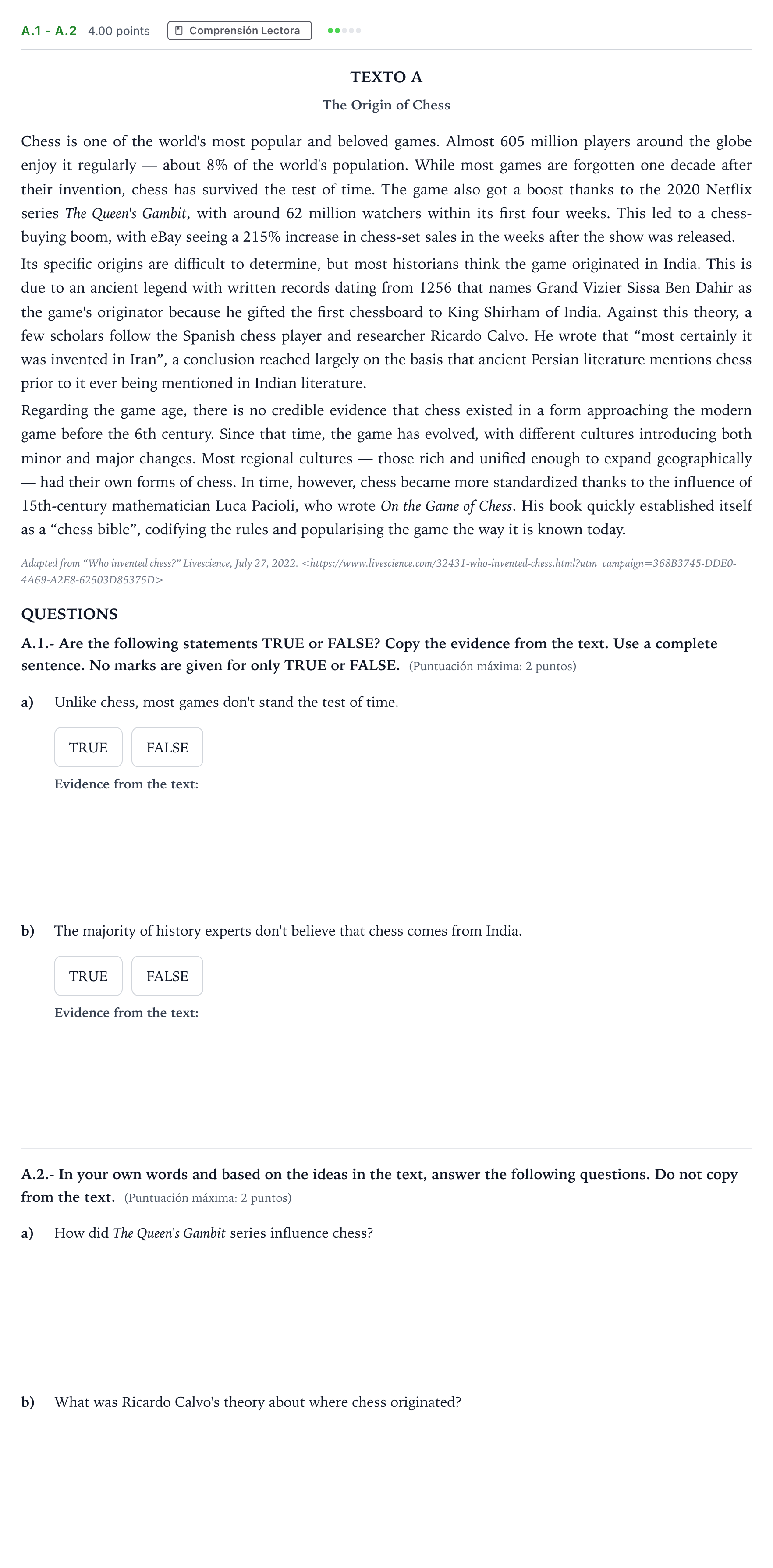
Chess is one of the world's most popular and beloved games. Almost 605 million players around the globe enjoy it regularly — about 8% of the world's population. While most games are forgotten one decade after their invention, chess has survived the test of time. The game also got a boost thanks to the 2020 Netflix series The Queen's Gambit, with around 62 million watchers within its first four weeks. This led to a chess-buying boom, with eBay seeing a 215% increase in chess-set sales in the weeks after the show was released.
Its specific origins are difficult to determine, but most historians think the game originated in India. This is due to an ancient legend with written records dating from 1256 that names Grand Vizier Sissa Ben Dahir as the game's originator because he gifted the first chessboard to King Shirham of India. Against this theory, a few scholars follow the Spanish chess player and researcher Ricardo Calvo. He wrote that “most certainly it was invented in Iran”, a conclusion reached largely on the basis that ancient Persian literature mentions chess prior to it ever being mentioned in Indian literature.
Regarding the game age, there is no credible evidence that chess existed in a form approaching the modern game before the 6th century. Since that time, the game has evolved, with different cultures introducing both minor and major changes. Most regional cultures — those rich and unified enough to expand geographically — had their own forms of chess. In time, however, chess became more standardized thanks to the influence of 15th-century mathematician Luca Pacioli, who wrote On the Game of Chess. His book quickly established itself as a “chess bible”, codifying the rules and popularising the game the way it is known today.
Adapted from “Who invented chess?” Livescience, July 27, 2022. <https://www.livescience.com/32431-who-invented-chess.html?utm_campaign=368B3745-DDE0-4A69-A2E8-62503D85375D>
QUESTIONS
A.1.- Are the following statements TRUE or FALSE? Copy the evidence from the text. Use a complete sentence. No marks are given for only TRUE or FALSE. (Puntuación máxima: 2 puntos)
a)
Unlike chess, most games don't stand the test of time.
TRUE
FALSE
b)
The majority of history experts don't believe that chess comes from India.
TRUE
FALSE
A.2.- In your own words and based on the ideas in the text, answer the following questions. Do not copy from the text. (Puntuación máxima: 2 puntos)
a)
How did The Queen's Gambit series influence chess?
b)
What was Ricardo Calvo's theory about where chess originated?
Solución
Según los criterios oficiales de corrección
A.1.a) Unlike chess, most games don't stand the test of time. [TRUE / FALSE]
Solución: TRUE
A.1.a) Evidence from the text: Unlike chess, most games don't stand the test of time.
Solución: "While most games are forgotten one decade after their invention, chess has survived the test of time."
A.1.b) The majority of history experts don't believe that chess comes from India. [TRUE / FALSE]
Solución: FALSE
A.1.b) Evidence from the text: The majority of history experts don't believe that chess comes from India.
Solución: "Its specific origins are difficult to determine, but most historians think the game originated in India."
A.2.a) How did The Queen's Gambit series influence chess?
Solución: The 2020 Netflix series The Queen's Gambit was a success and, as many people watched it, the number of games sold rose significantly.
A.2.b) What was Ricardo Calvo's theory about where chess originated?
Solución: He considered that chess was invented in Iran because the game appeared in old Persian books that were written before the Indian literature that also mentioned chess.
La explicación paso a paso, hecha con IA, es Premium. Premium
Resuélvelo aquí mismo: corrección automática, pistas y solución paso a paso.
‹ Ejercicio B · Ordinaria Martes 2024 · Ejercicio B.1 - B.2 · Extraordinaria 2023 ›
Más ejercicios de Comprensión Lectora
- Ejercicio A.2 · Ordinaria Lunes 2024
- Ejercicio B.1 · Ordinaria Lunes 2024
- Ejercicio B.2 · Ordinaria Lunes 2024
- Ejercicio A · Ordinaria Martes 2024
- Ejercicio B · Ordinaria Martes 2024
- Ejercicio B.1 - B.2 · Extraordinaria 2023
- Ejercicio A.1 - A.2 · Extraordinaria (2ª lengua) 2023
- Ejercicio B.1 - B.2 · Extraordinaria (2ª lengua) 2023
- Ejercicio A · Modelo 2023
- Ejercicio B · Modelo 2023