Opción B · Inglés PAU Madrid Ordinaria 2018
Tema: Comprensión Lectora · Del examen Ordinaria (2018)
Enunciado
OPCIÓN B
Clara Barton: American Red Cross Founder
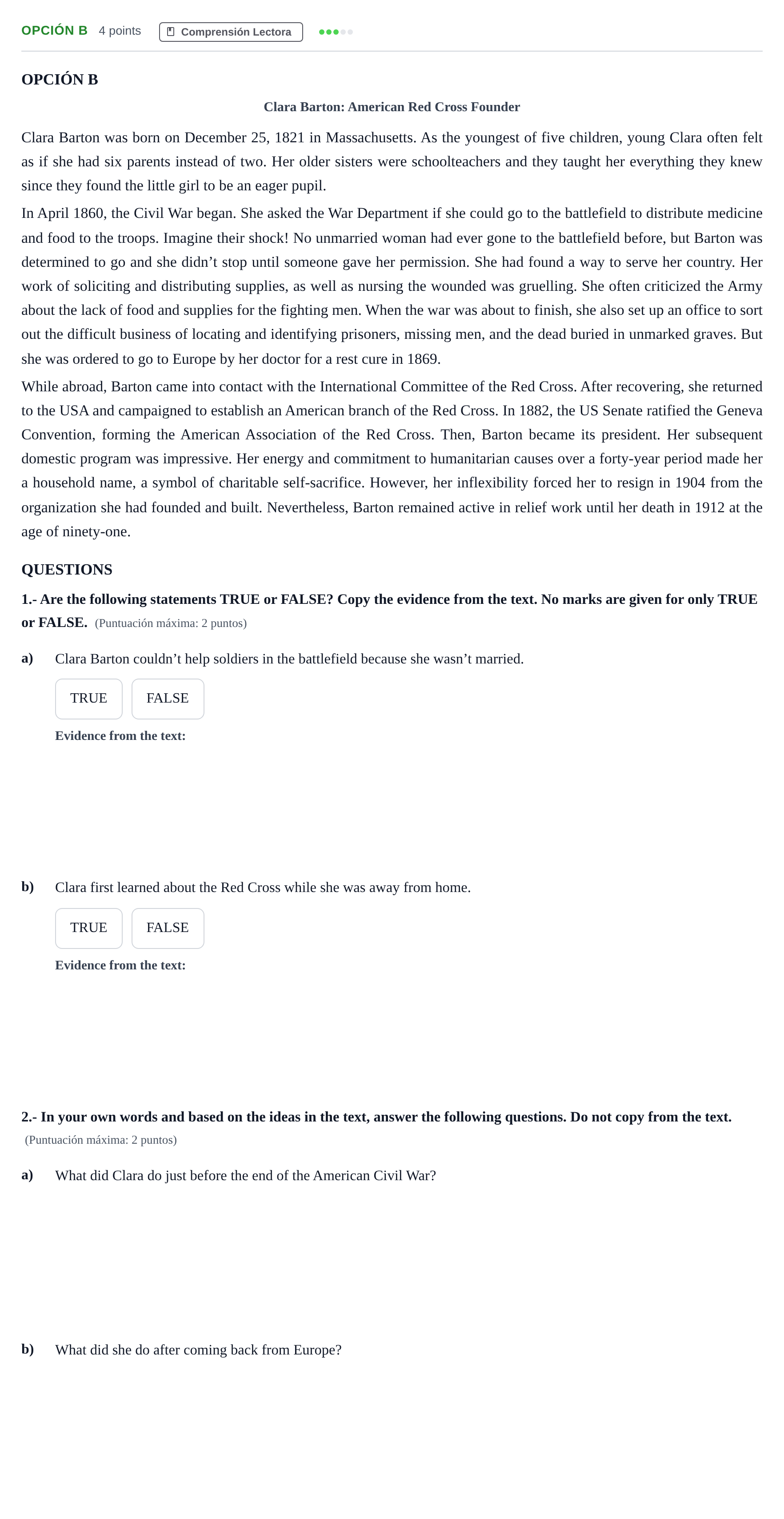
Clara Barton was born on December 25, 1821 in Massachusetts. As the youngest of five children, young Clara often felt as if she had six parents instead of two. Her older sisters were schoolteachers and they taught her everything they knew since they found the little girl to be an eager pupil.
In April 1860, the Civil War began. She asked the War Department if she could go to the battlefield to distribute medicine and food to the troops. Imagine their shock! No unmarried woman had ever gone to the battlefield before, but Barton was determined to go and she didn’t stop until someone gave her permission. She had found a way to serve her country. Her work of soliciting and distributing supplies, as well as nursing the wounded was gruelling. She often criticized the Army about the lack of food and supplies for the fighting men. When the war was about to finish, she also set up an office to sort out the difficult business of locating and identifying prisoners, missing men, and the dead buried in unmarked graves. But she was ordered to go to Europe by her doctor for a rest cure in 1869.
While abroad, Barton came into contact with the International Committee of the Red Cross. After recovering, she returned to the USA and campaigned to establish an American branch of the Red Cross. In 1882, the US Senate ratified the Geneva Convention, forming the American Association of the Red Cross. Then, Barton became its president. Her subsequent domestic program was impressive. Her energy and commitment to humanitarian causes over a forty-year period made her a household name, a symbol of charitable self-sacrifice. However, her inflexibility forced her to resign in 1904 from the organization she had founded and built. Nevertheless, Barton remained active in relief work until her death in 1912 at the age of ninety-one.
QUESTIONS
1.- Are the following statements TRUE or FALSE? Copy the evidence from the text. No marks are given for only TRUE or FALSE. (Puntuación máxima: 2 puntos)
a)
Clara Barton couldn’t help soldiers in the battlefield because she wasn’t married.
TRUE
FALSE
b)
Clara first learned about the Red Cross while she was away from home.
TRUE
FALSE
2.- In your own words and based on the ideas in the text, answer the following questions. Do not copy from the text. (Puntuación máxima: 2 puntos)
a)
What did Clara do just before the end of the American Civil War?
b)
What did she do after coming back from Europe?
Solución
Según los criterios oficiales de corrección
1.a) Clara Barton couldn’t help soldiers in the battlefield because she wasn’t married. (TRUE/FALSE)
Solución: FALSE
1.a) Copy the evidence from the text for statement a
Solución: "No unmarried woman had ever gone to the battlefield before, but Barton was determined to go and she didn't stop until someone gave her permission." / "She had found a way to serve her country. Her work of soliciting and distributing supplies, as well as nursing the wounded was gruelling."
1.b) Clara first learned about the Red Cross while she was away from home. (TRUE/FALSE)
Solución: TRUE
1.b) Copy the evidence from the text for statement b
Solución: "While abroad, Barton came into contact with the International Committee of the Red Cross."
2.a) What did Clara do just before the end of the American Civil War?
Solución: She established an office dedicated to finding and identifying missing soldiers and prisoners of war, as well as locating unmarked graves of deceased soldiers.
2.b) What did she do after coming back from Europe?
Solución: After returning from Europe, she campaigned for the creation of an American branch of the Red Cross, helped achieve the US ratification of the Geneva Convention, and became the first president of the American Red Cross.
La explicación paso a paso, hecha con IA, es Premium. Premium
Resuélvelo aquí mismo: corrección automática, pistas y solución paso a paso.
‹ Opción A · Ordinaria 2018 · Opción A · Ordinaria (2ª lengua) 2018 ›