Problema 2 · Inglés PAU La Rioja Ordinaria 2025
Tema: Preguntas abiertas sobre el texto: respuesta breve o con tus propias palabras · Del examen Ordinaria (2025)
Enunciado
Read the following text and answer the questions below:
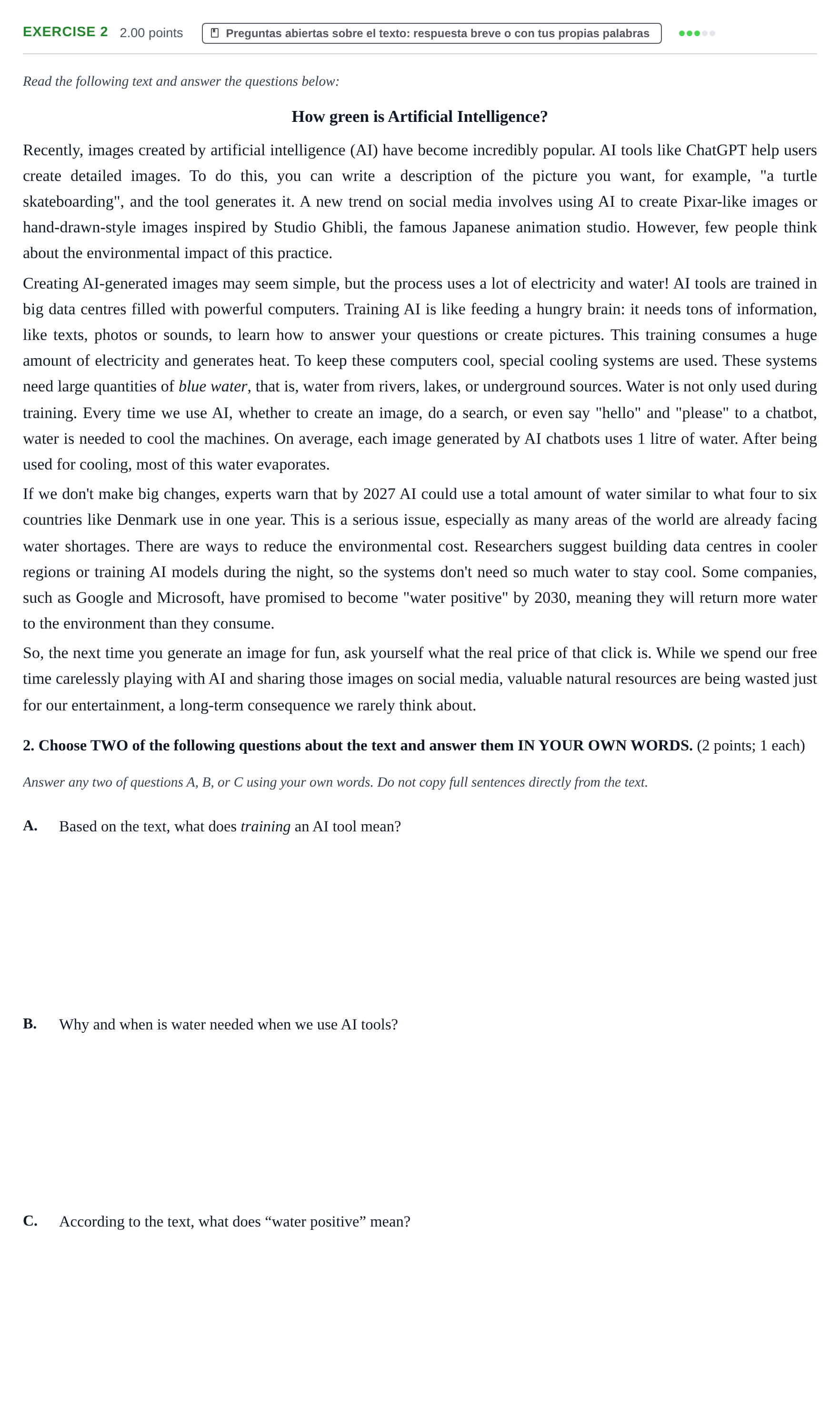
How green is Artificial Intelligence?
Recently, images created by artificial intelligence (AI) have become incredibly popular. AI tools like ChatGPT help users create detailed images. To do this, you can write a description of the picture you want, for example, "a turtle skateboarding", and the tool generates it. A new trend on social media involves using AI to create Pixar-like images or hand-drawn-style images inspired by Studio Ghibli, the famous Japanese animation studio. However, few people think about the environmental impact of this practice.
Creating AI-generated images may seem simple, but the process uses a lot of electricity and water! AI tools are trained in big data centres filled with powerful computers. Training AI is like feeding a hungry brain: it needs tons of information, like texts, photos or sounds, to learn how to answer your questions or create pictures. This training consumes a huge amount of electricity and generates heat. To keep these computers cool, special cooling systems are used. These systems need large quantities of blue water, that is, water from rivers, lakes, or underground sources. Water is not only used during training. Every time we use AI, whether to create an image, do a search, or even say "hello" and "please" to a chatbot, water is needed to cool the machines. On average, each image generated by AI chatbots uses 1 litre of water. After being used for cooling, most of this water evaporates.
If we don't make big changes, experts warn that by 2027 AI could use a total amount of water similar to what four to six countries like Denmark use in one year. This is a serious issue, especially as many areas of the world are already facing water shortages. There are ways to reduce the environmental cost. Researchers suggest building data centres in cooler regions or training AI models during the night, so the systems don't need so much water to stay cool. Some companies, such as Google and Microsoft, have promised to become "water positive" by 2030, meaning they will return more water to the environment than they consume.
So, the next time you generate an image for fun, ask yourself what the real price of that click is. While we spend our free time carelessly playing with AI and sharing those images on social media, valuable natural resources are being wasted just for our entertainment, a long-term consequence we rarely think about.
2. Choose TWO of the following questions about the text and answer them IN YOUR OWN WORDS. (2 points; 1 each)
Answer any two of questions A, B, or C using your own words. Do not copy full sentences directly from the text.
A.
Based on the text, what does training an AI tool mean?
B.
Why and when is water needed when we use AI tools?
C.
According to the text, what does “water positive” mean?
Solución
Según los criterios oficiales de corrección
A. Based on the text, what does training an AI tool mean?
Solución: Training an AI tool means feeding it massive volumes of data (such as texts, images, and sounds) so that the algorithms learn how to produce pictures or respond properly to user requests.
B. Why and when is water needed when we use AI tools?
Solución: Water is required to cool down the powerful computers and servers in data centres because they overheat during operation. It is used both while the models are being trained and every time a user interacts with AI (asking questions, generating images, etc.).
C. According to the text, what does “water positive” mean?
Solución: Being "water positive" means that a company promises to restore or give back more water to nature and the environment than the total amount it takes and consumes.
La explicación paso a paso, hecha con IA, es Premium. Premium
Resuélvelo aquí mismo: corrección automática, pistas y solución paso a paso.
‹ Problema 2 · Extraordinaria 2025 · Ejercicio 2A · Extraordinaria 2024 ›
Más ejercicios de Preguntas abiertas sobre el texto: respuesta breve o con tus propias palabras
- Problema 1 · Extraordinaria 2026
- Problema 1 · Ordinaria 2026
- Problema 2 · Extraordinaria 2025
- Ejercicio 2A · Extraordinaria 2024
- Ejercicio 2B · Extraordinaria 2024
- Ejercicio 2A · Ordinaria 2024
- Ejercicio 2B · Ordinaria 2024
- Ejercicio 2A · Extraordinaria 2023
- Ejercicio 2B · Extraordinaria 2023
- Ejercicio 2A · Ordinaria 2023