Ejercicio 1.2 · Inglés PAU Galicia Extraordinaria (2ª lengua extranjera) 2026
Tema: Vocabulario: sinónimos y antónimos en el texto (Find a synonym/antonym) · Del examen Extraordinaria (2ª lengua extranjera) (2026)
Enunciado
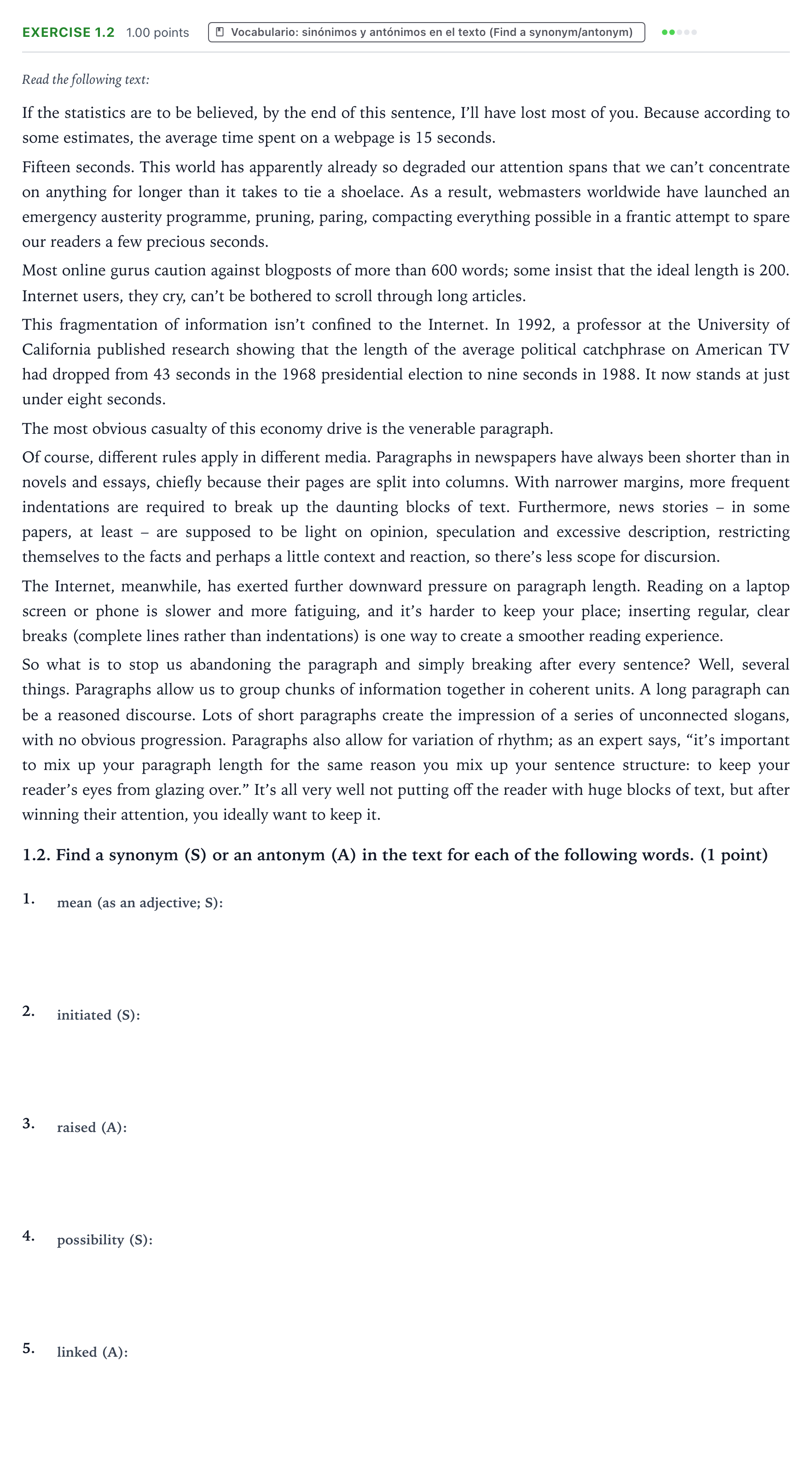
Read the following text:
If the statistics are to be believed, by the end of this sentence, I’ll have lost most of you. Because according to some estimates, the average time spent on a webpage is 15 seconds.
Fifteen seconds. This world has apparently already so degraded our attention spans that we can’t concentrate on anything for longer than it takes to tie a shoelace. As a result, webmasters worldwide have launched an emergency austerity programme, pruning, paring, compacting everything possible in a frantic attempt to spare our readers a few precious seconds.
Most online gurus caution against blogposts of more than 600 words; some insist that the ideal length is 200. Internet users, they cry, can’t be bothered to scroll through long articles.
This fragmentation of information isn’t confined to the Internet. In 1992, a professor at the University of California published research showing that the length of the average political catchphrase on American TV had dropped from 43 seconds in the 1968 presidential election to nine seconds in 1988. It now stands at just under eight seconds.
The most obvious casualty of this economy drive is the venerable paragraph.
Of course, different rules apply in different media. Paragraphs in newspapers have always been shorter than in novels and essays, chiefly because their pages are split into columns. With narrower margins, more frequent indentations are required to break up the daunting blocks of text. Furthermore, news stories – in some papers, at least – are supposed to be light on opinion, speculation and excessive description, restricting themselves to the facts and perhaps a little context and reaction, so there’s less scope for discursion.
The Internet, meanwhile, has exerted further downward pressure on paragraph length. Reading on a laptop screen or phone is slower and more fatiguing, and it’s harder to keep your place; inserting regular, clear breaks (complete lines rather than indentations) is one way to create a smoother reading experience.
So what is to stop us abandoning the paragraph and simply breaking after every sentence? Well, several things. Paragraphs allow us to group chunks of information together in coherent units. A long paragraph can be a reasoned discourse. Lots of short paragraphs create the impression of a series of unconnected slogans, with no obvious progression. Paragraphs also allow for variation of rhythm; as an expert says, “it’s important to mix up your paragraph length for the same reason you mix up your sentence structure: to keep your reader’s eyes from glazing over.” It’s all very well not putting off the reader with huge blocks of text, but after winning their attention, you ideally want to keep it.
1.2. Find a synonym (S) or an antonym (A) in the text for each of the following words. (1 point)
1.
2.
3.
4.
5.
Solución
Según los criterios oficiales de corrección
1. mean (as an adjective; S)
Solución: average
2. initiated (S)
Solución: launched
3. raised (A)
Solución: dropped
4. possibility (S)
Solución: scope
5. linked (A)
Solución: unconnected
La explicación paso a paso, hecha con IA, es Premium. Premium
Resuélvelo aquí mismo: corrección automática, pistas y solución paso a paso.
‹ Ejercicio 1.2 · Extraordinaria 2026 · Ejercicio 1.2 · Ordinaria 2026 ›
Más ejercicios de Vocabulario: sinónimos y antónimos en el texto (Find a synonym/antonym)
- Ejercicio 1.2 · Extraordinaria 2026
- Ejercicio 1.2 · Ordinaria 2026
- Ejercicio 1.2 · Ordinaria (2ª lengua extranjera) 2026
- Ejercicio 1.2 · Extraordinaria 2025
- Ejercicio 1.2 · Extraordinaria (2ª lengua extranjera) 2025
- Ejercicio 1.2 · Ordinaria 2025
- Ejercicio 1.2 · Ordinaria (2ª lengua extranjera) 2025
- Ejercicio 1.2 · Extraordinaria 2024
- Ejercicio 2.2 · Extraordinaria 2024
- Ejercicio 1.2 · Extraordinaria (2ª lengua extranjera) 2024