Ejercicio Text 1 - Exercise 2 · Inglés PAU Extremadura Extraordinaria 2021
Tema: Vocabulario: encontrar en el texto sinónimos, antónimos y definiciones (Find words) · Del examen Extraordinaria (2021)
Enunciado
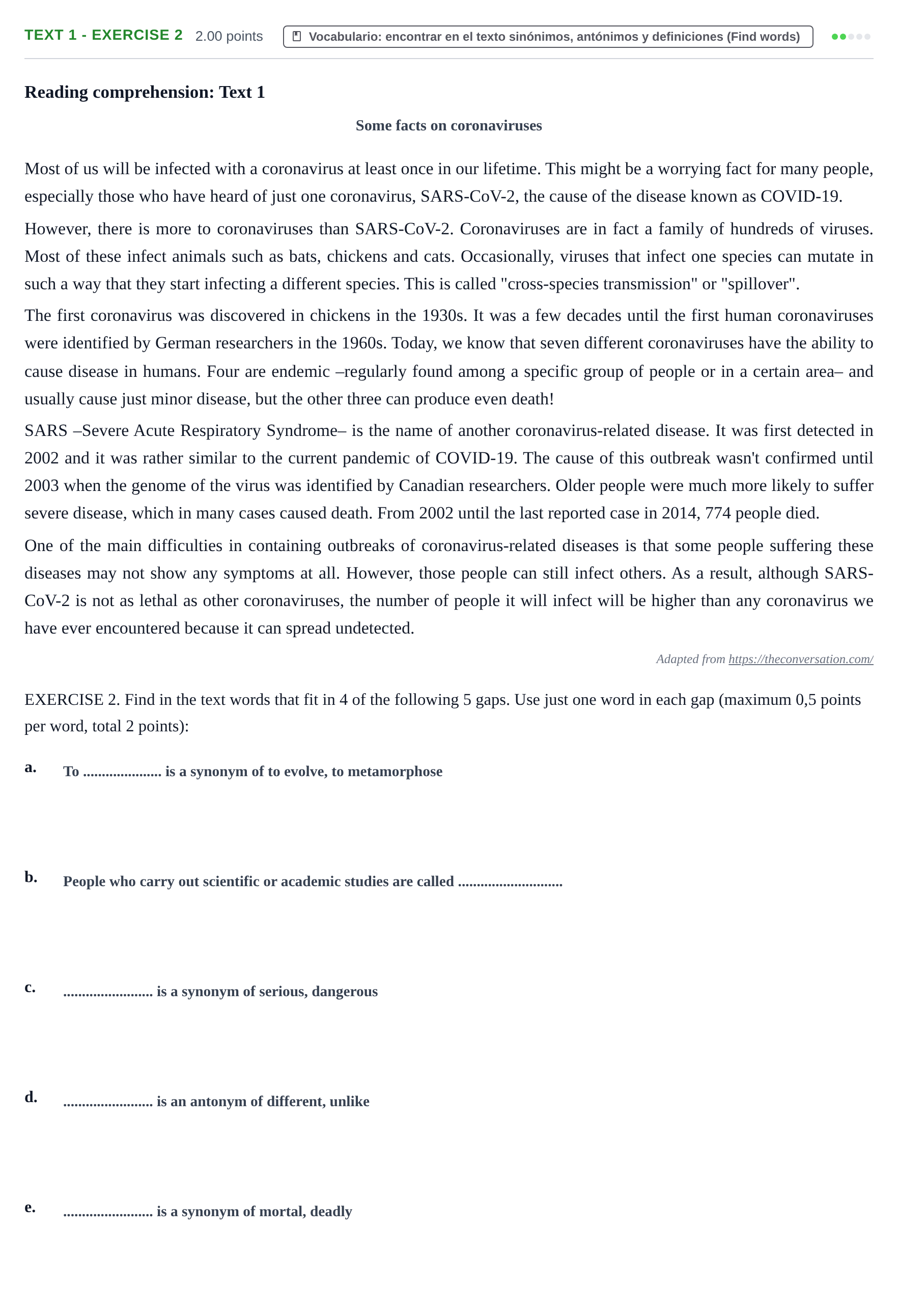
Reading comprehension: Text 1
Some facts on coronaviruses
Most of us will be infected with a coronavirus at least once in our lifetime. This might be a worrying fact for many people, especially those who have heard of just one coronavirus, SARS-CoV-2, the cause of the disease known as COVID-19.
However, there is more to coronaviruses than SARS-CoV-2. Coronaviruses are in fact a family of hundreds of viruses. Most of these infect animals such as bats, chickens and cats. Occasionally, viruses that infect one species can mutate in such a way that they start infecting a different species. This is called "cross-species transmission" or "spillover".
The first coronavirus was discovered in chickens in the 1930s. It was a few decades until the first human coronaviruses were identified by German researchers in the 1960s. Today, we know that seven different coronaviruses have the ability to cause disease in humans. Four are endemic –regularly found among a specific group of people or in a certain area– and usually cause just minor disease, but the other three can produce even death!
SARS –Severe Acute Respiratory Syndrome– is the name of another coronavirus-related disease. It was first detected in 2002 and it was rather similar to the current pandemic of COVID-19. The cause of this outbreak wasn't confirmed until 2003 when the genome of the virus was identified by Canadian researchers. Older people were much more likely to suffer severe disease, which in many cases caused death. From 2002 until the last reported case in 2014, 774 people died.
One of the main difficulties in containing outbreaks of coronavirus-related diseases is that some people suffering these diseases may not show any symptoms at all. However, those people can still infect others. As a result, although SARS-CoV-2 is not as lethal as other coronaviruses, the number of people it will infect will be higher than any coronavirus we have ever encountered because it can spread undetected.
Adapted from https://theconversation.com/
EXERCISE 2. Find in the text words that fit in 4 of the following 5 gaps. Use just one word in each gap (maximum 0,5 points per word, total 2 points):
a.
b.
c.
d.
e.
Solución
Según los criterios oficiales de corrección
To ..................... is a synonym of to evolve, to metamorphose
Solución: mutate
People who carry out scientific or academic studies are called ............................
Solución: researchers
........................ is a synonym of serious, dangerous
Solución: severe
........................ is an antonym of different, unlike
Solución: similar
........................ is a synonym of mortal, deadly
Solución: lethal
La explicación paso a paso, hecha con IA, es Premium. Premium
Resuélvelo aquí mismo: corrección automática, pistas y solución paso a paso.
‹ Ejercicio Text 2 - Exercise 2 · Ordinaria 2022 · Ejercicio Text 2 - Exercise 2 · Extraordinaria 2021 ›
Más ejercicios de Vocabulario: encontrar en el texto sinónimos, antónimos y definiciones (Find words)
- Ejercicio Text 2 - Exercise 2 · Ordinaria 2023
- Ejercicio Text 1 - Exercise 2 · Extraordinaria 2022
- Ejercicio Text 2 - Exercise 2 · Extraordinaria 2022
- Ejercicio Text 1 - Exercise 2 · Ordinaria 2022
- Ejercicio Text 2 - Exercise 2 · Ordinaria 2022
- Ejercicio Text 2 - Exercise 2 · Extraordinaria 2021
- Ejercicio Text 1 - Exercise 2 · Ordinaria 2021
- Ejercicio Text 2 - Exercise 2 · Ordinaria 2021