Ejercicio Option B - 4 · Inglés PAU Castilla y León Ordinaria 2021
Tema: Vocabulario: definiciones y sinónimos en el texto (Vocabulary) · Del examen Ordinaria (2021)
Enunciado
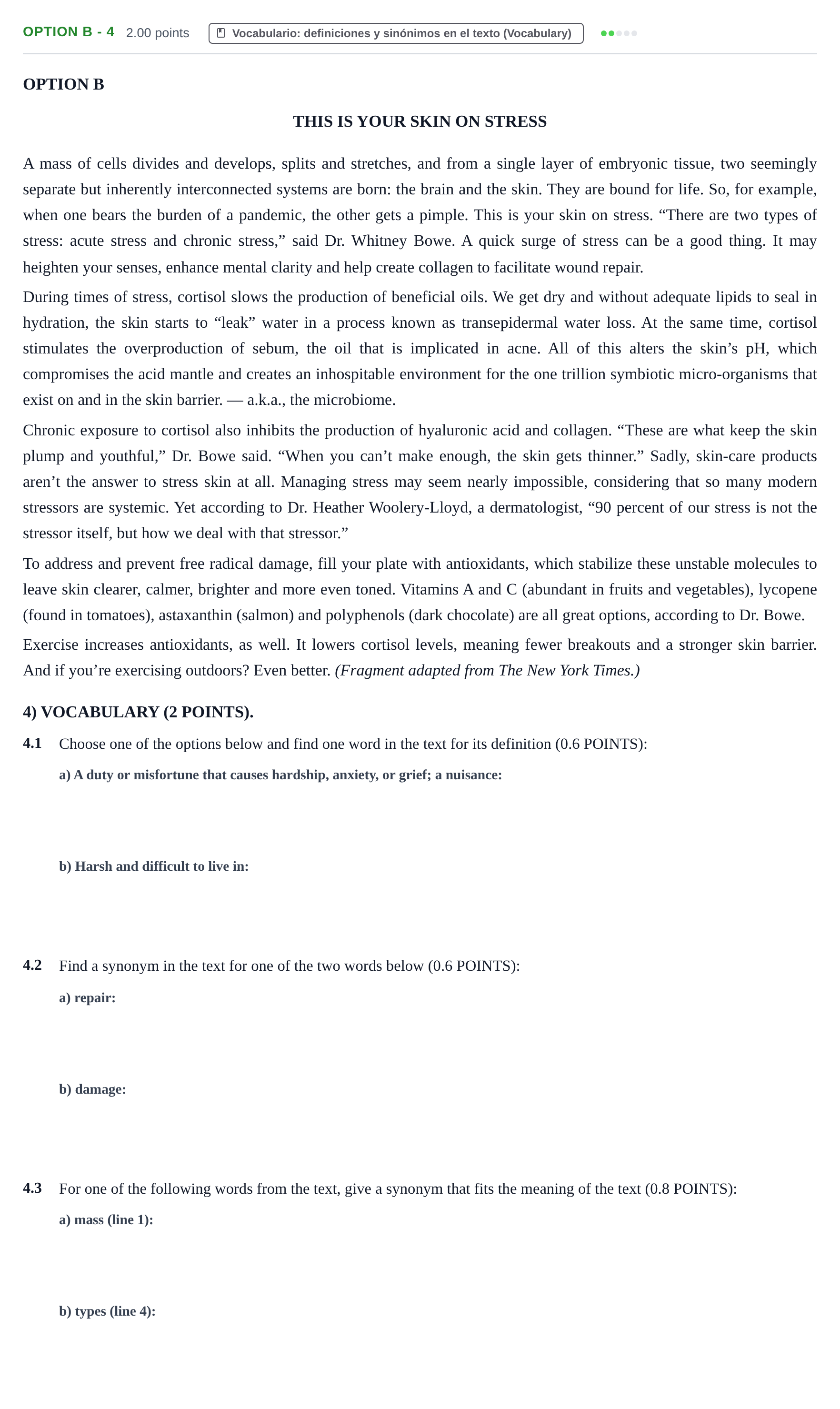
OPTION B
THIS IS YOUR SKIN ON STRESS
A mass of cells divides and develops, splits and stretches, and from a single layer of embryonic tissue, two seemingly separate but inherently interconnected systems are born: the brain and the skin. They are bound for life. So, for example, when one bears the burden of a pandemic, the other gets a pimple. This is your skin on stress. “There are two types of stress: acute stress and chronic stress,” said Dr. Whitney Bowe. A quick surge of stress can be a good thing. It may heighten your senses, enhance mental clarity and help create collagen to facilitate wound repair.
During times of stress, cortisol slows the production of beneficial oils. We get dry and without adequate lipids to seal in hydration, the skin starts to “leak” water in a process known as transepidermal water loss. At the same time, cortisol stimulates the overproduction of sebum, the oil that is implicated in acne. All of this alters the skin’s pH, which compromises the acid mantle and creates an inhospitable environment for the one trillion symbiotic micro-organisms that exist on and in the skin barrier. — a.k.a., the microbiome.
Chronic exposure to cortisol also inhibits the production of hyaluronic acid and collagen. “These are what keep the skin plump and youthful,” Dr. Bowe said. “When you can’t make enough, the skin gets thinner.” Sadly, skin-care products aren’t the answer to stress skin at all. Managing stress may seem nearly impossible, considering that so many modern stressors are systemic. Yet according to Dr. Heather Woolery-Lloyd, a dermatologist, “90 percent of our stress is not the stressor itself, but how we deal with that stressor.”
To address and prevent free radical damage, fill your plate with antioxidants, which stabilize these unstable molecules to leave skin clearer, calmer, brighter and more even toned. Vitamins A and C (abundant in fruits and vegetables), lycopene (found in tomatoes), astaxanthin (salmon) and polyphenols (dark chocolate) are all great options, according to Dr. Bowe.
Exercise increases antioxidants, as well. It lowers cortisol levels, meaning fewer breakouts and a stronger skin barrier. And if you’re exercising outdoors? Even better. (Fragment adapted from The New York Times.)
4) VOCABULARY (2 POINTS).
4.1
Choose one of the options below and find one word in the text for its definition (0.6 POINTS):
0 }" autocomplete="off"> 0 }" autocomplete="off">
4.2
Find a synonym in the text for one of the two words below (0.6 POINTS):
0 }" autocomplete="off"> 0 }" autocomplete="off">
4.3
For one of the following words from the text, give a synonym that fits the meaning of the text (0.8 POINTS):
0 }" autocomplete="off"> 0 }" autocomplete="off">
Solución
Solución de AprenAI (no es la oficial)
4.1 a) A duty or misfortune that causes hardship, anxiety, or grief; a nuisance
Solución: burden
4.1 b) Harsh and difficult to live in
Solución: inhospitable
4.2 a) repair (synonym in the text)
Solución: address
Las soluciones de los 3 apartados que faltan y la explicación paso a paso son Premium. Premium
Resuélvelo aquí mismo: corrección automática, pistas y solución paso a paso.
‹ Ejercicio Option A - 4 · Ordinaria 2021 · Ejercicio Option A - 4 · Ordinaria (Fase Mejora de Nota) 2021 ›
Más ejercicios de Vocabulario: definiciones y sinónimos en el texto (Vocabulary)
- Opción A - 4 · Extraordinaria 2021
- Opción B - 4 · Extraordinaria 2021
- Opción A - 4 · Extraordinaria (Fase Mejora de Nota) 2021
- Opción B - 4 · Extraordinaria (Fase Mejora de Nota) 2021
- Ejercicio Option A - 4 · Ordinaria 2021
- Ejercicio Option A - 4 · Ordinaria (Fase Mejora de Nota) 2021
- Ejercicio Option B - 4 · Ordinaria (Fase Mejora de Nota) 2021