Opción A - 2 · Inglés PAU Castilla y León Extraordinaria 2024
Tema: Verdadero o falso con justificación del texto (True/False) · Del examen Extraordinaria (2024)
Enunciado
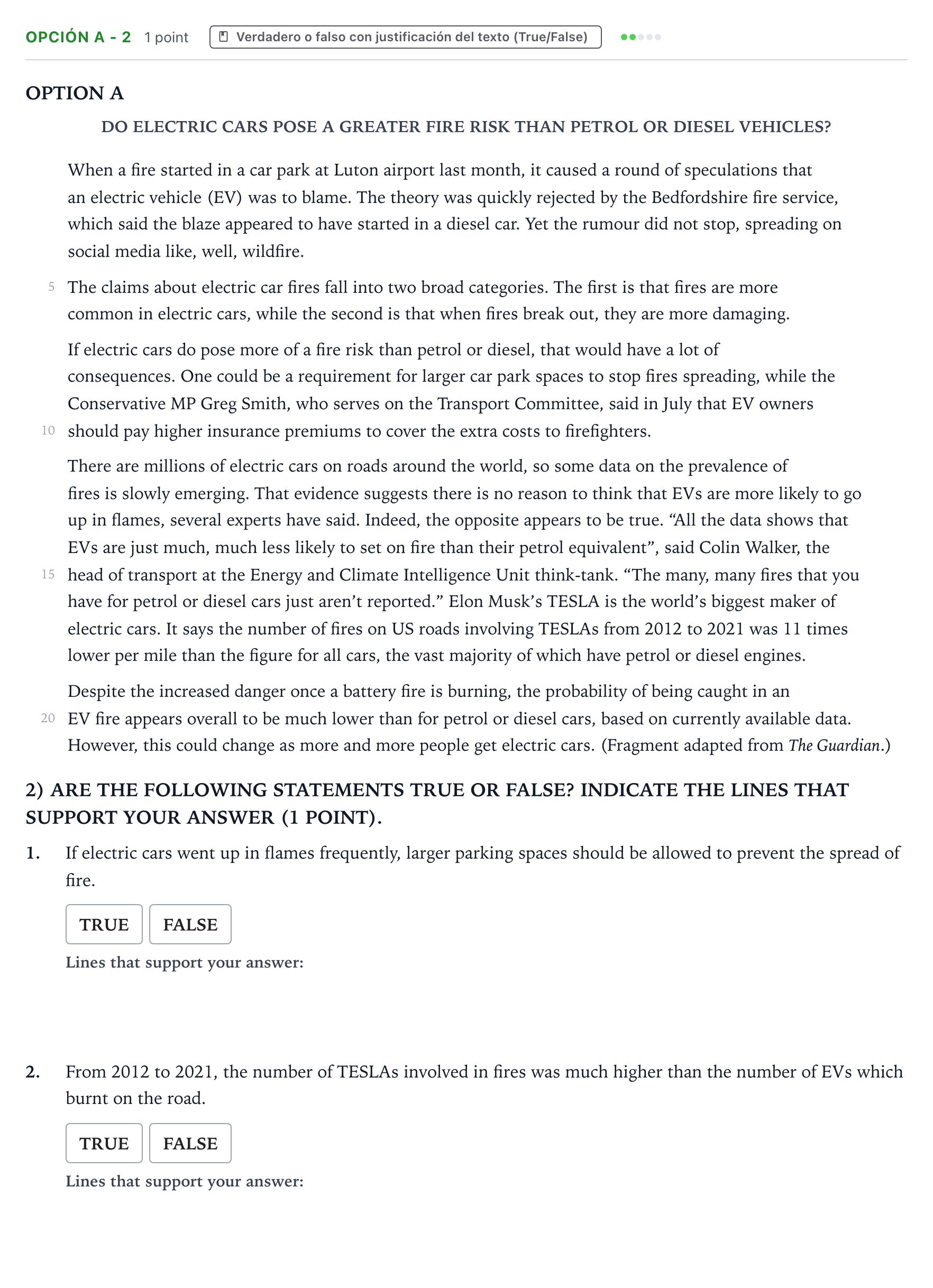
OPTION A
DO ELECTRIC CARS POSE A GREATER FIRE RISK THAN PETROL OR DIESEL VEHICLES?
When a fire started in a car park at Luton airport last month, it caused a round of speculations that
an electric vehicle (EV) was to blame. The theory was quickly rejected by the Bedfordshire fire service,
which said the blaze appeared to have started in a diesel car. Yet the rumour did not stop, spreading on
social media like, well, wildfire.
5 The claims about electric car fires fall into two broad categories. The first is that fires are more
common in electric cars, while the second is that when fires break out, they are more damaging.
If electric cars do pose more of a fire risk than petrol or diesel, that would have a lot of
consequences. One could be a requirement for larger car park spaces to stop fires spreading, while the
Conservative MP Greg Smith, who serves on the Transport Committee, said in July that EV owners
10 should pay higher insurance premiums to cover the extra costs to firefighters.
There are millions of electric cars on roads around the world, so some data on the prevalence of
fires is slowly emerging. That evidence suggests there is no reason to think that EVs are more likely to go
up in flames, several experts have said. Indeed, the opposite appears to be true. “All the data shows that
EVs are just much, much less likely to set on fire than their petrol equivalent”, said Colin Walker, the
15 head of transport at the Energy and Climate Intelligence Unit think-tank. “The many, many fires that you
have for petrol or diesel cars just aren’t reported.” Elon Musk’s TESLA is the world’s biggest maker of
electric cars. It says the number of fires on US roads involving TESLAs from 2012 to 2021 was 11 times
lower per mile than the figure for all cars, the vast majority of which have petrol or diesel engines.
Despite the increased danger once a battery fire is burning, the probability of being caught in an
20 EV fire appears overall to be much lower than for petrol or diesel cars, based on currently available data.
However, this could change as more and more people get electric cars. (Fragment adapted from The Guardian.)
2) ARE THE FOLLOWING STATEMENTS TRUE OR FALSE? INDICATE THE LINES THAT SUPPORT YOUR ANSWER (1 POINT).
1.
If electric cars went up in flames frequently, larger parking spaces should be allowed to prevent the spread of fire.
TRUE
FALSE
2.
From 2012 to 2021, the number of TESLAs involved in fires was much higher than the number of EVs which burnt on the road.
TRUE
FALSE
Solución
Según los criterios oficiales de corrección
1. If electric cars went up in flames frequently, larger parking spaces should be allowed to prevent the spread of fire.
Solución: TRUE
1. Lines that support your answer
Solución: 8-9
2. From 2012 to 2021, the number of TESLAs involved in fires was much higher than the number of EVs which burnt on the road.
Solución: FALSE
2. Lines that support your answer
Solución: 17-18
La explicación paso a paso, hecha con IA, es Premium. Premium
Resuélvelo aquí mismo: corrección automática, pistas y solución paso a paso.
‹ Problema 1 · Ordinaria 2025 · Opción B - 2 · Extraordinaria 2024 ›
Más ejercicios de Verdadero o falso con justificación del texto (True/False)
- Problema 1 · Extraordinaria 2026
- Problema 1 · Ordinaria 2026
- Problema 1 · Extraordinaria 2025
- Problema 1 · Ordinaria 2025
- Opción B - 2 · Extraordinaria 2024
- Opción A - 2 · Extraordinaria (Fase Mejora de Nota) 2024
- Opción B - 2 · Extraordinaria (Fase Mejora de Nota) 2024
- Opción A - 2 · Ordinaria 2024
- Opción B - 2 · Ordinaria 2024
- Opción A - 2 · Ordinaria (Fase Mejora de Nota) 2024