Opción B - 2 · Inglés PAU Castilla y León Extraordinaria (Fase Mejora de Nota) 2021
Tema: Verdadero o falso con justificación del texto (True/False) · Del examen Extraordinaria (Fase Mejora de Nota) (2021)
Enunciado
OPTION B
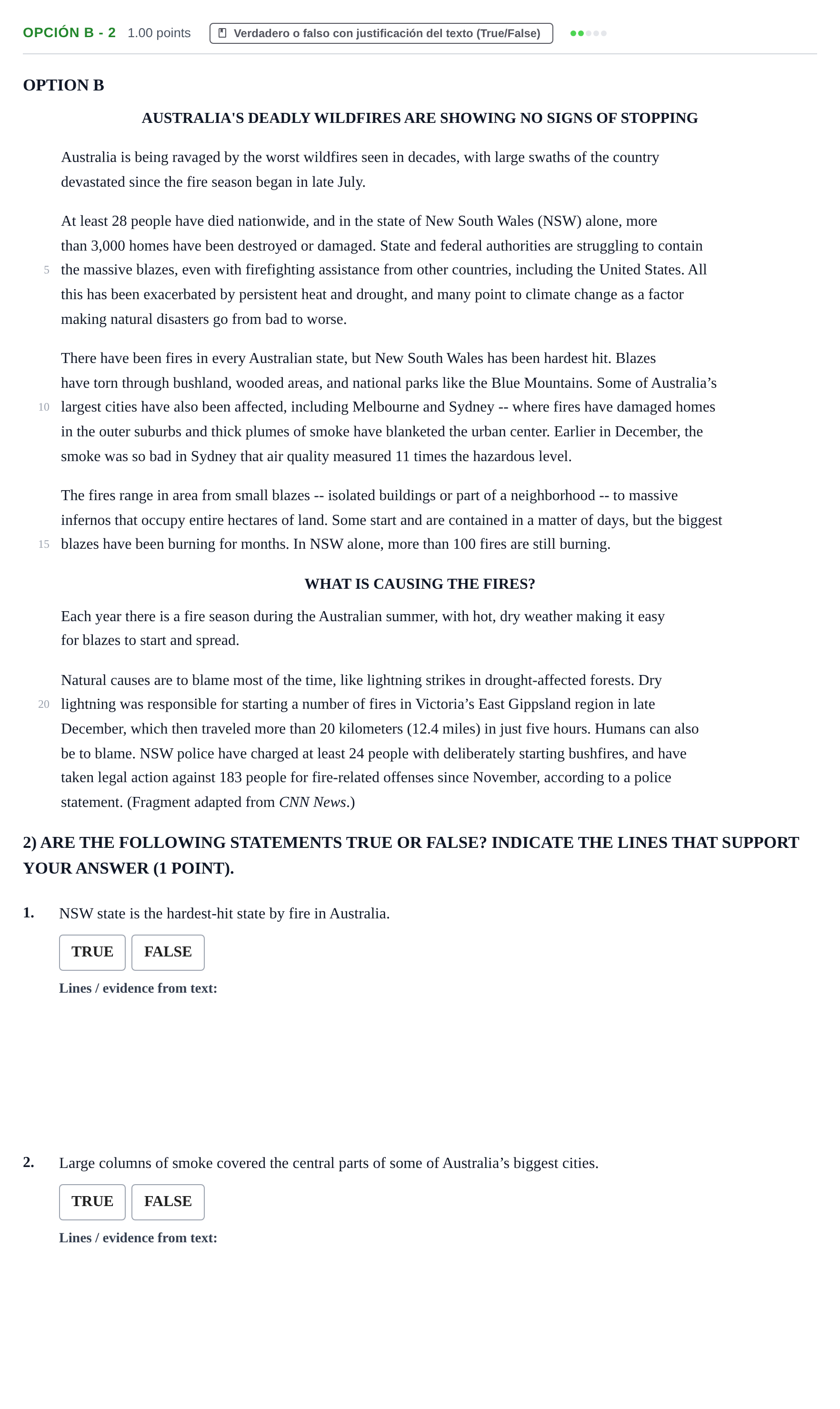
AUSTRALIA'S DEADLY WILDFIRES ARE SHOWING NO SIGNS OF STOPPING
Australia is being ravaged by the worst wildfires seen in decades, with large swaths of the country
devastated since the fire season began in late July.
At least 28 people have died nationwide, and in the state of New South Wales (NSW) alone, more
than 3,000 homes have been destroyed or damaged. State and federal authorities are struggling to contain
5 the massive blazes, even with firefighting assistance from other countries, including the United States. All
this has been exacerbated by persistent heat and drought, and many point to climate change as a factor
making natural disasters go from bad to worse.
There have been fires in every Australian state, but New South Wales has been hardest hit. Blazes
have torn through bushland, wooded areas, and national parks like the Blue Mountains. Some of Australia’s
10 largest cities have also been affected, including Melbourne and Sydney -- where fires have damaged homes
in the outer suburbs and thick plumes of smoke have blanketed the urban center. Earlier in December, the
smoke was so bad in Sydney that air quality measured 11 times the hazardous level.
The fires range in area from small blazes -- isolated buildings or part of a neighborhood -- to massive
infernos that occupy entire hectares of land. Some start and are contained in a matter of days, but the biggest
15 blazes have been burning for months. In NSW alone, more than 100 fires are still burning.
WHAT IS CAUSING THE FIRES?
Each year there is a fire season during the Australian summer, with hot, dry weather making it easy
for blazes to start and spread.
Natural causes are to blame most of the time, like lightning strikes in drought-affected forests. Dry
20 lightning was responsible for starting a number of fires in Victoria’s East Gippsland region in late
December, which then traveled more than 20 kilometers (12.4 miles) in just five hours. Humans can also
be to blame. NSW police have charged at least 24 people with deliberately starting bushfires, and have
taken legal action against 183 people for fire-related offenses since November, according to a police
statement. (Fragment adapted from CNN News.)
2) ARE THE FOLLOWING STATEMENTS TRUE OR FALSE? INDICATE THE LINES THAT SUPPORT YOUR ANSWER (1 POINT).
1.
NSW state is the hardest-hit state by fire in Australia.
2.
Large columns of smoke covered the central parts of some of Australia’s biggest cities.
Solución
Solución de AprenAI (no es la oficial)
1. NSW state is the hardest-hit state by fire in Australia. / 2. Large columns of smoke covered the central parts of some of Australia’s biggest cities. (True / False)
Solución: 1. TRUE / 2. TRUE
1. Indicate the lines that support your answer: NSW state is the hardest-hit state by fire in Australia.
Solución: Lines 8-9: "...New South Wales has been hardest hit."
La solución del apartado que falta y la explicación paso a paso son Premium. Premium
Resuélvelo aquí mismo: corrección automática, pistas y solución paso a paso.
‹ Opción A - 2 · Extraordinaria (Fase Mejora de Nota) 2021 · Ejercicio Option A - 2 · Ordinaria 2021 ›
Más ejercicios de Verdadero o falso con justificación del texto (True/False)
- Opción A - 2 · Ordinaria (Fase Mejora de Nota) 2022
- Opción B - 2 · Ordinaria (Fase Mejora de Nota) 2022
- Opción A - 2 · Extraordinaria 2021
- Opción B - 2 · Extraordinaria 2021
- Opción A - 2 · Extraordinaria (Fase Mejora de Nota) 2021
- Ejercicio Option A - 2 · Ordinaria 2021
- Ejercicio Option B - 2 · Ordinaria 2021
- Ejercicio Option A - 2 · Ordinaria (Fase Mejora de Nota) 2021
- Ejercicio Option B - 2 · Ordinaria (Fase Mejora de Nota) 2021