PART I. QUESTIONS · Inglés PAU Castilla-La Mancha Extraordinaria 2025
Tema: Reading: verdadero o falso con cita del texto (True/False) · Del examen Extraordinaria (2025)
Enunciado
READING
Young people´s screen time
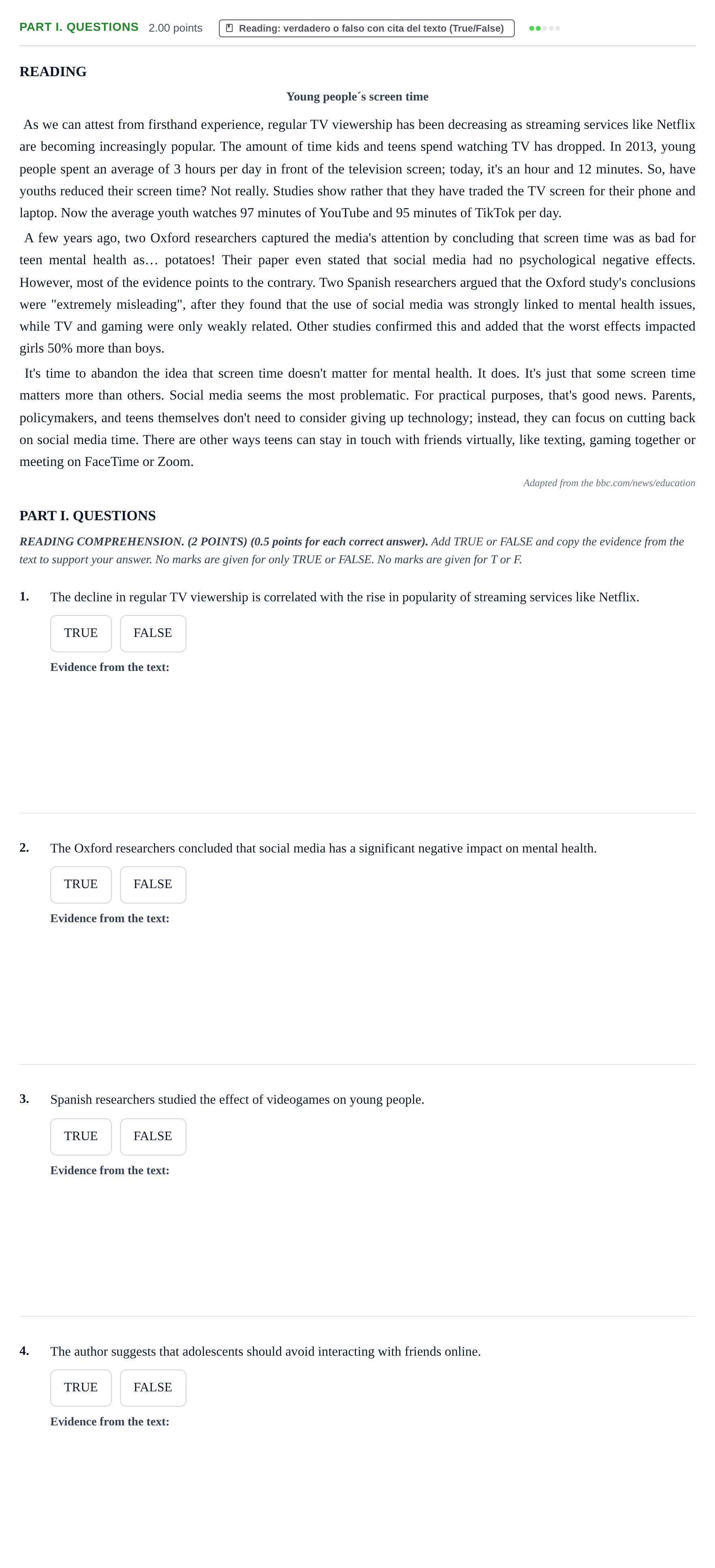
1. As we can attest from firsthand experience, regular TV viewership has been decreasing as streaming services like Netflix are becoming increasingly popular. The amount of time kids and teens spend watching TV has dropped. In 2013, young people spent an average of 3 hours per day in front of the television screen; today, it's an hour and 12 minutes. So, have youths reduced their screen time? Not really. Studies show rather that they have traded the TV screen for their phone and laptop. Now the average youth watches 97 minutes of YouTube and 95 minutes of TikTok per day.
7. A few years ago, two Oxford researchers captured the media's attention by concluding that screen time was as bad for teen mental health as… potatoes! Their paper even stated that social media had no psychological negative effects. However, most of the evidence points to the contrary. Two Spanish researchers argued that the Oxford study's conclusions were "extremely misleading", after they found that the use of social media was strongly linked to mental health issues, while TV and gaming were only weakly related. Other studies confirmed this and added that the worst effects impacted girls 50% more than boys.
13. It's time to abandon the idea that screen time doesn't matter for mental health. It does. It's just that some screen time matters more than others. Social media seems the most problematic. For practical purposes, that's good news. Parents, policymakers, and teens themselves don't need to consider giving up technology; instead, they can focus on cutting back on social media time. There are other ways teens can stay in touch with friends virtually, like texting, gaming together or meeting on FaceTime or Zoom.
Adapted from the bbc.com/news/education
PART I. QUESTIONS
READING COMPREHENSION. (2 POINTS) (0.5 points for each correct answer). Add TRUE or FALSE and copy the evidence from the text to support your answer. No marks are given for only TRUE or FALSE. No marks are given for T or F.
1.
The decline in regular TV viewership is correlated with the rise in popularity of streaming services like Netflix.
TRUE
FALSE
2.
The Oxford researchers concluded that social media has a significant negative impact on mental health.
TRUE
FALSE
3.
Spanish researchers studied the effect of videogames on young people.
TRUE
FALSE
4.
The author suggests that adolescents should avoid interacting with friends online.
TRUE
FALSE
Solución
Según los criterios oficiales de corrección
PART I. QUESTIONS (True/False choice)
Solución: 1. TRUE; 2. FALSE; 3. TRUE; 4. FALSE
1. The decline in regular TV viewership is correlated with the rise in popularity of streaming services like Netflix. (Evidence)
Solución: Regular TV viewership has been decreasing as streaming services like Netflix are becoming increasingly popular
2. The Oxford researchers concluded that social media has a significant negative impact on mental health. (Evidence)
Solución: Their paper even stated that social media had no psychological negative effects
3. Spanish researchers studied the effect of videogames on young people. (Evidence)
Solución: After they found that the use of social media was strongly linked to mental health issues, while TV and gaming were only weakly related
4. The author suggests that adolescents should avoid interacting with friends online. (Evidence)
Solución: There are other ways teens can stay in touch with friends virtually, like texting, gaming together or meeting on FaceTime or Zoom.
La explicación paso a paso, hecha con IA, es Premium. Premium
Resuélvelo aquí mismo: corrección automática, pistas y solución paso a paso.
‹ Part I · Ordinaria 2026 · Part I · Ordinaria 2025 ›
Más ejercicios de Reading: verdadero o falso con cita del texto (True/False)
- Part I · Extraordinaria 2026
- Part I · Ordinaria 2026
- Part I · Ordinaria 2025
- Ejercicio Text 1 - Part I. Reading Comprehension · Extraordinaria 2024
- Ejercicio Text 2 - Part I. Reading Comprehension · Extraordinaria 2024
- Ejercicio Text 1 - Part I. Reading Comprehension · Ordinaria 2024
- Ejercicio Text 2 - Part I. Reading Comprehension · Ordinaria 2024
- Ejercicio Text 1 - Part I. Reading Comprehension · Extraordinaria 2023
- Ejercicio Text 2 - Part I. Reading Comprehension · Extraordinaria 2023
- Ejercicio Text 1 - Part I. Reading · Ordinaria 2023