Ejercicio Text 2 - Part II.B. Phonetics · Inglés PAU Castilla-La Mancha Ordinaria 2024
Tema: Phonetics: sonidos y pronunciación · Del examen Ordinaria (2024)
Enunciado
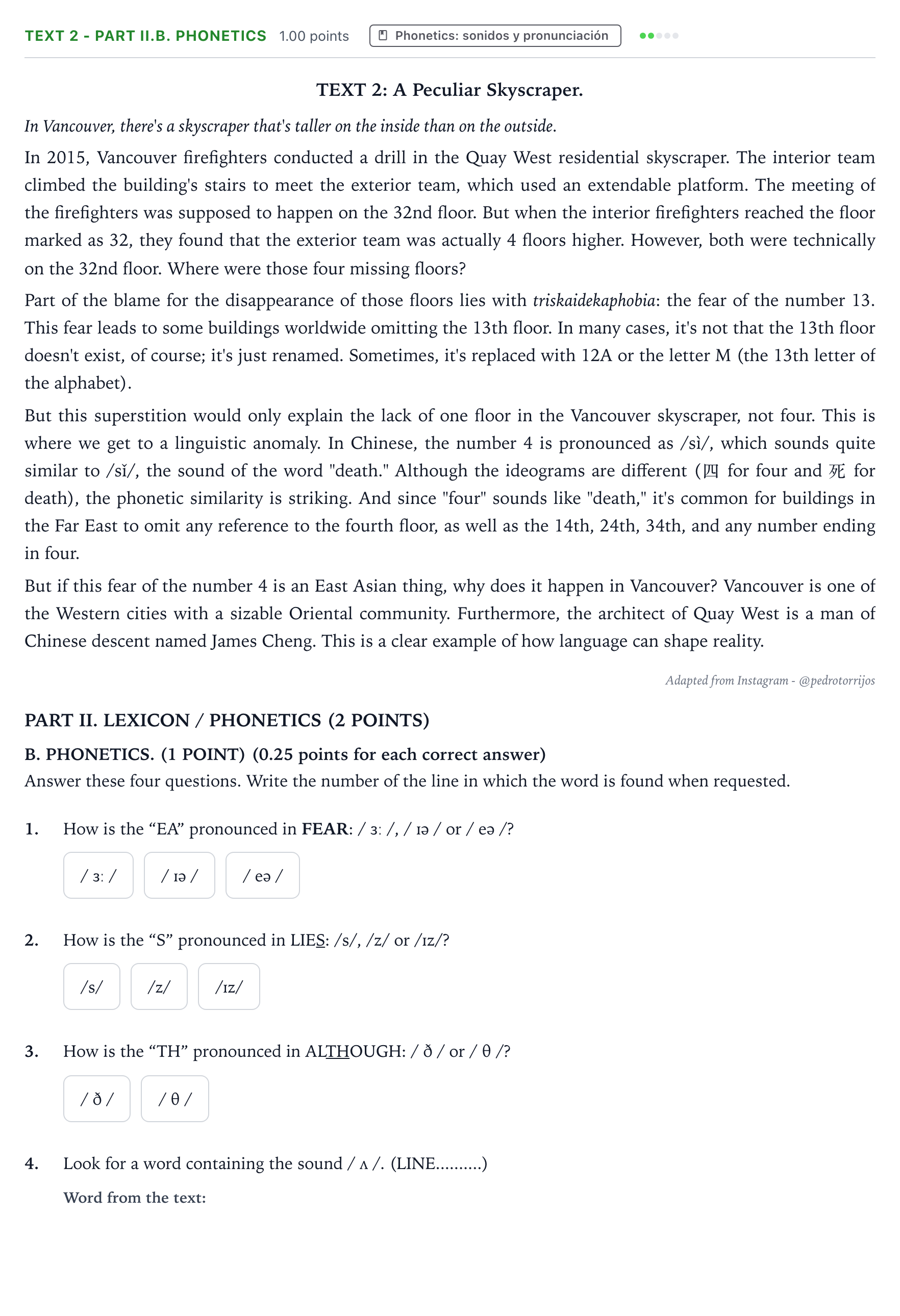
TEXT 2: A Peculiar Skyscraper.
In Vancouver, there's a skyscraper that's taller on the inside than on the outside.
In 2015, Vancouver firefighters conducted a drill in the Quay West residential skyscraper. The interior team climbed the building's stairs to meet the exterior team, which used an extendable platform. The meeting of the firefighters was supposed to happen on the 32nd floor. But when the interior firefighters reached the floor marked as 32, they found that the exterior team was actually 4 floors higher. However, both were technically on the 32nd floor. Where were those four missing floors?
Part of the blame for the disappearance of those floors lies with triskaidekaphobia: the fear of the number 13. This fear leads to some buildings worldwide omitting the 13th floor. In many cases, it's not that the 13th floor doesn't exist, of course; it's just renamed. Sometimes, it's replaced with 12A or the letter M (the 13th letter of the alphabet).
But this superstition would only explain the lack of one floor in the Vancouver skyscraper, not four. This is where we get to a linguistic anomaly. In Chinese, the number 4 is pronounced as /sì/, which sounds quite similar to /sǐ/, the sound of the word "death." Although the ideograms are different (四 for four and 死 for death), the phonetic similarity is striking. And since "four" sounds like "death," it's common for buildings in the Far East to omit any reference to the fourth floor, as well as the 14th, 24th, 34th, and any number ending in four.
But if this fear of the number 4 is an East Asian thing, why does it happen in Vancouver? Vancouver is one of the Western cities with a sizable Oriental community. Furthermore, the architect of Quay West is a man of Chinese descent named James Cheng. This is a clear example of how language can shape reality.
Adapted from Instagram - @pedrotorrijos
PART II. LEXICON / PHONETICS (2 POINTS)
B. PHONETICS. (1 POINT) (0.25 points for each correct answer)
Answer these four questions. Write the number of the line in which the word is found when requested.
1.
How is the “EA” pronounced in FEAR: / ɜː /, / ɪə / or / eə /?
2.
How is the “S” pronounced in LIE S: /s/, /z/ or /ɪz/?
3.
How is the “TH” pronounced in AL TH OUGH: / ð / or / θ /?
4.
Look for a word containing the sound / ʌ /. (LINE..........)
Solución
Según los criterios oficiales de corrección
1. How is the “EA” pronounced in FEAR: / ɜː /, / ɪə / or / eə /?
Solución: / ɪə /
2. How is the “S” pronounced in LIES: /s/, /z/ or /ɪz/?
Solución: /z/
3. How is the “TH” pronounced in ALTHOUGH: / ð / or / θ /?
Solución: / ð /
4. Look for a word containing the sound / ʌ /. (LINE..........)
Solución: CONDUCTED / BUT / NUMBER / SOME / DOESN'T / JUST / SOMETIMES / ONE / DOES
La explicación paso a paso, hecha con IA, es Premium. Premium
Resuélvelo aquí mismo: corrección automática, pistas y solución paso a paso.
‹ Ejercicio Text 1 - Part II.B. Phonetics · Ordinaria 2024 · Ejercicio Text 1 - Part II.B. Phonetics · Extraordinaria 2023 ›
Más ejercicios de Phonetics: sonidos y pronunciación
- PART II. B. PHONETICS · Extraordinaria 2025
- Part II. B - Phonetics · Ordinaria 2025
- Ejercicio Text 1 - Part II B. Phonetics · Extraordinaria 2024
- Ejercicio Text 2 - Part II B. Phonetics · Extraordinaria 2024
- Ejercicio Text 1 - Part II.B. Phonetics · Ordinaria 2024
- Ejercicio Text 1 - Part II.B. Phonetics · Extraordinaria 2023
- Ejercicio Text 2 - Part II.B. Phonetics · Extraordinaria 2023
- Ejercicio Text 1 - Part II B. Phonetics · Ordinaria 2023
- Ejercicio Text 2 - Part II B. Phonetics · Ordinaria 2023
- Ejercicio Text 1 - 2.B Phonetics · Extraordinaria 2022