Ejercicio Text 2 - 2.B Phonetics · Inglés PAU Castilla-La Mancha Extraordinaria 2022
Tema: Phonetics: sonidos y pronunciación · Del examen Extraordinaria (2022)
Enunciado
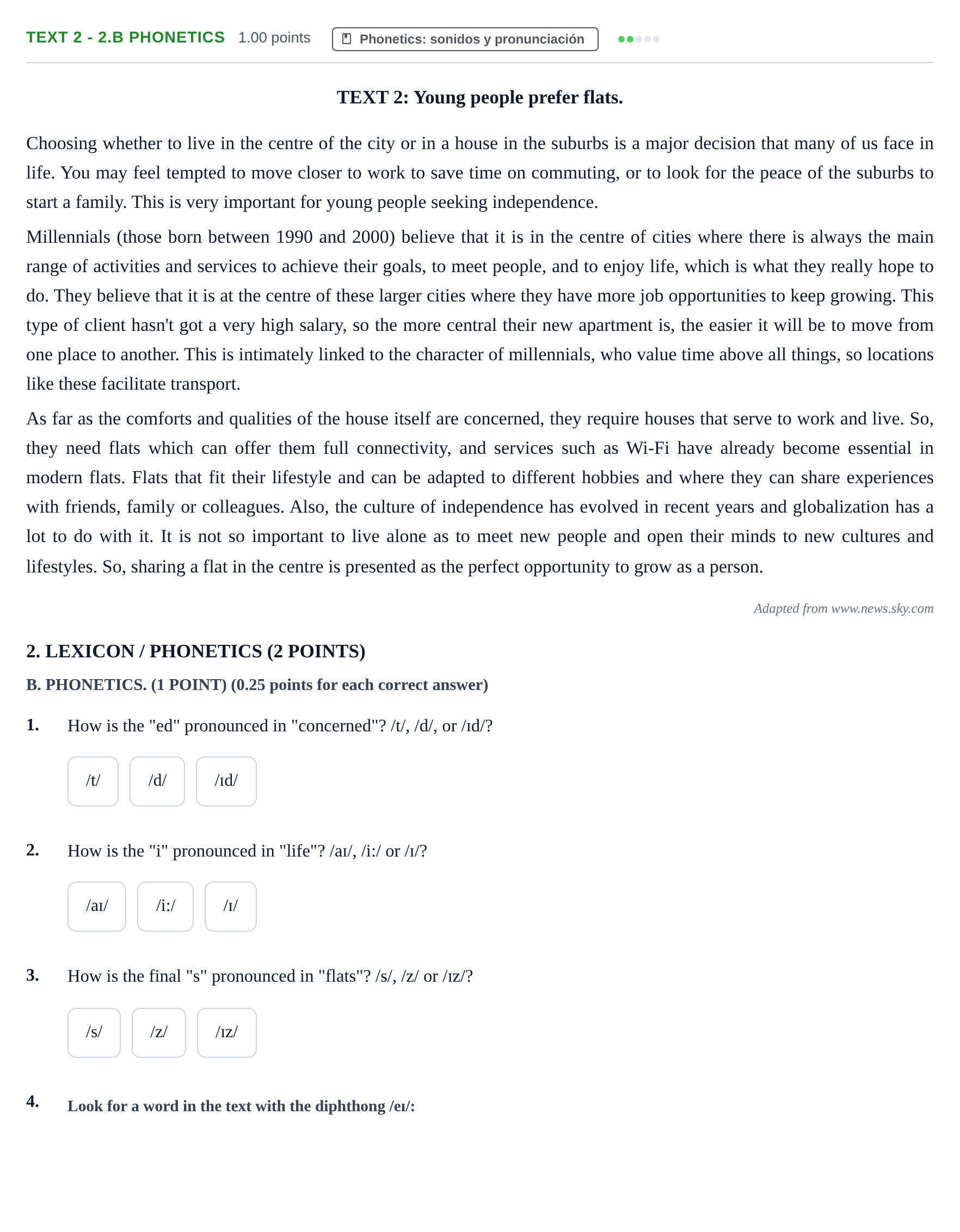
TEXT 2: Young people prefer flats.
Choosing whether to live in the centre of the city or in a house in the suburbs is a major decision that many of us face in life. You may feel tempted to move closer to work to save time on commuting, or to look for the peace of the suburbs to start a family. This is very important for young people seeking independence.
Millennials (those born between 1990 and 2000) believe that it is in the centre of cities where there is always the main range of activities and services to achieve their goals, to meet people, and to enjoy life, which is what they really hope to do. They believe that it is at the centre of these larger cities where they have more job opportunities to keep growing. This type of client hasn't got a very high salary, so the more central their new apartment is, the easier it will be to move from one place to another. This is intimately linked to the character of millennials, who value time above all things, so locations like these facilitate transport.
As far as the comforts and qualities of the house itself are concerned, they require houses that serve to work and live. So, they need flats which can offer them full connectivity, and services such as Wi-Fi have already become essential in modern flats. Flats that fit their lifestyle and can be adapted to different hobbies and where they can share experiences with friends, family or colleagues. Also, the culture of independence has evolved in recent years and globalization has a lot to do with it. It is not so important to live alone as to meet new people and open their minds to new cultures and lifestyles. So, sharing a flat in the centre is presented as the perfect opportunity to grow as a person.
Adapted from www.news.sky.com
2. LEXICON / PHONETICS (2 POINTS)
B. PHONETICS. (1 POINT) (0.25 points for each correct answer)
1.
How is the "ed" pronounced in "concerned"? /t/, /d/, or /ɪd/?
/t/
/d/
/ɪd/
2.
How is the "i" pronounced in "life"? /aɪ/, /i:/ or /ɪ/?
/aɪ/
/i:/
/ɪ/
3.
How is the final "s" pronounced in "flats"? /s/, /z/ or /ɪz/?
/s/
/z/
/ɪz/
4.
Solución
Según los criterios oficiales de corrección
1. How is the "ed" pronounced in "concerned"? /t/, /d/, or /ɪd/?
Solución: /d/
2. How is the "i" pronounced in "life"? /aɪ/, /i:/ or /ɪ/?
Solución: /aɪ/
3. How is the final "s" pronounced in "flats"? /s/, /z/ or /ɪz/?
Solución: /s/
4. Look for a word in the text with the diphthong /eɪ/:
Solución: major / save / range / places / place / facilitate / globalization
La explicación paso a paso, hecha con IA, es Premium. Premium
Resuélvelo aquí mismo: corrección automática, pistas y solución paso a paso.
‹ Ejercicio Text 1 - 2.B Phonetics · Extraordinaria 2022 · Ejercicio Text 1 - 2.B Phonetics · Ordinaria 2022 ›
Más ejercicios de Phonetics: sonidos y pronunciación
- Ejercicio Text 1 - Part II.B. Phonetics · Extraordinaria 2023
- Ejercicio Text 2 - Part II.B. Phonetics · Extraordinaria 2023
- Ejercicio Text 1 - Part II B. Phonetics · Ordinaria 2023
- Ejercicio Text 2 - Part II B. Phonetics · Ordinaria 2023
- Ejercicio Text 1 - 2.B Phonetics · Extraordinaria 2022
- Ejercicio Text 1 - 2.B Phonetics · Ordinaria 2022
- Ejercicio Text 2 - 2.B Phonetics · Ordinaria 2022
- Ejercicio Text 1 - B. Phonetics · Extraordinaria 2021
- Ejercicio Text 2 - B. Phonetics · Extraordinaria 2021
- Ejercicio Text 1 - B. Phonetics · Ordinaria (Ciencias) 2021