Part 1 - Option 1 - Question 1 · Inglés PAU Cantabria Ordinaria 2026
Tema: Verdadero o falso con justificación del texto (True/False) · Del examen Ordinaria (2026)
Enunciado
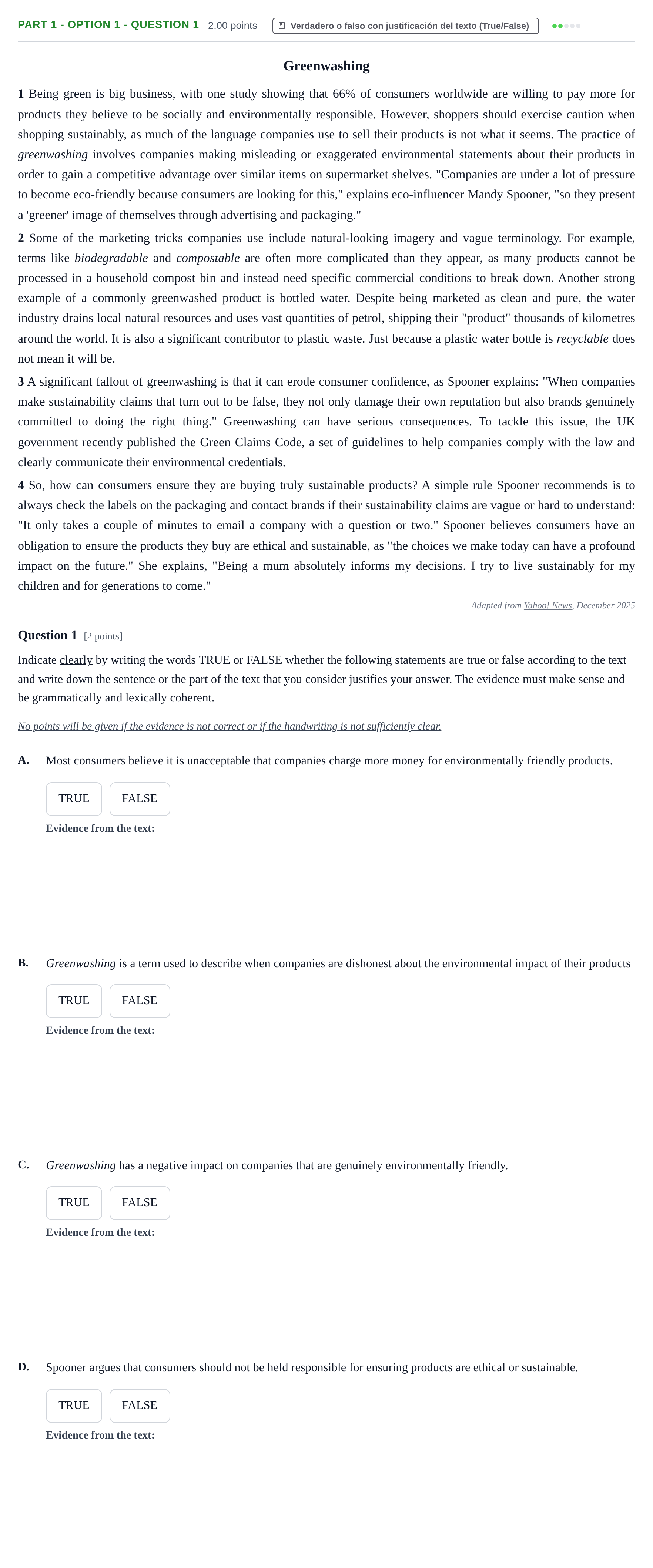
Greenwashing
1 Being green is big business, with one study showing that 66% of consumers worldwide are willing to pay more for products they believe to be socially and environmentally responsible. However, shoppers should exercise caution when shopping sustainably, as much of the language companies use to sell their products is not what it seems. The practice of greenwashing involves companies making misleading or exaggerated environmental statements about their products in order to gain a competitive advantage over similar items on supermarket shelves. "Companies are under a lot of pressure to become eco-friendly because consumers are looking for this," explains eco-influencer Mandy Spooner, "so they present a 'greener' image of themselves through advertising and packaging."
2 Some of the marketing tricks companies use include natural-looking imagery and vague terminology. For example, terms like biodegradable and compostable are often more complicated than they appear, as many products cannot be processed in a household compost bin and instead need specific commercial conditions to break down. Another strong example of a commonly greenwashed product is bottled water. Despite being marketed as clean and pure, the water industry drains local natural resources and uses vast quantities of petrol, shipping their "product" thousands of kilometres around the world. It is also a significant contributor to plastic waste. Just because a plastic water bottle is recyclable does not mean it will be.
3 A significant fallout of greenwashing is that it can erode consumer confidence, as Spooner explains: "When companies make sustainability claims that turn out to be false, they not only damage their own reputation but also brands genuinely committed to doing the right thing." Greenwashing can have serious consequences. To tackle this issue, the UK government recently published the Green Claims Code, a set of guidelines to help companies comply with the law and clearly communicate their environmental credentials.
4 So, how can consumers ensure they are buying truly sustainable products? A simple rule Spooner recommends is to always check the labels on the packaging and contact brands if their sustainability claims are vague or hard to understand: "It only takes a couple of minutes to email a company with a question or two." Spooner believes consumers have an obligation to ensure the products they buy are ethical and sustainable, as "the choices we make today can have a profound impact on the future." She explains, "Being a mum absolutely informs my decisions. I try to live sustainably for my children and for generations to come."
Adapted from Yahoo! News, December 2025
Question 1 [2 points]
Indicate clearly by writing the words TRUE or FALSE whether the following statements are true or false according to the text and write down the sentence or the part of the text that you consider justifies your answer. The evidence must make sense and be grammatically and lexically coherent.
No points will be given if the evidence is not correct or if the handwriting is not sufficiently clear.
A.
Most consumers believe it is unacceptable that companies charge more money for environmentally friendly products.
TRUE
FALSE
B.
Greenwashing is a term used to describe when companies are dishonest about the environmental impact of their products
TRUE
FALSE
C.
Greenwashing has a negative impact on companies that are genuinely environmentally friendly.
TRUE
FALSE
D.
Spooner argues that consumers should not be held responsible for ensuring products are ethical or sustainable.
TRUE
FALSE
Solución
Según los criterios oficiales de corrección
A. Most consumers believe it is unacceptable that companies charge more money for environmentally friendly products.
Solución: FALSE
Evidence A: Most consumers believe it is unacceptable that companies charge more money for environmentally friendly products.
Solución: 66% of consumers worldwide are willing to pay more for products they believe to be socially and environmentally responsible.
B. Greenwashing is a term used to describe when companies are dishonest about the environmental impact of their products
Solución: TRUE
Evidence B: Greenwashing is a term used to describe when companies are dishonest about the environmental impact of their products
Solución: greenwashing involves companies making misleading or exaggerated environmental statements about their products
C. Greenwashing has a negative impact on companies that are genuinely environmentally friendly.
Solución: TRUE
Evidence C: Greenwashing has a negative impact on companies that are genuinely environmentally friendly.
Solución: they not only damage their own reputation but also brands genuinely committed to doing the right thing.
D. Spooner argues that consumers should not be held responsible for ensuring products are ethical or sustainable.
Solución: FALSE
Evidence D: Spooner argues that consumers should not be held responsible for ensuring products are ethical or sustainable.
Solución: Spooner believes consumers have an obligation to ensure the products they buy are ethical and sustainable
La explicación paso a paso, hecha con IA, es Premium. Premium
Resuélvelo aquí mismo: corrección automática, pistas y solución paso a paso.
‹ Part 1 - Option 2 - Question 1 · Extraordinaria 2026 · Part 1 - Option 2 - Question 1 · Ordinaria 2026 ›
Más ejercicios de Verdadero o falso con justificación del texto (True/False)
- Part 1 - Option 1 - Question 1 · Extraordinaria 2026
- Part 1 - Option 2 - Question 1 · Extraordinaria 2026
- Part 1 - Option 2 - Question 1 · Ordinaria 2026
- Ejercicio Option 1 - Question 1 · Extraordinaria 2025
- Ejercicio Option 2 - Question 1 · Extraordinaria 2025
- Ejercicio Option 1 - Question 1 · Ordinaria 2025
- Ejercicio Option 2 - Question 1 · Ordinaria 2025
- Ejercicio Option 1 - Question 1 · Extraordinaria 2024
- Ejercicio Option 2 - Question 1 · Extraordinaria 2024
- Ejercicio Option 1 - Question 1 · Ordinaria 2024