Problema 3 · Inglés PAU Canarias Julio (Reserva) 2025
Tema: Vocabulary: finding words or expressions in the text · Del examen Julio (Reserva) (2025)
Enunciado
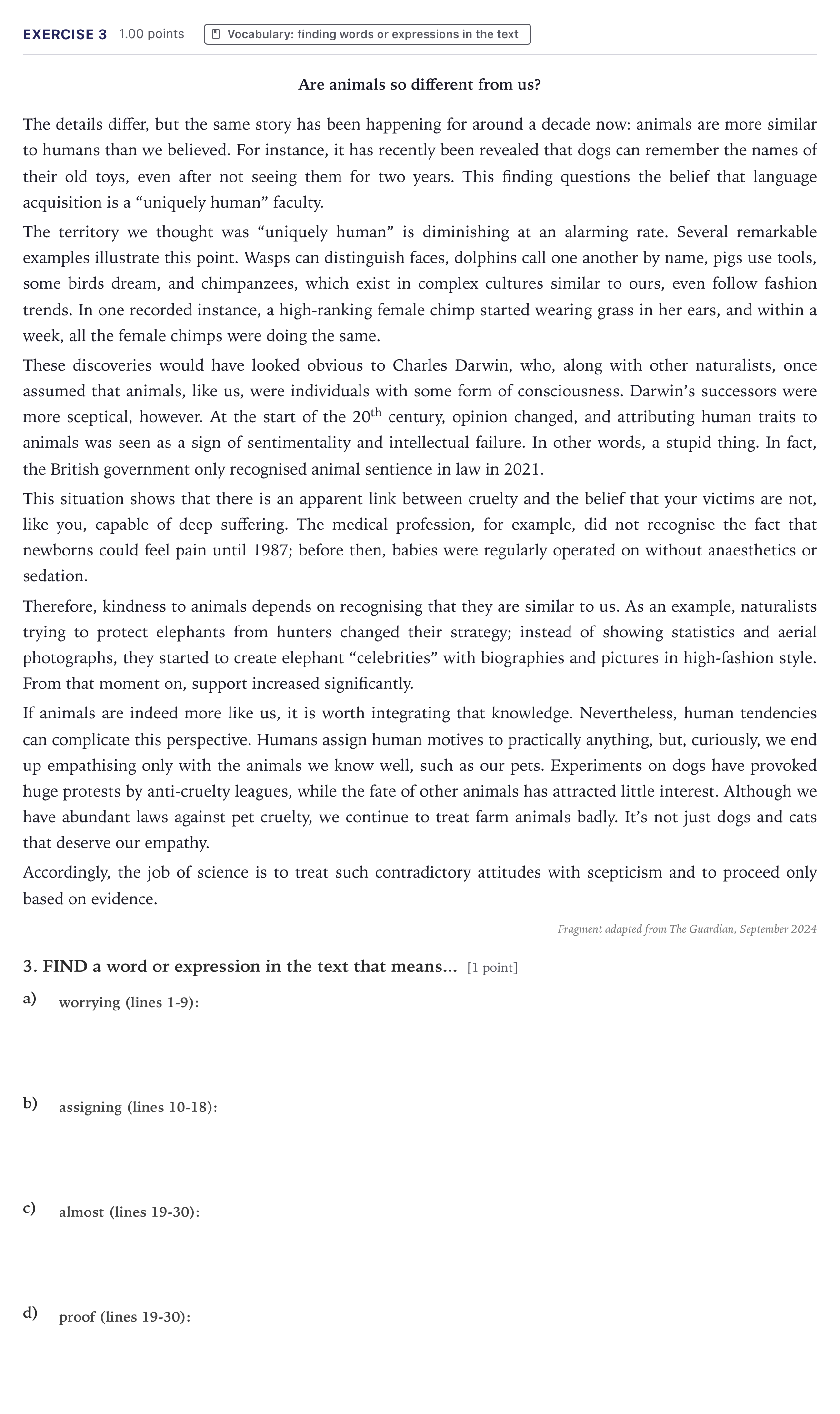
Are animals so different from us?
The details differ, but the same story has been happening for around a decade now: animals are more similar to humans than we believed. For instance, it has recently been revealed that dogs can remember the names of their old toys, even after not seeing them for two years. This finding questions the belief that language acquisition is a “uniquely human” faculty.
The territory we thought was “uniquely human” is diminishing at an alarming rate. Several remarkable examples illustrate this point. Wasps can distinguish faces, dolphins call one another by name, pigs use tools, some birds dream, and chimpanzees, which exist in complex cultures similar to ours, even follow fashion trends. In one recorded instance, a high-ranking female chimp started wearing grass in her ears, and within a week, all the female chimps were doing the same.
These discoveries would have looked obvious to Charles Darwin, who, along with other naturalists, once assumed that animals, like us, were individuals with some form of consciousness. Darwin’s successors were more sceptical, however. At the start of the 20 th century, opinion changed, and attributing human traits to animals was seen as a sign of sentimentality and intellectual failure. In other words, a stupid thing. In fact, the British government only recognised animal sentience in law in 2021.
This situation shows that there is an apparent link between cruelty and the belief that your victims are not, like you, capable of deep suffering. The medical profession, for example, did not recognise the fact that newborns could feel pain until 1987; before then, babies were regularly operated on without anaesthetics or sedation.
Therefore, kindness to animals depends on recognising that they are similar to us. As an example, naturalists trying to protect elephants from hunters changed their strategy; instead of showing statistics and aerial photographs, they started to create elephant “celebrities” with biographies and pictures in high-fashion style. From that moment on, support increased significantly.
If animals are indeed more like us, it is worth integrating that knowledge. Nevertheless, human tendencies can complicate this perspective. Humans assign human motives to practically anything, but, curiously, we end up empathising only with the animals we know well, such as our pets. Experiments on dogs have provoked huge protests by anti-cruelty leagues, while the fate of other animals has attracted little interest. Although we have abundant laws against pet cruelty, we continue to treat farm animals badly. It’s not just dogs and cats that deserve our empathy.
Accordingly, the job of science is to treat such contradictory attitudes with scepticism and to proceed only based on evidence.
Fragment adapted from The Guardian, September 2024
3. FIND a word or expression in the text that means... [1 point]
a)
b)
c)
d)
Solución
Según los criterios oficiales de corrección
a) worrying (lines 1-9)
Solución: alarming
b) assigning (lines 10-18)
Solución: attributing
c) almost (lines 19-30)
Solución: practically
d) proof (lines 19-30)
Solución: evidence
La explicación paso a paso, hecha con IA, es Premium. Premium
Resuélvelo aquí mismo: corrección automática, pistas y solución paso a paso.
‹ Problema 3 · Julio 2025 · Problema 3 · Junio (Ciencias) 2025 ›
Más ejercicios de Vocabulary: finding words or expressions in the text
- Problema 3 · Julio 2026
- Problema 3 · Julio (Reserva) 2026
- Problema 3 · Junio (Ciencias) 2026
- Problema 3 · Junio (Humanidades) 2026
- Problema 3 · Julio 2025
- Problema 3 · Junio (Ciencias) 2025
- Problema 3 · Junio (Humanidades) 2025
- Ejercicio Grupo A - 3 · Julio 2024
- Ejercicio Grupo B - 3 · Julio 2024
- Ejercicio Grupo A - 3 · Junio (Ciencias) 2024