Ejercicio (5) Grupo A - 1 · Inglés PAU Canarias Julio (2) 2023
Tema: Reading comprehension: True/False with evidence · Del examen Julio (2) (2023)
Enunciado
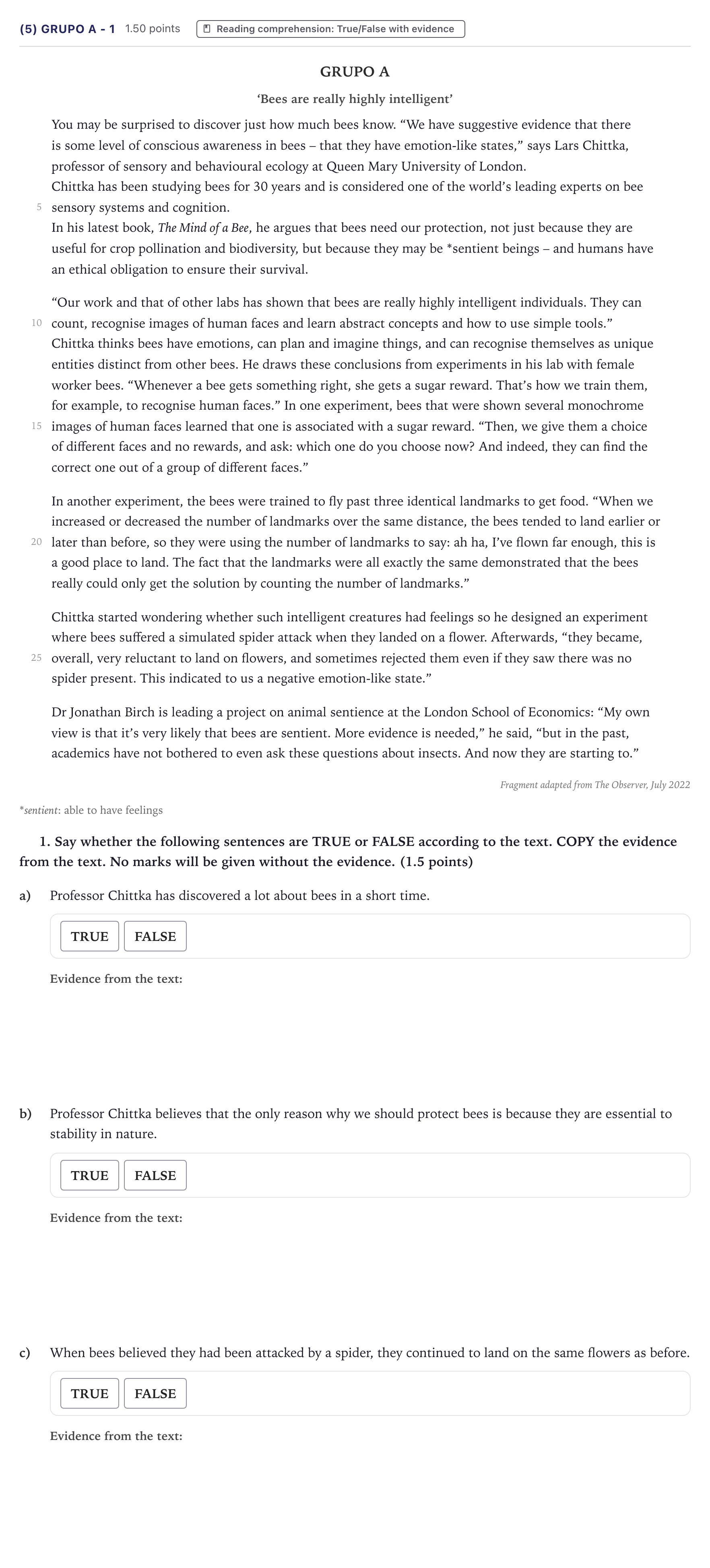
GRUPO A
‘Bees are really highly intelligent’
You may be surprised to discover just how much bees know. “We have suggestive evidence that there
is some level of conscious awareness in bees – that they have emotion-like states,” says Lars Chittka,
professor of sensory and behavioural ecology at Queen Mary University of London.
Chittka has been studying bees for 30 years and is considered one of the world’s leading experts on bee
5 sensory systems and cognition.
In his latest book, The Mind of a Bee, he argues that bees need our protection, not just because they are
useful for crop pollination and biodiversity, but because they may be *sentient beings – and humans have
an ethical obligation to ensure their survival.
“Our work and that of other labs has shown that bees are really highly intelligent individuals. They can
10 count, recognise images of human faces and learn abstract concepts and how to use simple tools.”
Chittka thinks bees have emotions, can plan and imagine things, and can recognise themselves as unique
entities distinct from other bees. He draws these conclusions from experiments in his lab with female
worker bees. “Whenever a bee gets something right, she gets a sugar reward. That’s how we train them,
for example, to recognise human faces.” In one experiment, bees that were shown several monochrome
15 images of human faces learned that one is associated with a sugar reward. “Then, we give them a choice
of different faces and no rewards, and ask: which one do you choose now? And indeed, they can find the
correct one out of a group of different faces.”
In another experiment, the bees were trained to fly past three identical landmarks to get food. “When we
increased or decreased the number of landmarks over the same distance, the bees tended to land earlier or
20 later than before, so they were using the number of landmarks to say: ah ha, I’ve flown far enough, this is
a good place to land. The fact that the landmarks were all exactly the same demonstrated that the bees
really could only get the solution by counting the number of landmarks.”
Chittka started wondering whether such intelligent creatures had feelings so he designed an experiment
where bees suffered a simulated spider attack when they landed on a flower. Afterwards, “they became,
25 overall, very reluctant to land on flowers, and sometimes rejected them even if they saw there was no
spider present. This indicated to us a negative emotion-like state.”
Dr Jonathan Birch is leading a project on animal sentience at the London School of Economics: “My own
view is that it’s very likely that bees are sentient. More evidence is needed,” he said, “but in the past,
academics have not bothered to even ask these questions about insects. And now they are starting to.”
Fragment adapted from The Observer, July 2022
* sentient: able to have feelings
1. Say whether the following sentences are TRUE or FALSE according to the text. COPY the evidence from the text. No marks will be given without the evidence. (1.5 points)
a)
Professor Chittka has discovered a lot about bees in a short time.
b)
Professor Chittka believes that the only reason why we should protect bees is because they are essential to stability in nature.
c)
When bees believed they had been attacked by a spider, they continued to land on the same flowers as before.
Solución
Según los criterios oficiales de corrección
a) Professor Chittka has discovered a lot about bees in a short time.
Solución: "Chittka has been studying bees for 30 years (and is considered one of the world's leading experts on bee sensory systems and cognition.)" (lines 4-5)
b) Professor Chittka believes that the only reason why we should protect bees is because they are essential to stability in nature.
Solución: "(In his latest book, The Mind of a Bee, he argues that) bees need our protection, not just because they are useful for crop pollination and biodiversity, but because they may be sentient beings (- and humans have an ethical obligation to ensure their survival.)" (lines 6-8)
c) When bees believed they had been attacked by a spider, they continued to land on the same flowers as before.
Solución: "(Afterwards, "they became, overall, very reluctant to land on flowers,) and sometimes rejected them even if they saw there was no spider present. This indicated to us a negative emotion-like state."" (lines 24-26)
1. Say whether the following sentences are TRUE or FALSE according to the text.
Solución: a) FALSE; b) FALSE; c) FALSE
La explicación paso a paso, hecha con IA, es Premium. Premium
Resuélvelo aquí mismo: corrección automática, pistas y solución paso a paso.
‹ Ejercicio (3) Grupo B - 1 · Julio (2) 2023 · Ejercicio (5) Grupo B - 1 · Julio (2) 2023 ›
Más ejercicios de Reading comprehension: True/False with evidence
- Ejercicio Grupo B - 1 · Junio (Humanidades) 2024
- Ejercicio Grupo A - 1 · Julio 2023
- Ejercicio Grupo B - 1 · Julio 2023
- Ejercicio (3) Grupo A - 1 · Julio (2) 2023
- Ejercicio (3) Grupo B - 1 · Julio (2) 2023
- Ejercicio (5) Grupo B - 1 · Julio (2) 2023
- Ejercicio Grupo A - 1 · Junio (Ciencias) 2023
- Ejercicio Grupo B - 1 · Junio (Ciencias) 2023
- Ejercicio Grupo A - Pregunta 1 · Junio (Humanidades) 2023
- Ejercicio Grupo B - Pregunta 1 · Junio (Humanidades) 2023