Ejercicio Grupo B - 1 · Inglés PAU Canarias Julio 2021
Tema: Reading comprehension: True/False with evidence · Del examen Julio (2021)
Enunciado
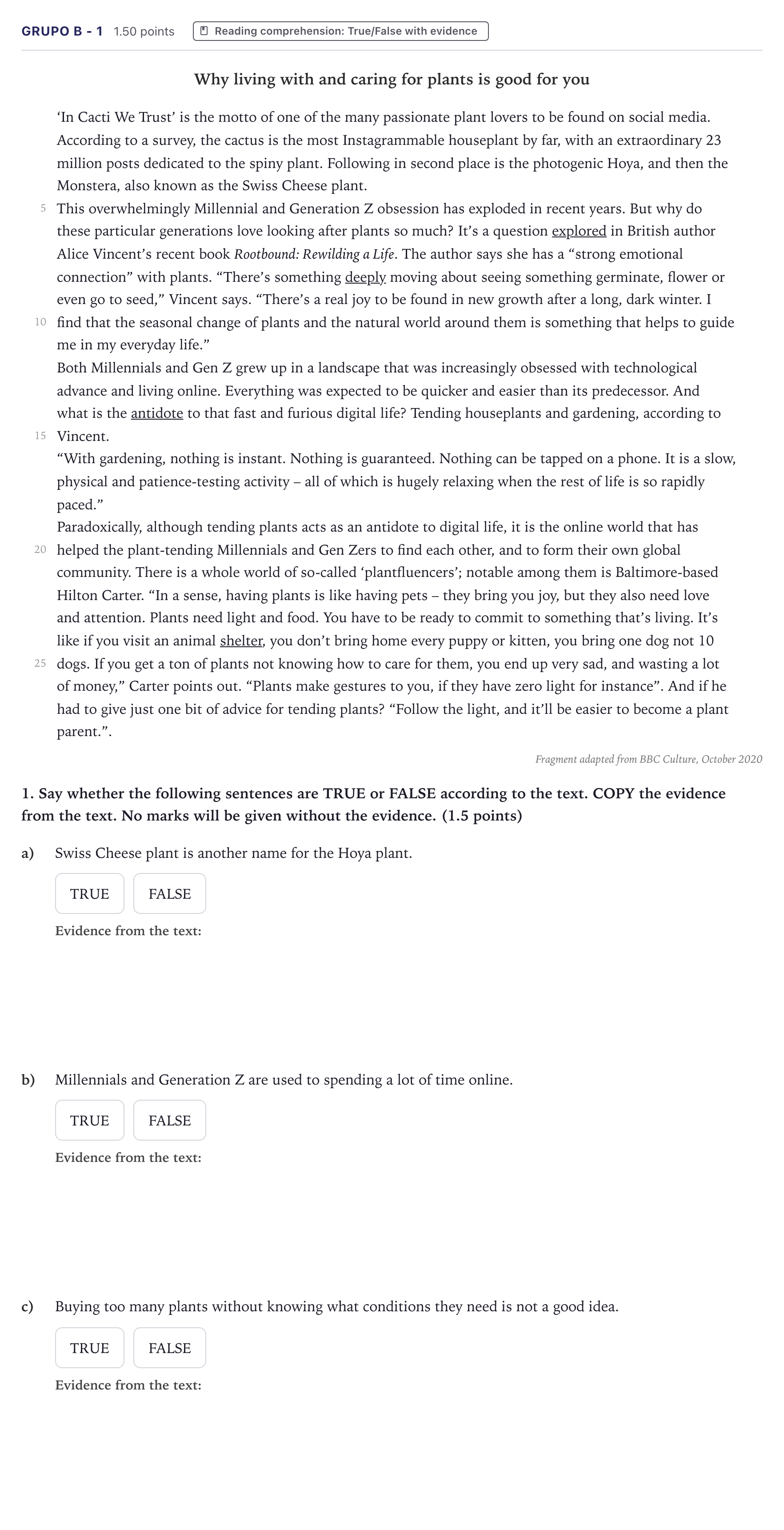
Why living with and caring for plants is good for you
‘In Cacti We Trust’ is the motto of one of the many passionate plant lovers to be found on social media.
According to a survey, the cactus is the most Instagrammable houseplant by far, with an extraordinary 23
million posts dedicated to the spiny plant. Following in second place is the photogenic Hoya, and then the
Monstera, also known as the Swiss Cheese plant.
5 This overwhelmingly Millennial and Generation Z obsession has exploded in recent years. But why do
these particular generations love looking after plants so much? It’s a question explored in British author
Alice Vincent’s recent book Rootbound: Rewilding a Life. The author says she has a “strong emotional
connection” with plants. “There’s something deeply moving about seeing something germinate, flower or
even go to seed,” Vincent says. “There’s a real joy to be found in new growth after a long, dark winter. I
10 find that the seasonal change of plants and the natural world around them is something that helps to guide
me in my everyday life.”
Both Millennials and Gen Z grew up in a landscape that was increasingly obsessed with technological
advance and living online. Everything was expected to be quicker and easier than its predecessor. And
what is the antidote to that fast and furious digital life? Tending houseplants and gardening, according to
15 Vincent.
“With gardening, nothing is instant. Nothing is guaranteed. Nothing can be tapped on a phone. It is a slow,
physical and patience-testing activity – all of which is hugely relaxing when the rest of life is so rapidly
paced.”
Paradoxically, although tending plants acts as an antidote to digital life, it is the online world that has
20 helped the plant-tending Millennials and Gen Zers to find each other, and to form their own global
community. There is a whole world of so-called ‘plantfluencers’; notable among them is Baltimore-based
Hilton Carter. “In a sense, having plants is like having pets – they bring you joy, but they also need love
and attention. Plants need light and food. You have to be ready to commit to something that’s living. It’s
like if you visit an animal shelter, you don’t bring home every puppy or kitten, you bring one dog not 10
25 dogs. If you get a ton of plants not knowing how to care for them, you end up very sad, and wasting a lot
of money,” Carter points out. “Plants make gestures to you, if they have zero light for instance”. And if he
had to give just one bit of advice for tending plants? “Follow the light, and it’ll be easier to become a plant
parent.”.
Fragment adapted from BBC Culture, October 2020
1. Say whether the following sentences are TRUE or FALSE according to the text. COPY the evidence from the text. No marks will be given without the evidence. (1.5 points)
a)
Swiss Cheese plant is another name for the Hoya plant.
TRUE
FALSE
b)
Millennials and Generation Z are used to spending a lot of time online.
TRUE
FALSE
c)
Buying too many plants without knowing what conditions they need is not a good idea.
TRUE
FALSE
Solución
Según los criterios oficiales de corrección
a) Swiss Cheese plant is another name for the Hoya plant. [TRUE / FALSE]
Solución: FALSE
a) Evidence from the text
Solución: "...and then the Monstera, also known as the Swiss Cheese plant." (lines 3-4)
b) Millennials and Generation Z are used to spending a lot of time online. [TRUE / FALSE]
Solución: TRUE
b) Evidence from the text
Solución: "Both Millennials and Gen Z grew up in a landscape that was increasingly obsessed with technological advance and living online." (lines 11-12)
c) Buying too many plants without knowing what conditions they need is not a good idea. [TRUE / FALSE]
Solución: TRUE
c) Evidence from the text
Solución: "If you get a ton of plants not knowing how to care for them, you end up very sad, and wasting a lot of money..." (lines 25-26)
La explicación paso a paso, hecha con IA, es Premium. Premium
Resuélvelo aquí mismo: corrección automática, pistas y solución paso a paso.
‹ Ejercicio Grupo A - 1 · Julio 2021 · Ejercicio Grupo A - 1 · Junio (Ciencias) 2021 ›
Más ejercicios de Reading comprehension: True/False with evidence
- Ejercicio Grupo A - 1 · Junio (Ciencias) 2022
- Ejercicio Grupo B - 1 · Junio (Ciencias) 2022
- Ejercicio Grupo A - 1 · Junio (Humanidades) 2022
- Ejercicio Grupo B - 1 · Junio (Humanidades) 2022
- Ejercicio Grupo A - 1 · Julio 2021
- Ejercicio Grupo A - 1 · Junio (Ciencias) 2021
- Ejercicio Grupo B - 1 · Junio (Ciencias) 2021
- Ejercicio Grupo A - 1 · Junio (Humanidades) 2021
- Ejercicio Grupo B - 1 · Junio (Humanidades) 2021