Ejercicio (3) Grupo B - 2 · Inglés PAU Canarias Julio (2) 2023
Tema: Reading comprehension: short questions answered by quoting the text · Del examen Julio (2) (2023)
Enunciado
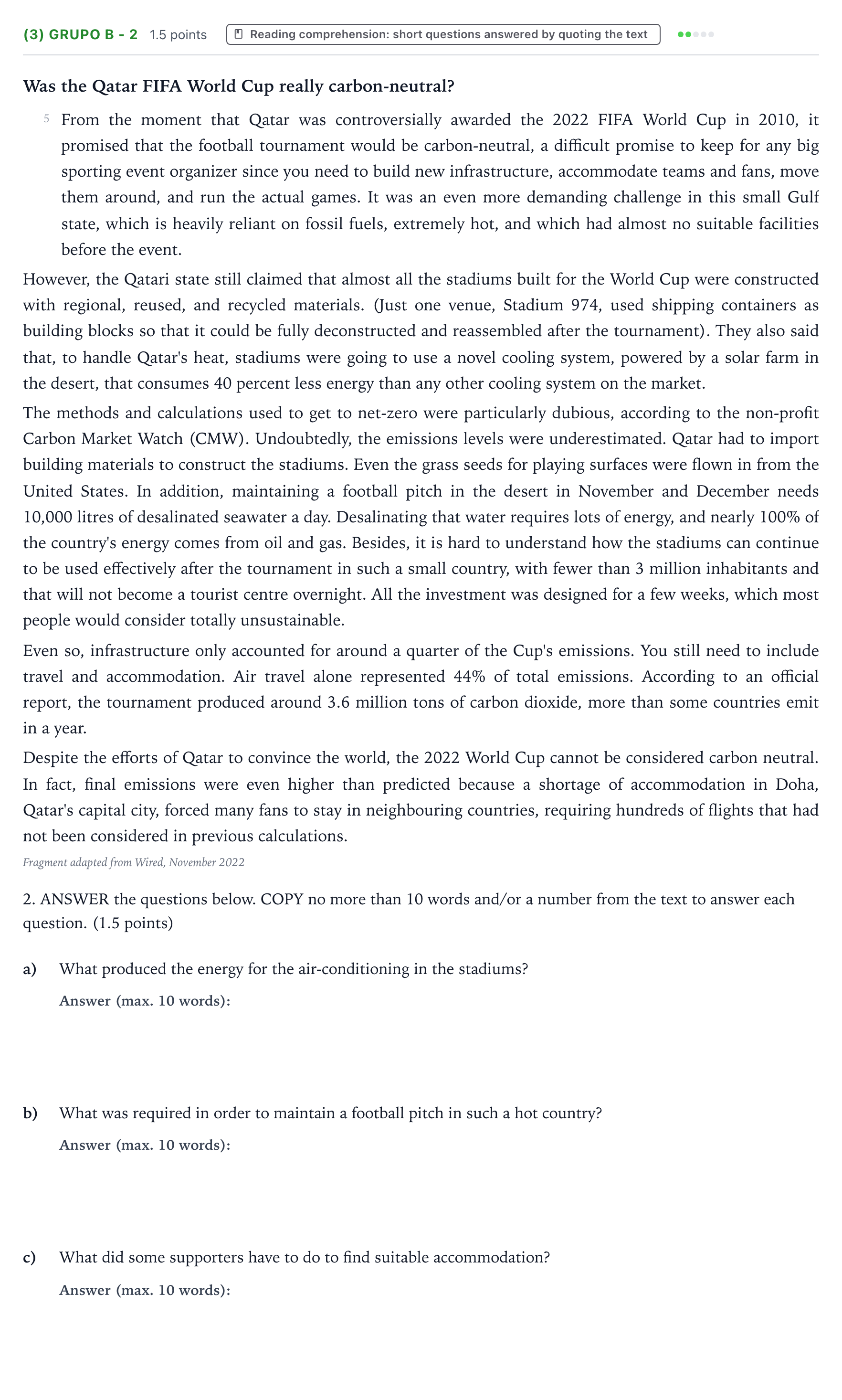
Was the Qatar FIFA World Cup really carbon-neutral?
From the moment that Qatar was controversially awarded the 2022 FIFA World Cup in 2010, it promised that the football tournament would be carbon-neutral, a difficult promise to keep for any big sporting event organizer since you need to build new infrastructure, accommodate teams and fans, move them around, and run the actual games. 5 It was an even more demanding challenge in this small Gulf state, which is heavily reliant on fossil fuels, extremely hot, and which had almost no suitable facilities before the event.
However, the Qatari state still claimed that almost all the stadiums built for the World Cup were constructed with regional, reused, and recycled materials. (Just one venue, Stadium 974, used shipping containers as building blocks so that it could be fully deconstructed and reassembled after the tournament). They also said that, to handle Qatar's heat, stadiums were going to use a novel cooling system, powered by a solar farm in 10 the desert, that consumes 40 percent less energy than any other cooling system on the market.
The methods and calculations used to get to net-zero were particularly dubious, according to the non-profit Carbon Market Watch (CMW). Undoubtedly, the emissions levels were underestimated. Qatar had to import building materials to construct the stadiums. Even the grass seeds for playing surfaces were flown in from the United States. In addition, maintaining a football pitch in the desert in November and December needs 15 10,000 litres of desalinated seawater a day. Desalinating that water requires lots of energy, and nearly 100% of the country's energy comes from oil and gas. Besides, it is hard to understand how the stadiums can continue to be used effectively after the tournament in such a small country, with fewer than 3 million inhabitants and that will not become a tourist centre overnight. All the investment was designed for a few weeks, which most people would consider totally unsustainable.
20 Even so, infrastructure only accounted for around a quarter of the Cup's emissions. You still need to include travel and accommodation. Air travel alone represented 44% of total emissions. According to an official report, the tournament produced around 3.6 million tons of carbon dioxide, more than some countries emit in a year.
Despite the efforts of Qatar to convince the world, the 2022 World Cup cannot be considered carbon neutral. 25 In fact, final emissions were even higher than predicted because a shortage of accommodation in Doha, Qatar's capital city, forced many fans to stay in neighbouring countries, requiring hundreds of flights that had not been considered in previous calculations.
Fragment adapted from Wired, November 2022
2. ANSWER the questions below. COPY no more than 10 words and/or a number from the text to answer each question. (1.5 points)
a)
What produced the energy for the air-conditioning in the stadiums?
b)
What was required in order to maintain a football pitch in such a hot country?
c)
What did some supporters have to do to find suitable accommodation?
Solución
Solución de AprenAI (no es la oficial)
a) What produced the energy for the air-conditioning in the stadiums?
Solución: (powered by) a solar farm in the desert
b) What was required in order to maintain a football pitch in such a hot country?
Solución: 10,000 litres of desalinated seawater a day
La solución del apartado que falta y la explicación paso a paso son Premium. Premium
Resuélvelo aquí mismo: corrección automática, pistas y solución paso a paso.
‹ Ejercicio (3) Grupo A - 2 · Julio (2) 2023 · Ejercicio (5) Grupo A - 2 · Julio (2) 2023 ›
Más ejercicios de Reading comprehension: short questions answered by quoting the text
- Ejercicio Grupo A - 2 · Junio (Humanidades) 2024
- Ejercicio Grupo B - 2 · Junio (Humanidades) 2024
- Ejercicio Grupo A - 2 · Julio 2023
- Ejercicio Grupo B - 2 · Julio 2023
- Ejercicio (3) Grupo A - 2 · Julio (2) 2023
- Ejercicio (5) Grupo A - 2 · Julio (2) 2023
- Ejercicio (5) Grupo B - 2 · Julio (2) 2023
- Ejercicio Grupo A - 2 · Junio (Ciencias) 2023
- Ejercicio Grupo B - 2 · Junio (Ciencias) 2023
- Ejercicio Grupo A - Pregunta 2 · Junio (Humanidades) 2023