Ejercicio Opció B - 2 · Inglés PAU Baleares Extraordinaria 2022
Tema: Preguntas abiertas con tus propias palabras (Comprehension questions) · Del examen Extraordinaria (2022)
Enunciado
OPCIÓ B
Read the passage carefully and answer the questions in English. USE YOUR OWN WORDS AS FAR AS POSSIBLE.
Why a texted ‘yup’ feels so negative
“Thank you, great job”. Seeing this simple phrase in an email should make me happy – yet, without the warmth of an exclamation point, I feel a twinge of panic, even sadness. I understand different work and social cultures have different communication norms, yet part of my brain is working double-time to understand the meaning of that great job, minus punctuation. Did I do something wrong to deserve a frigid response? Was it frigid at all? Of course, I am not alone in applying microscopic scrutiny to words or phrases and their punctuation over email and chat. The way we use written language changes constantly. Not every phrase is loaded, yet we tend to be shocked when certain short words and phrases show up in our inbox or chat windows, unpunctuated: “sure”, “OK”, “fine”, “yup”, “no prob”, “gotcha”, or even “yes”, “no”, “thank you”, and “sorry”. What is it about these short, common words and phrases that lend themselves to such varied interpretation when written?
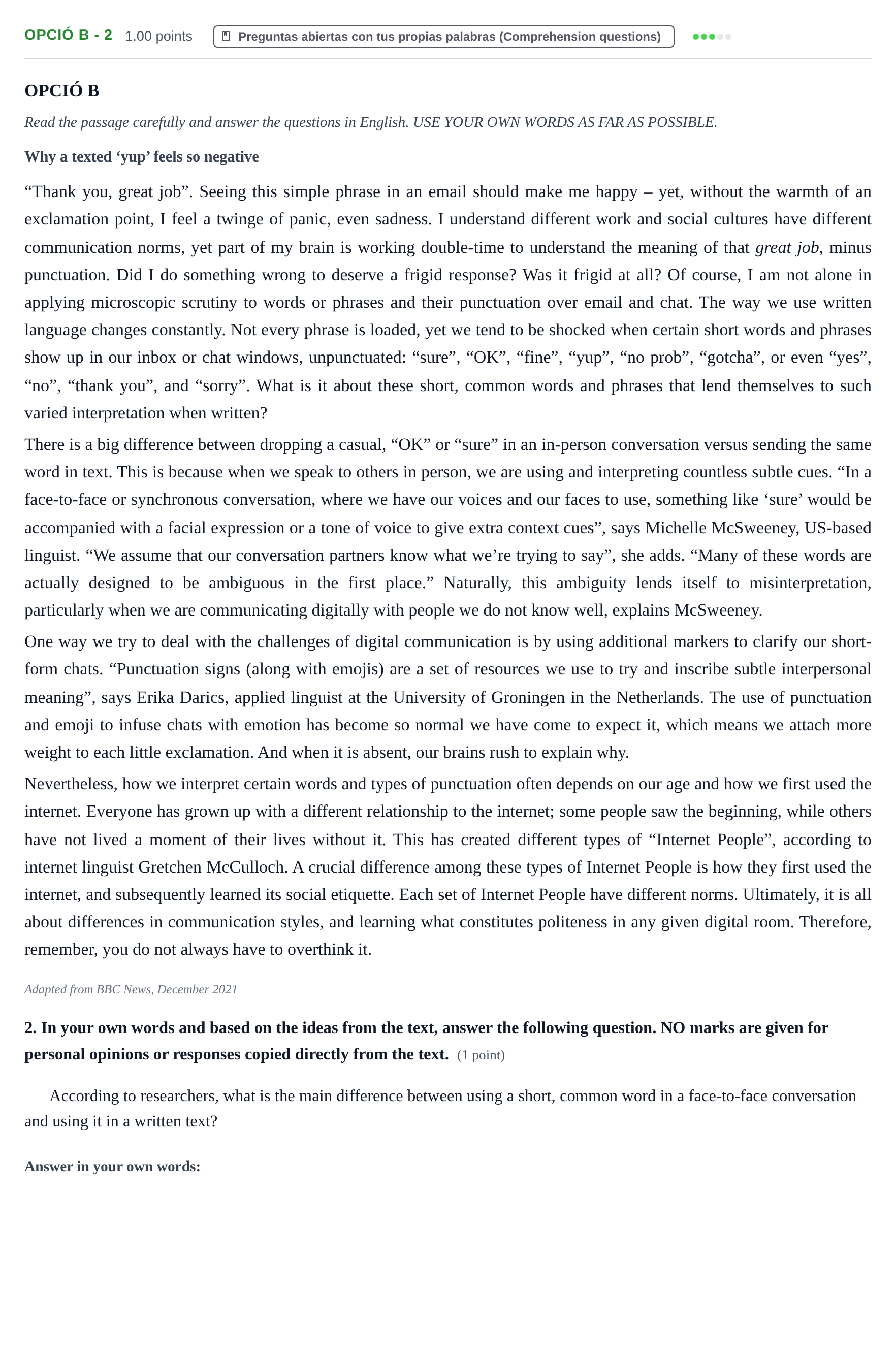
There is a big difference between dropping a casual, “OK” or “sure” in an in-person conversation versus sending the same word in text. This is because when we speak to others in person, we are using and interpreting countless subtle cues. “In a face-to-face or synchronous conversation, where we have our voices and our faces to use, something like ‘sure’ would be accompanied with a facial expression or a tone of voice to give extra context cues”, says Michelle McSweeney, US-based linguist. “We assume that our conversation partners know what we’re trying to say”, she adds. “Many of these words are actually designed to be ambiguous in the first place.” Naturally, this ambiguity lends itself to misinterpretation, particularly when we are communicating digitally with people we do not know well, explains McSweeney.
One way we try to deal with the challenges of digital communication is by using additional markers to clarify our short-form chats. “Punctuation signs (along with emojis) are a set of resources we use to try and inscribe subtle interpersonal meaning”, says Erika Darics, applied linguist at the University of Groningen in the Netherlands. The use of punctuation and emoji to infuse chats with emotion has become so normal we have come to expect it, which means we attach more weight to each little exclamation. And when it is absent, our brains rush to explain why.
Nevertheless, how we interpret certain words and types of punctuation often depends on our age and how we first used the internet. Everyone has grown up with a different relationship to the internet; some people saw the beginning, while others have not lived a moment of their lives without it. This has created different types of “Internet People”, according to internet linguist Gretchen McCulloch. A crucial difference among these types of Internet People is how they first used the internet, and subsequently learned its social etiquette. Each set of Internet People have different norms. Ultimately, it is all about differences in communication styles, and learning what constitutes politeness in any given digital room. Therefore, remember, you do not always have to overthink it.
Adapted from BBC News, December 2021
2. In your own words and based on the ideas from the text, answer the following question. NO marks are given for personal opinions or responses copied directly from the text. (1 point)
According to researchers, what is the main difference between using a short, common word in a face-to-face conversation and using it in a written text?
Solución
Según los criterios oficiales de corrección
According to researchers, what is the main difference between using a short, common word in a face-to-face conversation and using it in a written text?
Solución: In an in-person conversation, we use and interpret countless subtle cues such as facial expressions or tone of voice to convey extra meaning, which are absent in written texts.
La explicación paso a paso, hecha con IA, es Premium. Premium
Resuélvelo aquí mismo: corrección automática, pistas y solución paso a paso.
‹ Ejercicio Opció A - 2 · Extraordinaria 2022 · Ejercicio Opció A - 2 · Ordinaria 2022 ›
Más ejercicios de Preguntas abiertas con tus propias palabras (Comprehension questions)
- Ejercicio Opció A - 2 · Extraordinaria 2023
- Ejercicio Opció B - 2 · Extraordinaria 2023
- Ejercicio Opció A - 2 · Ordinaria 2023
- Ejercicio Opció B - 2 · Ordinaria 2023
- Ejercicio Opció A - 2 · Extraordinaria 2022
- Ejercicio Opció A - 2 · Ordinaria 2022
- Ejercicio Opció B - 2 · Ordinaria 2022
- Ejercicio Opció A - 2 · Extraordinaria 2021
- Ejercicio Opció B - 2 · Extraordinaria 2021
- Ejercicio Opció A - 2 · Ordinaria 2021