Ejercicio Texto A - Pregunta 5 · Inglés PAU Asturias Ordinaria (2ª lengua extranjera) 2022
Tema: Texto con huecos: una palabra por hueco (Fill the gaps) · Del examen Ordinaria (2ª lengua extranjera) (2022)
Enunciado
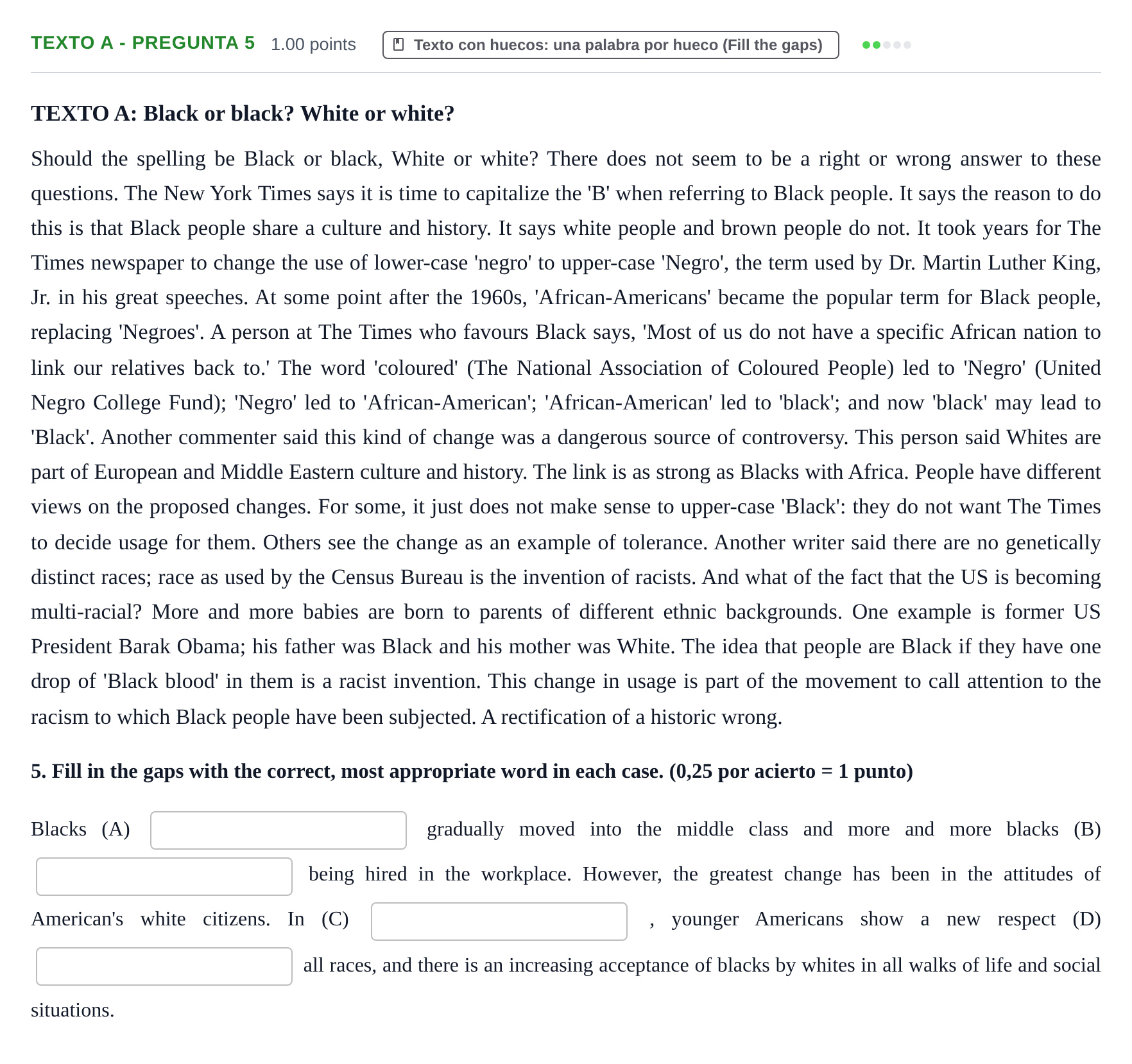
TEXTO A: Black or black? White or white?
Should the spelling be Black or black, White or white? There does not seem to be a right or wrong answer to these questions. The New York Times says it is time to capitalize the 'B' when referring to Black people. It says the reason to do this is that Black people share a culture and history. It says white people and brown people do not. It took years for The Times newspaper to change the use of lower-case 'negro' to upper-case 'Negro', the term used by Dr. Martin Luther King, Jr. in his great speeches. At some point after the 1960s, 'African-Americans' became the popular term for Black people, replacing 'Negroes'. A person at The Times who favours Black says, 'Most of us do not have a specific African nation to link our relatives back to.' The word 'coloured' (The National Association of Coloured People) led to 'Negro' (United Negro College Fund); 'Negro' led to 'African-American'; 'African-American' led to 'black'; and now 'black' may lead to 'Black'. Another commenter said this kind of change was a dangerous source of controversy. This person said Whites are part of European and Middle Eastern culture and history. The link is as strong as Blacks with Africa. People have different views on the proposed changes. For some, it just does not make sense to upper-case 'Black': they do not want The Times to decide usage for them. Others see the change as an example of tolerance. Another writer said there are no genetically distinct races; race as used by the Census Bureau is the invention of racists. And what of the fact that the US is becoming multi-racial? More and more babies are born to parents of different ethnic backgrounds. One example is former US President Barak Obama; his father was Black and his mother was White. The idea that people are Black if they have one drop of 'Black blood' in them is a racist invention. This change in usage is part of the movement to call attention to the racism to which Black people have been subjected. A rectification of a historic wrong.
5. Fill in the gaps with the correct, most appropriate word in each case. (0,25 por acierto = 1 punto)
Blacks (A) gradually moved into the middle class and more and more blacks (B) being hired in the workplace. However, the greatest change has been in the attitudes of American's white citizens. In (C), younger Americans show a new respect (D) all races, and there is an increasing acceptance of blacks by whites in all walks of life and social situations.
Solución
Según los criterios oficiales de corrección
Gap (A)
Solución: have
Gap (B)
Solución: are
Gap (C)
Solución: particular
Gap (D)
Solución: for
La explicación paso a paso, hecha con IA, es Premium. Premium
Resuélvelo aquí mismo: corrección automática, pistas y solución paso a paso.
‹ Ejercicio Texto B - 5 · Ordinaria 2022 · Ejercicio Texto B - Pregunta 5 · Ordinaria (2ª lengua extranjera) 2022 ›
Más ejercicios de Texto con huecos: una palabra por hueco (Fill the gaps)
- Ejercicio Texto B - 5 · Extraordinaria 2022
- Ejercicio TEXTO A - 5 · Extraordinaria (2ª lengua extranjera) 2022
- Ejercicio TEXTO B - 5 · Extraordinaria (2ª lengua extranjera) 2022
- Ejercicio Texto A - 5 · Ordinaria 2022
- Ejercicio Texto B - 5 · Ordinaria 2022
- Ejercicio Texto B - Pregunta 5 · Ordinaria (2ª lengua extranjera) 2022
- Ejercicio Texto A - Pregunta 5 · Extraordinaria 2021
- Ejercicio Texto B - Pregunta 5 · Extraordinaria 2021
- Ejercicio Texto A - Pregunta 5 · Extraordinaria (2ª lengua extranjera) 2021
- Ejercicio Texto B - Pregunta 5 · Extraordinaria (2ª lengua extranjera) 2021