Pregunta 5A · Química PAU Aragón Ordinaria 2025
Tema: Electroquímica: potenciales estándar, espontaneidad y pilas · Del examen Ordinaria (2025)
Enunciado
PREGUNTA 5. (2 puntos)
Responda solo a uno de estos dos apartados (5A o 5B):
5A)
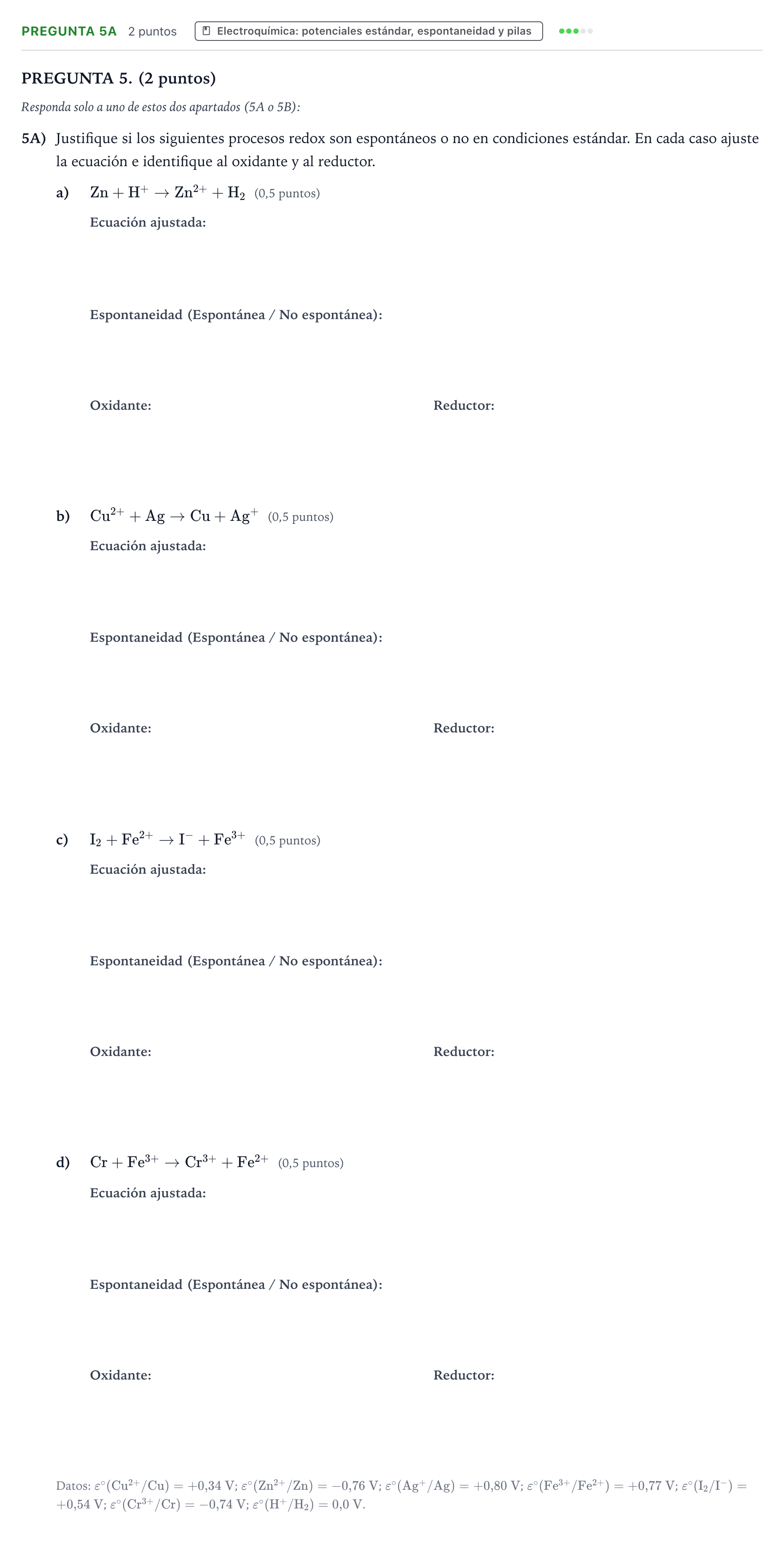
Justifique si los siguientes procesos redox son espontáneos o no en condiciones estándar. En cada caso ajuste la ecuación e identifique al oxidante y al reductor.
a)
(0,5 puntos)
b)
(0,5 puntos)
c)
(0,5 puntos)
d)
(0,5 puntos)
Datos: ; ; ; ; ; ; .
Solución
Según los criterios oficiales de corrección
5A) a) Ecuación ajustada: Zn + H+ -> Zn2+ + H2
Solución:
5A) a) Espontaneidad de la reacción
Solución: Espontánea
5A) a) Oxidante
Solución:
5A) a) Reductor
Solución:
5A) b) Ecuación ajustada: Cu2+ + Ag -> Cu + Ag+
Solución:
5A) b) Espontaneidad de la reacción
Solución: No espontánea
5A) b) Oxidante
Solución:
5A) b) Reductor
Solución:
5A) c) Ecuación ajustada: I2 + Fe2+ -> I- + Fe3+
Solución:
5A) c) Espontaneidad de la reacción
Solución: No espontánea
5A) c) Oxidante
Solución:
5A) c) Reductor
Solución:
5A) d) Ecuación ajustada: Cr + Fe3+ -> Cr3+ + Fe2+
Solución:
5A) d) Espontaneidad de la reacción
Solución: Espontánea
5A) d) Oxidante
Solución:
5A) d) Reductor
Solución:
La explicación paso a paso, hecha con IA, es Premium. Premium
Resuélvelo aquí mismo: corrección automática, pistas y solución paso a paso.
‹ Pregunta 1 · Extraordinaria 2026 · Problema 6 · Extraordinaria 2024 ›
Más ejercicios de Electroquímica: potenciales estándar, espontaneidad y pilas
- Pregunta 1 · Extraordinaria 2026
- Problema 6 · Extraordinaria 2024
- Ejercicio 2 a) - Electroquímica · Ordinaria 2024
- Ejercicio 1 b) - Electroquímica · Extraordinaria 2023
- Problema 1 · Ordinaria 2023
- Ejercicio 5 - Electroquímica · Extraordinaria 2022
- Problema 6 · Ordinaria 2022
- Problema 8 · Extraordinaria 2021
- Problema 5 · Ordinaria 2021