Ejercicio 1.1 · Inglés PAU Aragón Extraordinaria 2026
Tema: Verdadero o falso con justificación textual (True/False) · Del examen Extraordinaria (2026)
Enunciado
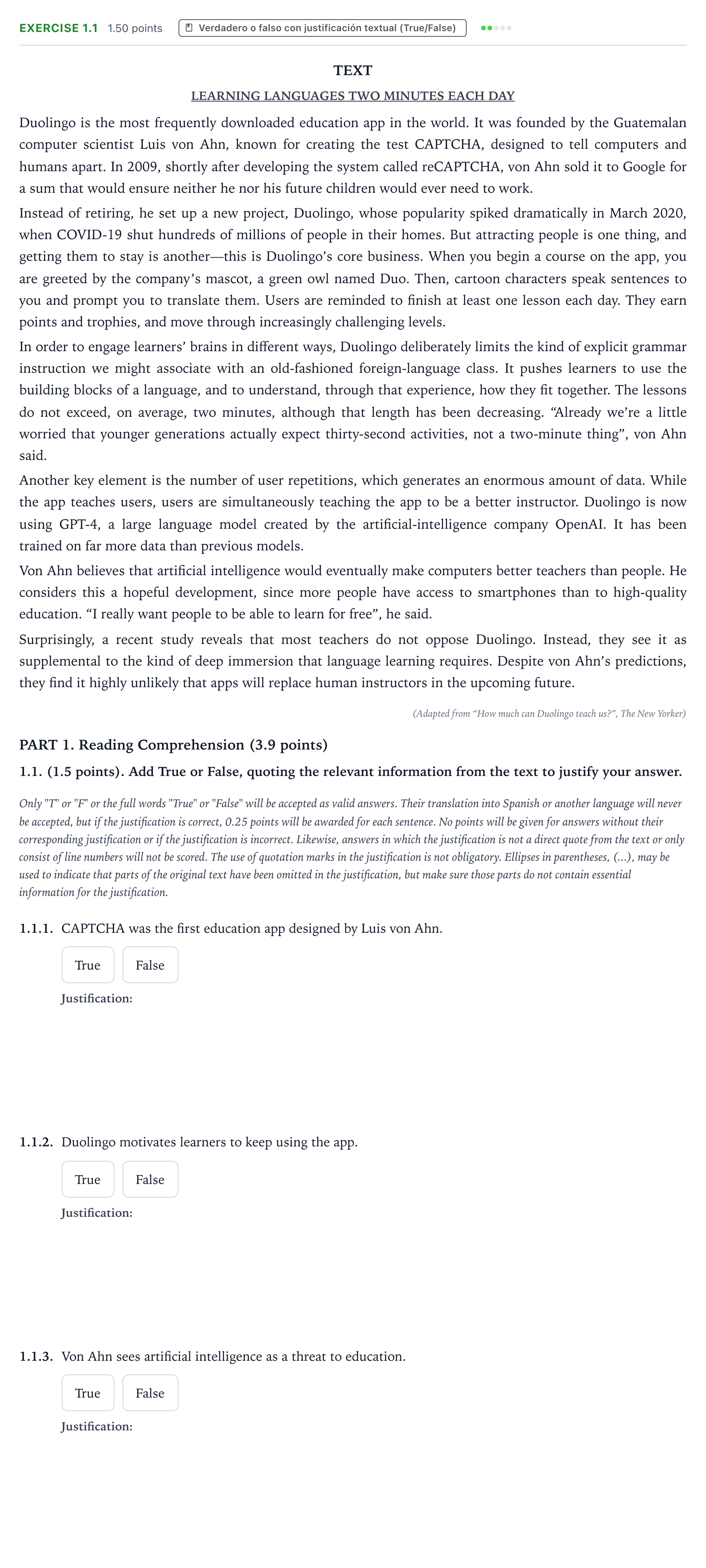
TEXT
LEARNING LANGUAGES TWO MINUTES EACH DAY
Duolingo is the most frequently downloaded education app in the world. It was founded by the Guatemalan computer scientist Luis von Ahn, known for creating the test CAPTCHA, designed to tell computers and humans apart. In 2009, shortly after developing the system called reCAPTCHA, von Ahn sold it to Google for a sum that would ensure neither he nor his future children would ever need to work.
Instead of retiring, he set up a new project, Duolingo, whose popularity spiked dramatically in March 2020, when COVID-19 shut hundreds of millions of people in their homes. But attracting people is one thing, and getting them to stay is another—this is Duolingo’s core business. When you begin a course on the app, you are greeted by the company’s mascot, a green owl named Duo. Then, cartoon characters speak sentences to you and prompt you to translate them. Users are reminded to finish at least one lesson each day. They earn points and trophies, and move through increasingly challenging levels.
In order to engage learners’ brains in different ways, Duolingo deliberately limits the kind of explicit grammar instruction we might associate with an old-fashioned foreign-language class. It pushes learners to use the building blocks of a language, and to understand, through that experience, how they fit together. The lessons do not exceed, on average, two minutes, although that length has been decreasing. “Already we’re a little worried that younger generations actually expect thirty-second activities, not a two-minute thing”, von Ahn said.
Another key element is the number of user repetitions, which generates an enormous amount of data. While the app teaches users, users are simultaneously teaching the app to be a better instructor. Duolingo is now using GPT-4, a large language model created by the artificial-intelligence company OpenAI. It has been trained on far more data than previous models.
Von Ahn believes that artificial intelligence would eventually make computers better teachers than people. He considers this a hopeful development, since more people have access to smartphones than to high-quality education. “I really want people to be able to learn for free”, he said.
Surprisingly, a recent study reveals that most teachers do not oppose Duolingo. Instead, they see it as supplemental to the kind of deep immersion that language learning requires. Despite von Ahn’s predictions, they find it highly unlikely that apps will replace human instructors in the upcoming future.
(Adapted from “How much can Duolingo teach us?”, The New Yorker)
PART 1. Reading Comprehension (3.9 points)
1.1. (1.5 points). Add True or False, quoting the relevant information from the text to justify your answer.
Only "T" or "F" or the full words "True" or "False" will be accepted as valid answers. Their translation into Spanish or another language will never be accepted, but if the justification is correct, 0.25 points will be awarded for each sentence. No points will be given for answers without their corresponding justification or if the justification is incorrect. Likewise, answers in which the justification is not a direct quote from the text or only consist of line numbers will not be scored. The use of quotation marks in the justification is not obligatory. Ellipses in parentheses, (...), may be used to indicate that parts of the original text have been omitted in the justification, but make sure those parts do not contain essential information for the justification.
1.1.1.
CAPTCHA was the first education app designed by Luis von Ahn.
True
False
1.1.2.
Duolingo motivates learners to keep using the app.
True
False
1.1.3.
Von Ahn sees artificial intelligence as a threat to education.
True
False
Solución
Según los criterios oficiales de corrección
1.1. Add True or False (1.1.1, 1.1.2, 1.1.3)
Solución: 1.1.1: False; 1.1.2: True; 1.1.3: False
1.1.1. CAPTCHA was the first education app designed by Luis von Ahn. (Justification)
Solución: "the test CAPTCHA, designed to tell computers and humans apart"
1.1.2. Duolingo motivates learners to keep using the app. (Justification)
Solución: "Users are reminded to finish at least one lesson each day. They earn points and trophies"
1.1.3. Von Ahn sees artificial intelligence as a threat to education. (Justification)
Solución: "Von Ahn believes that artificial intelligence would eventually make computers better teachers than people. He considers this a hopeful development" / "He considers this a positive development"
La explicación paso a paso, hecha con IA, es Premium. Premium
Resuélvelo aquí mismo: corrección automática, pistas y solución paso a paso.
Ejercicio 1.1 · Ordinaria 2026 ›
Más ejercicios de Verdadero o falso con justificación textual (True/False)
- Ejercicio 1.1 · Ordinaria 2026
- Problema 1 · Extraordinaria 2025
- Problema 1 · Ordinaria 2025
- Ejercicio Exercise A.1 · Extraordinaria 2024
- Ejercicio Exercise B.1 · Extraordinaria 2024
- Ejercicio Option A - Exercise A.1 · Ordinaria 2024
- Ejercicio Option B - Exercise B.1 · Ordinaria 2024
- Ejercicio Exercise A.1 · Extraordinaria 2023
- Ejercicio Exercise B.1 · Extraordinaria 2023
- Ejercicio Block 1 - Exercise A.1 · Ordinaria 2023