Ejercicio Practice Case - Question 4 · Economia de L'empresa UPF 2011
Tema: Especialització, costos de transacció i mercat versus empresa · Del examen Final Exam Business Economics - December 2011 (2011)
Enunciado
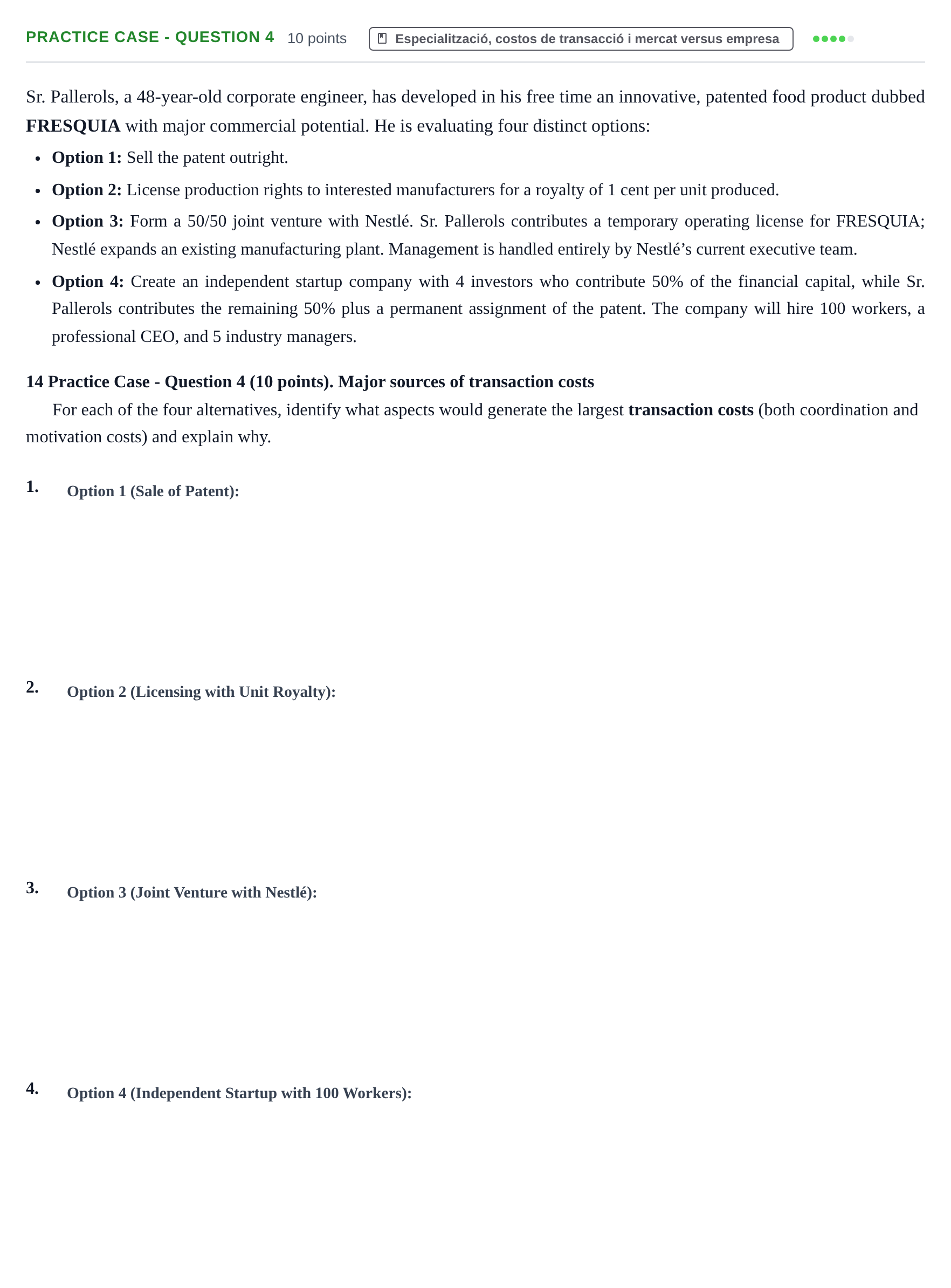
Sr. Pallerols, a 48-year-old corporate engineer, has developed in his free time an innovative, patented food product dubbed FRESQUIA with major commercial potential. He is evaluating four distinct options:
Option 1: Sell the patent outright.
Option 2: License production rights to interested manufacturers for a royalty of 1 cent per unit produced.
Option 3: Form a 50/50 joint venture with Nestlé. Sr. Pallerols contributes a temporary operating license for FRESQUIA; Nestlé expands an existing manufacturing plant. Management is handled entirely by Nestlé’s current executive team.
Option 4: Create an independent startup company with 4 investors who contribute 50% of the financial capital, while Sr. Pallerols contributes the remaining 50% plus a permanent assignment of the patent. The company will hire 100 workers, a professional CEO, and 5 industry managers.
14 Practice Case - Question 4 (10 points). Major sources of transaction costs
For each of the four alternatives, identify what aspects would generate the largest transaction costs (both coordination and motivation costs) and explain why.
1.
2.
3.
4.
Solución
Según los criterios oficiales de corrección
Option 1 (Sale of Patent): Largest transaction costs and reasons.
Solución: Search and bargaining costs. Locating potential corporate acquirers, valuing an unproven food novelty, and negotiating a fair lump-sum price under information asymmetry generate high initial coordination costs.
Option 2 (Licensing with Unit Royalty): Largest transaction costs and reasons.
Solución: Monitoring and enforcement costs. Verifying the actual units manufactured across multiple independent producers, monitoring product quality to protect brand goodwill, and preventing unauthorized leakage of the secret recipe.
Option 3 (Joint Venture with Nestlé): Largest transaction costs and reasons.
Solución: Contract specification and coordination costs. Drafting the joint venture governance charter, agreeing on transfer pricing for factory expansion, aligning corporate goals with a giant multinational partner, and resolving deadlock in a 50/50 voting structure.
Option 4 (Independent Startup with 100 Workers): Largest transaction costs and reasons.
Solución: Internal agency, coordination, and administrative costs. Recruiting, screening, and supervising 100 employees and 6 executives, establishing internal control systems, and resolving conflicts of interest between financial investors and the founding inventor.
La explicación paso a paso, hecha con IA, es Premium. Premium
Resuélvelo aquí mismo: corrección automática, pistas y solución paso a paso.
‹ Ejercicio Short Question 4 · 2011