Ejercicio 3 - Mercats financers: diner, bancs i política mo… · Introducció a la Macroeconomia UPF 2024
Tema: Mercats financers: diner, bancs i política monetària · Del examen Sample Exam 2024 (2024)
Enunciado
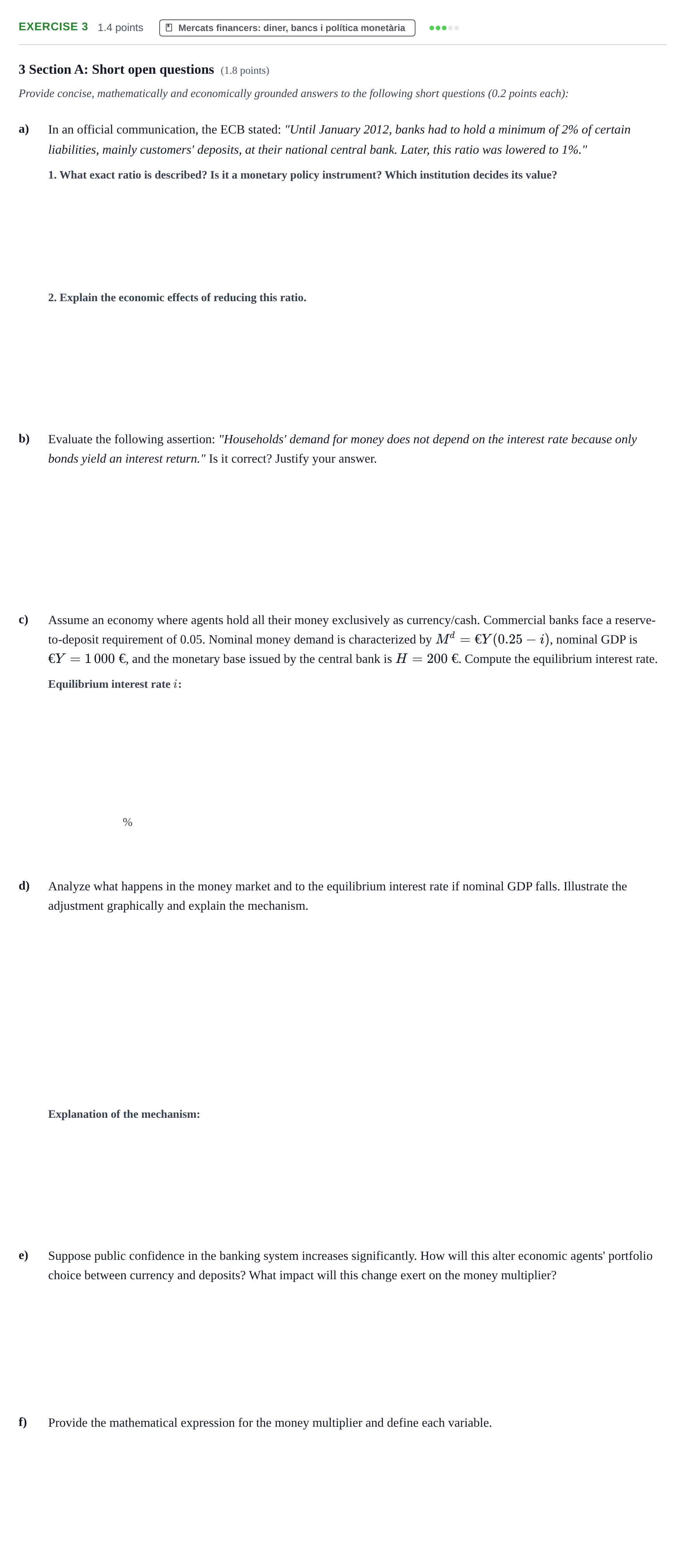
3 Section A: Short open questions (1.8 points)
Provide concise, mathematically and economically grounded answers to the following short questions (0.2 points each):
a)
In an official communication, the ECB stated: "Until January 2012, banks had to hold a minimum of 2% of certain liabilities, mainly customers' deposits, at their national central bank. Later, this ratio was lowered to 1%."
b)
Evaluate the following assertion: "Households' demand for money does not depend on the interest rate because only bonds yield an interest return." Is it correct? Justify your answer.
c)
Assume an economy where agents hold all their money exclusively as currency/cash. Commercial banks face a reserve-to-deposit requirement of 0.05. Nominal money demand is characterized by , nominal GDP is , and the monetary base issued by the central bank is . Compute the equilibrium interest rate.
%
d)
Analyze what happens in the money market and to the equilibrium interest rate if nominal GDP falls. Illustrate the adjustment graphically and explain the mechanism.
e)
Suppose public confidence in the banking system increases significantly. How will this alter economic agents' portfolio choice between currency and deposits? What impact will this change exert on the money multiplier?
f)
Provide the mathematical expression for the money multiplier and define each variable.
Solución
Según los criterios oficiales de corrección
a.1. What exact ratio is described? Is it a monetary policy instrument? Which institution decides its value?
Solución: Minimum reserve ratio (reserve requirement ratio, ). It is a monetary policy instrument decided by the Governing Council of the European Central Bank.
a.2. Explain the economic effects of reducing this ratio.
Solución: Lowering the ratio frees up liquidity for commercial banks, expands the money multiplier, increases money supply, and puts downward pressure on interest rates.
b. Evaluate the following assertion: "Households' demand for money does not depend on the interest rate because only bonds yield an interest return." Is it correct? Justify your answer.
Solución: The assertion is incorrect. The interest rate on bonds is the opportunity cost of holding money.
c. Compute the equilibrium interest rate.
Solución: 5 / 0.05
d. Illustrate the adjustment graphically.
Solución: Vertical money supply curve and downward-sloping money demand curve . A drop in shifts to the left, reducing equilibrium interest rate .
d. Explain the mechanism.
Solución: A fall in nominal GDP reduces transactions and shifts money demand left, leading to an excess supply of money; agents buy bonds, driving bond prices up and interest rates down.
e. Suppose public confidence in the banking system increases significantly. How will this alter economic agents' portfolio choice between currency and deposits? What impact will this change exert on the money multiplier?
Solución: The ratio of currency to money decreases (agents hold more deposits and less cash), increasing the money multiplier.
f. Provide the mathematical expression for the money multiplier and define each variable.
Solución:
La explicación paso a paso, hecha con IA, es Premium. Premium
Resuélvelo aquí mismo: corrección automática, pistas y solución paso a paso.
‹ Ejercicio 2 - Mercats financers: diner, bancs i política mo… · 2024 · Part I - Mercats financers: diner, bancs i políti… · 2021 ›
Más ejercicios de Mercats financers: diner, bancs i política monetària
- Ejercicio 1 - Mercats financers: diner, bancs i política mo… · 2024
- Ejercicio 2 - Mercats financers: diner, bancs i política mo… · 2024
- Part I - Mercats financers: diner, bancs i políti… · 2021
- Pregunta 2 · 2019
- Pregunta 3 · 2019
- Pregunta 8 · 2019
- Pregunta 10 · 2019
- Question 5 · 2019
- Question 6 · 2019
- Question 7 · 2019