Sujet 1 - Partie 1 · Bac Anglais, monde contemporain Métropole remplacement 2025
Thème : Environnements en mutation – Frontière et espace · Tiré du sujet Métropole France remplacement (2025)
Énoncé
SUJET 1
Le sujet porte sur la thématique « Environnements en mutation »
Document A
Welcome to NZ – now pay up: the risks and rewards of raising the foreign tourist tax
What should visiting Aotearoa 1 New Zealand cost your average tourist? The government has suggested raising the price of admission – otherwise known as the international visitor conservation and tourism levy (IVL) – from NZ100. […]
Tourism is a vital part of New Zealand's economy, earning about 48 million a day) before COVID. The pandemic put the industry on life support, of course, but it did provide a unique opportunity to rethink and reshape tourism policy.
One strategy that emerged was to attract "high-value" tourists rather than revert to the pre-pandemic model of mass tourism. Some popular destinations had been overwhelmed at times. This put a strain on 2 both environmental sustainability and the quality of visitor experiences.
This proposed shift was not unique to New Zealand. During the pandemic, many countries explored the potential of more sustainable and higher-value tourism once borders reopened.
But New Zealand's distinctive overseas marketing approach has long played up being a welcoming country for all. This tension between being inclusive as well as more exclusive also challenges the Māori concept of manaakitanga – hospitality and generosity – that has been key to tourism's messaging. […]
The business association Tourism Industry Aotearoa has released Tourism 2050: A Blueprint For Impact. […]
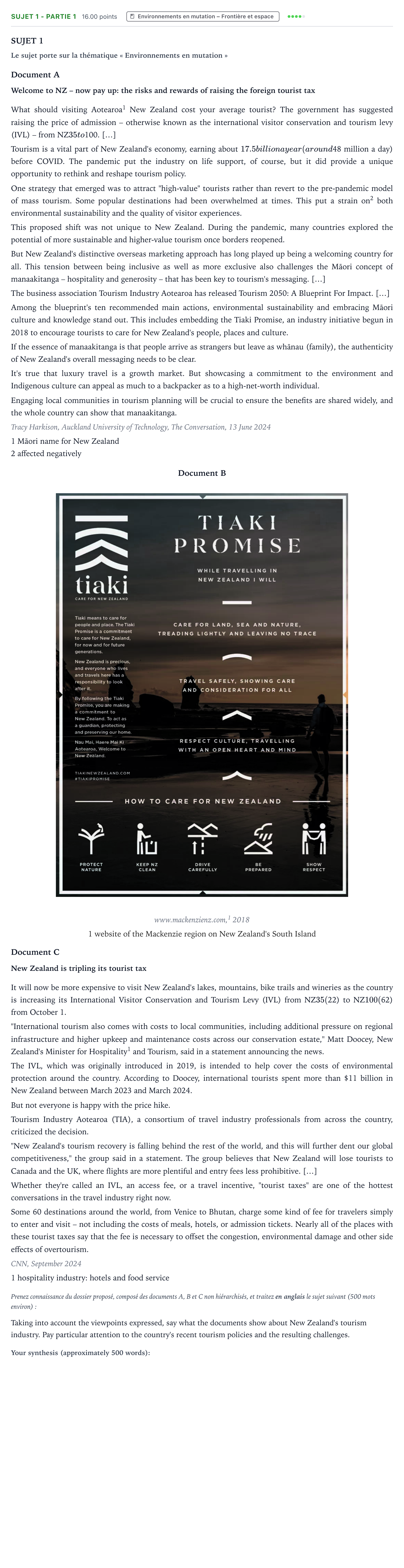
Among the blueprint's ten recommended main actions, environmental sustainability and embracing Māori culture and knowledge stand out. This includes embedding the Tiaki Promise, an industry initiative begun in 2018 to encourage tourists to care for New Zealand's people, places and culture.
If the essence of manaakitanga is that people arrive as strangers but leave as whānau (family), the authenticity of New Zealand's overall messaging needs to be clear.
It's true that luxury travel is a growth market. But showcasing a commitment to the environment and Indigenous culture can appeal as much to a backpacker as to a high-net-worth individual.
Engaging local communities in tourism planning will be crucial to ensure the benefits are shared widely, and the whole country can show that manaakitanga.
Tracy Harkison, Auckland University of Technology, The Conversation, 13 June 2024
1 Māori name for New Zealand
2 affected negatively
Document B
www.mackenzienz.com, 1 2018
1 website of the Mackenzie region on New Zealand's South Island
Document C
New Zealand is tripling its tourist tax
It will now be more expensive to visit New Zealand's lakes, mountains, bike trails and wineries as the country is increasing its International Visitor Conservation and Tourism Levy (IVL) from NZ22) to NZ62) from October 1.
"International tourism also comes with costs to local communities, including additional pressure on regional infrastructure and higher upkeep and maintenance costs across our conservation estate," Matt Doocey, New Zealand's Minister for Hospitality 1 and Tourism, said in a statement announcing the news.
The IVL, which was originally introduced in 2019, is intended to help cover the costs of environmental protection around the country. According to Doocey, international tourists spent more than $11 billion in New Zealand between March 2023 and March 2024.
But not everyone is happy with the price hike.
Tourism Industry Aotearoa (TIA), a consortium of travel industry professionals from across the country, criticized the decision.
"New Zealand's tourism recovery is falling behind the rest of the world, and this will further dent our global competitiveness," the group said in a statement. The group believes that New Zealand will lose tourists to Canada and the UK, where flights are more plentiful and entry fees less prohibitive. […]
Whether they're called an IVL, an access fee, or a travel incentive, "tourist taxes" are one of the hottest conversations in the travel industry right now.
Some 60 destinations around the world, from Venice to Bhutan, charge some kind of fee for travelers simply to enter and visit – not including the costs of meals, hotels, or admission tickets. Nearly all of the places with these tourist taxes say that the fee is necessary to offset the congestion, environmental damage and other side effects of overtourism.
CNN, September 2024
1 hospitality industry: hotels and food service
Prenez connaissance du dossier proposé, composé des documents A, B et C non hiérarchisés, et traitez en anglais le sujet suivant (500 mots environ):
Taking into account the viewpoints expressed, say what the documents show about New Zealand's tourism industry. Pay particular attention to the country's recent tourism policies and the resulting challenges.
Corrigé
Corrigé proposé par AprenAI (non officiel)
Taking into account the viewpoints expressed, say what the documents show about New Zealand's tourism industry. Pay particular attention to the country's recent tourism policies and the resulting challenges.
Réponse : The documents in the dossier illustrate the profound transformation of New Zealand's tourism industry in the post-pandemic era. They depict a nation grappling with the delicate balance between economic vitality, environmental preservation, and cultural integrity. Historically, tourism has been a cornerstone of New Zealand's economy, generating substantial revenue. However, as Document A and Document C emphasize, pre-pandemic mass tourism placed unsustainable pressure on regional infrastructure, natural ecosystems, and local communities. Popular sites suffered degradation, eroding both the quality of the visitor experience and the well-being of residents. In response, policymakers have shifted strategic direction, moving away from volume-based tourism toward a high-value, regenerative model that requires visitors to contribute directly to conservation. Central to these recent policies is the sharp increase in the International Visitor Conservation and Tourism Levy (IVL), which jumped from NZ100. As New Zealand's Tourism Minister asserts in Document C, this price hike aims to ensure that international travellers help fund the maintenance of national parks and public facilities, mitigating overtourism in line with global practices seen in destinations like Venice or Bhutan. Alongside fiscal measures, authorities and industry bodies promote environmental ethics through campaigns such as the "Tiaki Promise" (Document B and Document A). Grounded in Māori values, this initiative urges visitors to act as guardians (*tiaki*) of nature and respect local customs by treading lightly, disposing of waste, and travelling with care. Nevertheless, these policies generate significant tensions and challenges. Document C gives voice to Tourism Industry Aotearoa (TIA), which fears that tripling the entry fee will undermine New Zealand's global competitiveness. With distant flights already expensive, higher taxes could deter travellers in favor of more accessible destinations like Canada or the United Kingdom, thereby slowing post-COVID recovery. Furthermore, Document A raises an ethical and philosophical dilemma regarding national identity. Marketing New Zealand exclusively to affluent, "high-value" travellers risks creating an elitist destination. This conflicts with the core Māori value of *manaakitanga* (unconditional hospitality, generosity, and inclusivity), which promises that visitors arrive as strangers and leave as family (*whānau*). Excluding budget travellers or backpackers—who often share deep environmental values—contradicts the authentic spirit of hospitality. In conclusion, the dossier reveals that New Zealand's tourism model stands at a critical crossroads. While economic levies and cultural commitments like the Tiaki Promise represent innovative steps toward sustainable stewardship, policymakers must ensure that environmental protection does not compromise economic recovery or erode the hospitable identity that defines Aotearoa.
L’explication pas à pas, faite avec l’IA, est réservée aux membres Premium. Premium
Résous-le ici : correction automatique, indices et corrigé détaillé.