Sujet 2 - Partie 1 · Bac Anglais Amérique du Nord session normale 2021
Thème : Synthèse du dossier — Voyages, territoires, frontières · Tiré du sujet Session normale (2021)
Énoncé
Document A
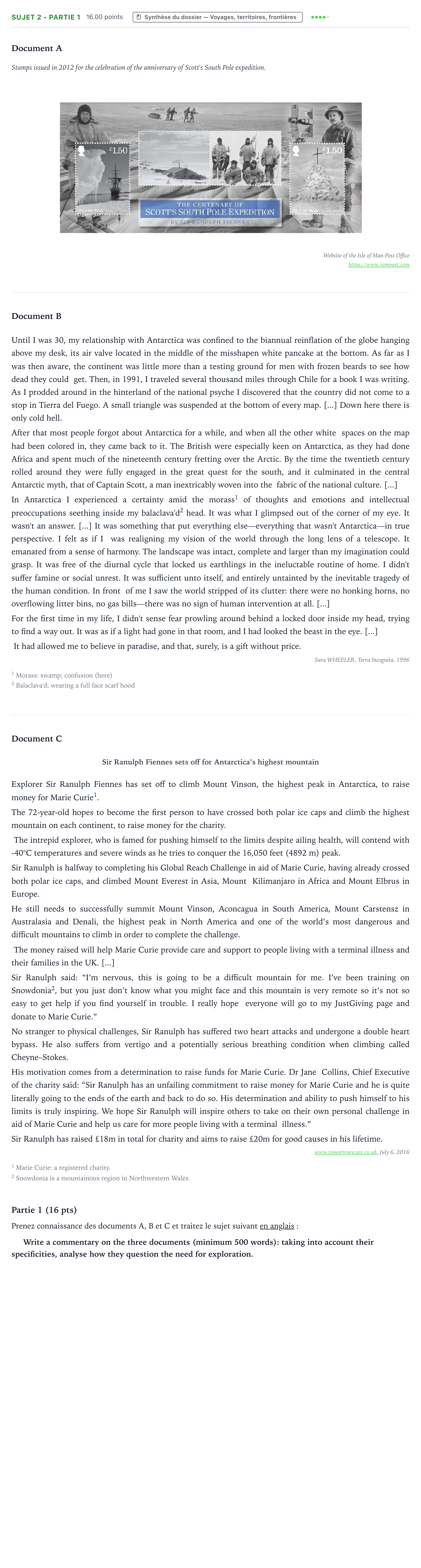
Stamps issued in 2012 for the celebration of the anniversary of Scott's South Pole expedition.
Website of the Isle of Man Post Office
https://www.iompost.com
Document B
Until I was 30, my relationship with Antarctica was confined to the biannual reinflation of the globe hanging above my desk, its air valve located in the middle of the misshapen white pancake at the bottom. As far as I was then aware, the continent was little more than a testing ground for men with frozen beards to see how dead they could 5 get. Then, in 1991, I traveled several thousand miles through Chile for a book I was writing. As I prodded around in the hinterland of the national psyche I discovered that the country did not come to a stop in Tierra del Fuego. A small triangle was suspended at the bottom of every map. [...] Down here there is only cold hell.
After that most people forgot about Antarctica for a while, and when all the other white 10 spaces on the map had been colored in, they came back to it. The British were especially keen on Antarctica, as they had done Africa and spent much of the nineteenth century fretting over the Arctic. By the time the twentieth century rolled around they were fully engaged in the great quest for the south, and it culminated in the central Antarctic myth, that of Captain Scott, a man inextricably woven into the 15 fabric of the national culture. [...]
In Antarctica I experienced a certainty amid the morass 1 of thoughts and emotions and intellectual preoccupations seething inside my balaclava'd 2 head. It was what I glimpsed out of the corner of my eye. It wasn't an answer. [...] It was something that put everything else—everything that wasn't Antarctica—in true perspective. I felt as if I 20 was realigning my vision of the world through the long lens of a telescope. It emanated from a sense of harmony. The landscape was intact, complete and larger than my imagination could grasp. It was free of the diurnal cycle that locked us earthlings in the ineluctable routine of home. I didn't suffer famine or social unrest. It was sufficient unto itself, and entirely untainted by the inevitable tragedy of the human condition. In front 25 of me I saw the world stripped of its clutter: there were no honking horns, no overflowing litter bins, no gas bills—there was no sign of human intervention at all. [...]
For the first time in my life, I didn't sense fear prowling around behind a locked door inside my head, trying to find a way out. It was as if a light had gone in that room, and I had looked the beast in the eye. [...]
30 It had allowed me to believe in paradise, and that, surely, is a gift without price.
Sara WHEELER, Terra Incognita, 1996
1 Morass: swamp; confusion (here)
2 Balaclava'd: wearing a full face scarf hood
Document C
Sir Ranulph Fiennes sets off for Antarctica’s highest mountain
Explorer Sir Ranulph Fiennes has set off to climb Mount Vinson, the highest peak in Antarctica, to raise money for Marie Curie 1.
The 72-year-old hopes to become the first person to have crossed both polar ice caps and climb the highest mountain on each continent, to raise money for the charity.
5 The intrepid explorer, who is famed for pushing himself to the limits despite ailing health, will contend with -40°C temperatures and severe winds as he tries to conquer the 16,050 feet (4892 m) peak.
Sir Ranulph is halfway to completing his Global Reach Challenge in aid of Marie Curie, having already crossed both polar ice caps, and climbed Mount Everest in Asia, Mount 10 Kilimanjaro in Africa and Mount Elbrus in Europe.
He still needs to successfully summit Mount Vinson, Aconcagua in South America, Mount Carstensz in Australasia and Denali, the highest peak in North America and one of the world’s most dangerous and difficult mountains to climb in order to complete the challenge.
15 The money raised will help Marie Curie provide care and support to people living with a terminal illness and their families in the UK. [...]
Sir Ranulph said: “I’m nervous, this is going to be a difficult mountain for me. I’ve been training on Snowdonia 2, but you just don’t know what you might face and this mountain is very remote so it’s not so easy to get help if you find yourself in trouble. I really hope 20 everyone will go to my JustGiving page and donate to Marie Curie.”
No stranger to physical challenges, Sir Ranulph has suffered two heart attacks and undergone a double heart bypass. He also suffers from vertigo and a potentially serious breathing condition when climbing called Cheyne–Stokes.
His motivation comes from a determination to raise funds for Marie Curie. Dr Jane 25 Collins, Chief Executive of the charity said: “Sir Ranulph has an unfailing commitment to raise money for Marie Curie and he is quite literally going to the ends of the earth and back to do so. His determination and ability to push himself to his limits is truly inspiring. We hope Sir Ranulph will inspire others to take on their own personal challenge in aid of Marie Curie and help us care for more people living with a terminal 30 illness.”
Sir Ranulph has raised £18m in total for charity and aims to raise £20m for good causes in his lifetime.
www.tomorrowscare.co.uk, July 6, 2016
1 Marie Curie: a registered charity.
2 Snowdonia is a mountainous region in Northwestern Wales.
Partie 1 (16 pts)
Prenez connaissance des documents A, B et C et traitez le sujet suivant en anglais:
Write a commentary on the three documents (minimum 500 words): taking into account their specificities, analyse how they question the need for exploration.
Corrigé
Corrigé proposé par AprenAI (non officiel)
Write a commentary on the three documents (minimum 500 words): taking into account their specificities, analyse how they question the need for exploration.
Réponse : Introduction Why do human beings feel the need to venture into the most hostile places on Earth? Antarctica, the coldest, emptiest and most remote continent, offers a perfect case study. Document A is a sheet of commemorative stamps issued by the Isle of Man Post Office in 2012 to mark the centenary of Captain Scott's South Pole expedition. The sheet is presented "by Sir Ranulph Fiennes". Document B is an extract from Terra Incognita (1996), a travel book in which Sara Wheeler recalls how her view of Antarctica changed. Document C is an online article from July 2016 about Sir Ranulph Fiennes setting off, aged 72, to climb Mount Vinson to raise money for the charity Marie Curie. Together, these documents raise one question: is exploration a quest for national glory, a personal and spiritual need, or a way of serving others? 1. Exploration as national glory and myth All three documents first link exploration with heroism and national identity. The stamps in Document A show the Terra Nova trapped in ice, the expedition hut, the polar party at the Pole with the Union Jack, and the snow cairn topped by a cross. They are framed by photographs of explorers dragging sledges. Stamps are official, state-issued objects that circulate widely, so they turn a tragedy into a heroic memory. Scott and his men died on the way back, yet they are celebrated a hundred years later. Wheeler explains how this myth was built. Once "all the other white spaces on the map had been colored in", the British, who "had done Africa", turned to the South. Their quest culminated in "the central Antarctic myth, that of Captain Scott, a man inextricably woven into the fabric of the national culture". Her ironic tone ("men with frozen beards to see how dead they could get", "cold hell") questions this vision. It suggests that exploration was often a competitive, imperial and almost absurd test of endurance rather than a real necessity. 2. Exploration as an inner journey Wheeler then offers a very different answer. For her, Antarctica is not a territory to conquer but a place of revelation. She discovers "a certainty amid the morass of thoughts", a "sense of harmony", and a landscape that is "intact, complete" and "untainted by the inevitable tragedy of the human condition". The list of what is absent ("no honking horns, no overflowing litter bins, no gas bills") shows that the need to explore is also a need to escape modern civilisation and see the world "in true perspective". The metaphor of fear "prowling around behind a locked door" shows that the journey is a psychological victory. By looking "the beast in the eye", she overcomes her anxieties. She concludes that Antarctica "allowed me to believe in paradise", "a gift without price". Exploration thus becomes a personal, almost spiritual quest for peace and meaning. 3. Exploration as a challenge for a cause Document C shows a modern version of the explorer. Sir Ranulph Fiennes is the heir of Scott; he even presents the 2012 stamps in Document A. He still seeks records: he wants to be "the first person" to cross both polar ice caps and climb the highest peak on every continent. Yet his motivation is presented as altruistic. He wants to raise money so that Marie Curie can care for terminally ill people. The article stresses the risks he takes: "-40°C temperatures", "two heart attacks", vertigo and Cheyne–Stokes. It also quotes his own fear ("I'm nervous"). In this way it makes him an inspiring role model and justifies the exploit. The figures (£18m raised, £20m targeted) and the call to donate on his JustGiving page show that exploration has become a media event and a fundraising tool. One may wonder, however, whether charity is the true need or partly a justification for a very personal taste for extreme challenges. Conclusion The three documents question the need for exploration in complementary ways. Exploration was once a matter of national prestige and myth, celebrated even in failure (Documents A and B). It can be an intimate journey that brings inner peace and a new vision of the world (Document B). Today it can also be a personal challenge that gives meaning through solidarity (Document C). Even though Antarctica has been mapped, the need to explore remains. What has changed is its purpose: from conquering the land to understanding oneself and helping others.
L’explication pas à pas, faite avec l’IA, est réservée aux membres Premium. Premium
Résous-le ici : correction automatique, indices et corrigé détaillé.