Sujet 1 - Partie 1 · Bac Anglais Amérique du Nord session normale 2021
Thème : Synthèse du dossier — Expression et construction de soi · Tiré du sujet Session normale (2021)
Énoncé
SUJET 1
Le sujet porte sur la thématique « Expression et construction de soi ».
Document A
Laurie Lee grew up in Slad, a small south-west England village. The scene takes place in 1934. He is 19 years old.
It was a bright Sunday morning in early June, the right time to be leaving home. [...] My mother had got up early and cooked me a heavy breakfast, had stood wordlessly while I ate it, her hand on my chair, and had then helped me pack up my few belongings. There had been no fuss, no appeals, no attempts at advice or persuasion, only a long and searching look. Then, with my bags on my back, I'd gone out into the early sunshine and climbed through the long grass to the road. [...]
As I left home that morning and walked away from the sleeping village, it never occurred to me that others had done this before me. I was propelled, of course, by the traditional forces that had sent many generations along this road—by the small tight valley closing in around one, stifling the breath with its mossy mouth, the cottage walls narrowing like the arms of an iron maiden, the local girls whispering, “Marry, and settle down.” [...]
And now I was on my journey, in a pair of thick boots and with a hazel stick in my hand. Naturally, I was going to London, which lay a hundred miles to the east. [...] The first day alone—and now I was really alone at last—steadily declined in excitement and vigour. [...]Through the solitary morning and afternoon I found myself longing for some opposition or rescue, for the sound of hurrying footsteps coming after me and family voices calling me back.
None came. I was free. I was affronted by freedom. The day's silence said, Go where you will. It's all yours. You asked for it. It's up to you now. You're on your own, and nobody's going to stop you. As I walked, I was haunted by echoes of home, by the tinkling sounds of the kitchen, shafts of sun from the windows falling across the familiar furniture, across the bedroom and the bed I had left.
When I judged it to be tea-time I sat on an old stone wall and opened my tin of treacle 1 biscuits. As I ate them, I could hear mother banging the kettle on the hob and my brothers rattling their tea-cups. The biscuits tasted sweetly of the honeyed squalor of home—still only a dozen miles away. I might have turned back then if it hadn't been for my brothers, but I couldn't have borne the look on their faces. [...]
When darkness came, full of moths and beetles, I was too weary to put up the tent. So I lay myself down in the middle of a field and stared up at the brilliant stars. I was oppressed by the velvety emptiness of the world and the swathes of soft grass I lay on. Then the fumes of the night finally put me to sleep—my first night without a roof or bed.
Laurie LEE, As I Walked Out One Midsummer Morning, 1969
1 Treacle: mélasse.
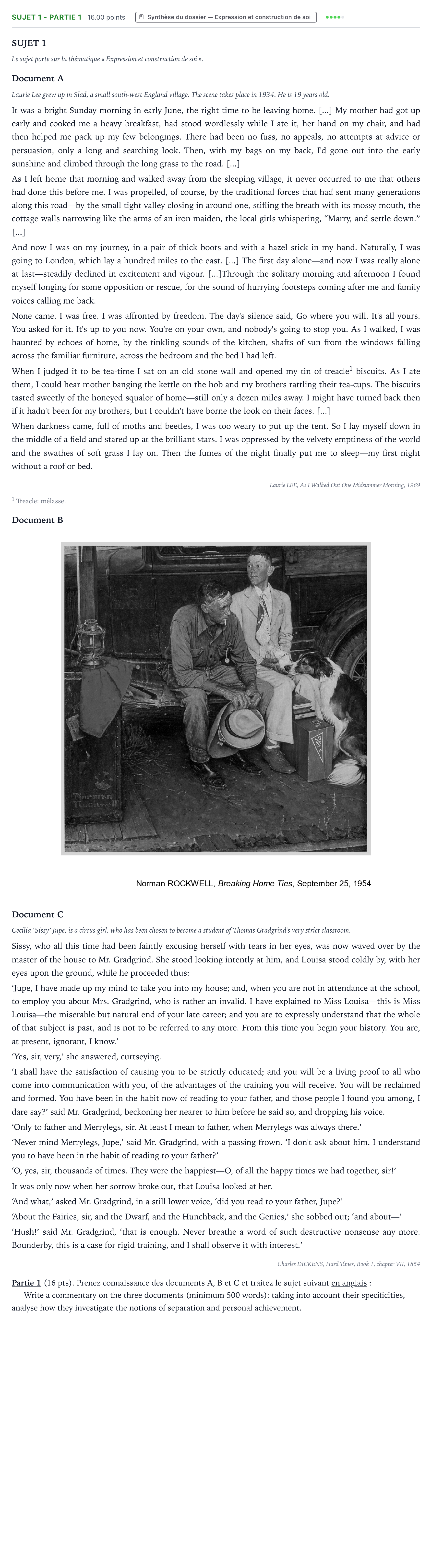
Document B
Document C
Cecilia ‘Sissy’ Jupe, is a circus girl, who has been chosen to become a student of Thomas Gradgrind's very strict classroom.
Sissy, who all this time had been faintly excusing herself with tears in her eyes, was now waved over by the master of the house to Mr. Gradgrind. She stood looking intently at him, and Louisa stood coldly by, with her eyes upon the ground, while he proceeded thus:
‘Jupe, I have made up my mind to take you into my house; and, when you are not in attendance at the school, to employ you about Mrs. Gradgrind, who is rather an invalid. I have explained to Miss Louisa—this is Miss Louisa—the miserable but natural end of your late career; and you are to expressly understand that the whole of that subject is past, and is not to be referred to any more. From this time you begin your history. You are, at present, ignorant, I know.’
‘Yes, sir, very,’ she answered, curtseying.
‘I shall have the satisfaction of causing you to be strictly educated; and you will be a living proof to all who come into communication with you, of the advantages of the training you will receive. You will be reclaimed and formed. You have been in the habit now of reading to your father, and those people I found you among, I dare say?’ said Mr. Gradgrind, beckoning her nearer to him before he said so, and dropping his voice.
‘Only to father and Merrylegs, sir. At least I mean to father, when Merrylegs was always there.’
‘Never mind Merrylegs, Jupe,’ said Mr. Gradgrind, with a passing frown. ‘I don't ask about him. I understand you to have been in the habit of reading to your father?’
‘O, yes, sir, thousands of times. They were the happiest—O, of all the happy times we had together, sir!’
It was only now when her sorrow broke out, that Louisa looked at her.
‘And what,’ asked Mr. Gradgrind, in a still lower voice, ‘did you read to your father, Jupe?’
‘About the Fairies, sir, and the Dwarf, and the Hunchback, and the Genies,’ she sobbed out; ‘and about—’
‘Hush!’ said Mr. Gradgrind, ‘that is enough. Never breathe a word of such destructive nonsense any more. Bounderby, this is a case for rigid training, and I shall observe it with interest.’
Charles DICKENS, Hard Times, Book 1, chapter VII, 1854
Partie 1 (16 pts). Prenez connaissance des documents A, B et C et traitez le sujet suivant en anglais:
Write a commentary on the three documents (minimum 500 words): taking into account their specificities, analyse how they investigate the notions of separation and personal achievement.
Corrigé
Corrigé proposé par AprenAI (non officiel)
Write a commentary on the three documents (minimum 500 words): taking into account their specificities, analyse how they investigate the notions of separation and personal achievement.
Réponse : Introduction Growing up often implies a painful rupture with the place and the people that shaped us. The three documents explore this paradox. Document A is an extract from Laurie Lee's autobiographical narrative *As I Walked Out One Midsummer Morning* (1969), in which the 19-year-old narrator leaves his Cotswold village of Slad on foot for London in 1934. Document B is Norman Rockwell's painting *Breaking Home Ties*, published on 25 September 1954, which shows a father and his son waiting for the train that will take the young man to university. Document C, from Charles Dickens's novel *Hard Times* (1854), depicts Sissy Jupe, a circus girl taken into Mr Gradgrind's house to be "strictly educated". We will analyse how these documents present separation as a necessary but painful step, and how they question what personal achievement really means. I. Separation as a necessary threshold In the three documents, leaving home marks the passage from childhood to adulthood. Lee's departure is chosen: he feels "propelled" by "traditional forces", and the village is described through images of suffocation, "the small tight valley closing in around one, stifling the breath with its mossy mouth", the walls "narrowing like the arms of an iron maiden". Staying would mean the destiny summed up by the local girls: "Marry, and settle down." Rockwell stages the same threshold visually. The two figures sit on the running board of the old ranch truck, yet they are already turned in opposite directions. The son, in a clean light suit and a loud tie, looks eagerly towards the coming train, while his weather-beaten father, in work clothes, stares the other way, holding two hats. The suitcase with its "State U" pennant and the books announce the son's new life. In Dickens's text, on the contrary, separation is imposed. Gradgrind decides that Sissy's past "is not to be referred to any more" and that "From this time you begin your history", as if her identity could be erased by decree. II. The emotional cost of rupture Separation is never simple. The mother in Document A stands "wordlessly", with "no fuss, no appeals", only "a long and searching look": love is expressed through silence. Once on the road, the narrator discovers loneliness. He is "affronted by freedom", longs for "family voices calling me back" and is "haunted by echoes of home". The treacle biscuits evoke "the honeyed squalor of home", an oxymoron that sums up his ambivalence, and only pride, the thought of his brothers' faces, prevents him from turning back. Rockwell conveys the same mixed feelings without words. The father is slumped, with a cigarette and a dejected face. The collie rests its head on the boy's lap, embodying the faithful home he leaves behind. Sissy's grief is more violent: she cries and "sobbed out" the memory of the "happiest" times spent reading to her father. Even cold Louisa looks at her only when "her sorrow broke out", which suggests that human emotion resists Gradgrind's system. III. What is personal achievement? For Lee and for Rockwell's young man, achievement means self-construction: it is freedom, knowledge and social mobility through university, gained by choice and at an emotional price. Lee's first night under "the brilliant stars", "without a roof or bed", is both a frightening emptiness and an initiation into independence. Rockwell's painting suggests a generational change: the son will rise above his father's manual life, which makes the image proud and nostalgic at the same time. Dickens offers a satirical counterpoint. For Gradgrind, success means being "reclaimed and formed", becoming "a living proof" of his method. He rejects imagination, fairy tales and Merrylegs as "destructive nonsense". Achievement here is not self-expression but conformity imposed from outside. Dickens denounces a utilitarian education that kills the self it claims to build. Conclusion Through an autobiographical narrative rich in sensory imagery, a painting relying on composition, gazes and symbols, and a satirical novel built on dialogue, the three documents show that separation is the price of growing up. Yet they also show that personal achievement is genuine only when it is chosen and when it preserves one's emotions and memories. Lee and Rockwell's young man move forward while carrying their home with them. Sissy's story warns that a self built by erasing the past is no achievement at all.
L’explication pas à pas, faite avec l’IA, est réservée aux membres Premium. Premium
Résous-le ici : correction automatique, indices et corrigé détaillé.