Aufgabe HT 3 - Aufgabe 1 · Abitur NRW Englisch GK · Haupttermin 2021
Thema: Textverständnis: Inhalte wiedergeben (Outline / Sum up) · Aus der Prüfung GK · Haupttermin (2021)
Aufgabenstellung
Klausurteil A: Leseverstehen und Schreiben integriert
Klausurteil A
Rene Germain and Adesuwa Ajayi
Black Lives Matter – Unless You’re Black in the Workplace
Rene Germain and Adesuwa Ajayi, the authors, are black women who live in the UK.
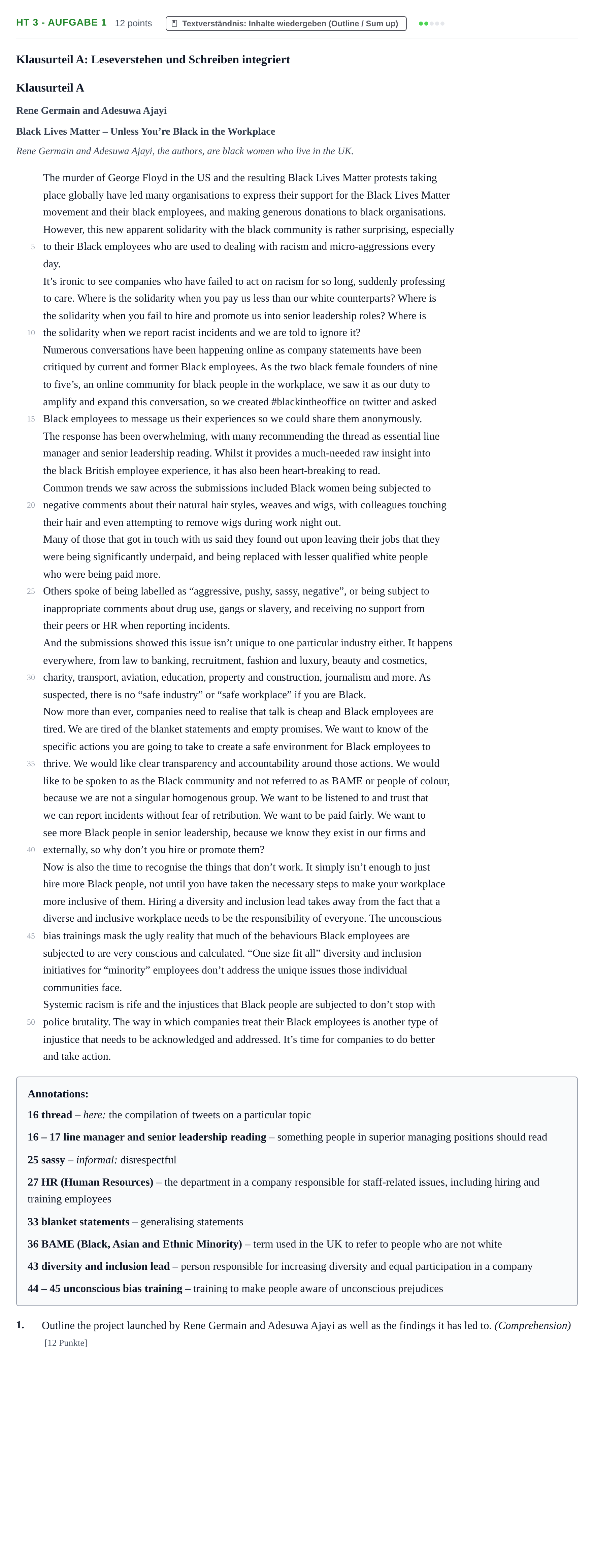
The murder of George Floyd in the US and the resulting Black Lives Matter protests taking
place globally have led many organisations to express their support for the Black Lives Matter
movement and their black employees, and making generous donations to black organisations.
However, this new apparent solidarity with the black community is rather surprising, especially
5 to their Black employees who are used to dealing with racism and micro-aggressions every
day.
It’s ironic to see companies who have failed to act on racism for so long, suddenly professing
to care. Where is the solidarity when you pay us less than our white counterparts? Where is
the solidarity when you fail to hire and promote us into senior leadership roles? Where is
10 the solidarity when we report racist incidents and we are told to ignore it?
Numerous conversations have been happening online as company statements have been
critiqued by current and former Black employees. As the two black female founders of nine
to five’s, an online community for black people in the workplace, we saw it as our duty to
amplify and expand this conversation, so we created #blackintheoffice on twitter and asked
15 Black employees to message us their experiences so we could share them anonymously.
The response has been overwhelming, with many recommending the thread as essential line
manager and senior leadership reading. Whilst it provides a much-needed raw insight into
the black British employee experience, it has also been heart-breaking to read.
Common trends we saw across the submissions included Black women being subjected to
20 negative comments about their natural hair styles, weaves and wigs, with colleagues touching
their hair and even attempting to remove wigs during work night out.
Many of those that got in touch with us said they found out upon leaving their jobs that they
were being significantly underpaid, and being replaced with lesser qualified white people
who were being paid more.
25 Others spoke of being labelled as “aggressive, pushy, sassy, negative”, or being subject to
inappropriate comments about drug use, gangs or slavery, and receiving no support from
their peers or HR when reporting incidents.
And the submissions showed this issue isn’t unique to one particular industry either. It happens
everywhere, from law to banking, recruitment, fashion and luxury, beauty and cosmetics,
30 charity, transport, aviation, education, property and construction, journalism and more. As
suspected, there is no “safe industry” or “safe workplace” if you are Black.
Now more than ever, companies need to realise that talk is cheap and Black employees are
tired. We are tired of the blanket statements and empty promises. We want to know of the
specific actions you are going to take to create a safe environment for Black employees to
35 thrive. We would like clear transparency and accountability around those actions. We would
like to be spoken to as the Black community and not referred to as BAME or people of colour,
because we are not a singular homogenous group. We want to be listened to and trust that
we can report incidents without fear of retribution. We want to be paid fairly. We want to
see more Black people in senior leadership, because we know they exist in our firms and
40 externally, so why don’t you hire or promote them?
Now is also the time to recognise the things that don’t work. It simply isn’t enough to just
hire more Black people, not until you have taken the necessary steps to make your workplace
more inclusive of them. Hiring a diversity and inclusion lead takes away from the fact that a
diverse and inclusive workplace needs to be the responsibility of everyone. The unconscious
45 bias trainings mask the ugly reality that much of the behaviours Black employees are
subjected to are very conscious and calculated. “One size fit all” diversity and inclusion
initiatives for “minority” employees don’t address the unique issues those individual
communities face.
Systemic racism is rife and the injustices that Black people are subjected to don’t stop with
50 police brutality. The way in which companies treat their Black employees is another type of
injustice that needs to be acknowledged and addressed. It’s time for companies to do better
and take action.
Annotations:
16 thread – here: the compilation of tweets on a particular topic
16 – 17 line manager and senior leadership reading – something people in superior managing positions should read
25 sassy – informal: disrespectful
27 HR (Human Resources) – the department in a company responsible for staff-related issues, including hiring and training employees
33 blanket statements – generalising statements
36 BAME (Black, Asian and Ethnic Minority) – term used in the UK to refer to people who are not white
43 diversity and inclusion lead – person responsible for increasing diversity and equal participation in a company
44 – 45 unconscious bias training – training to make people aware of unconscious prejudices
1.
Outline the project launched by Rene Germain and Adesuwa Ajayi as well as the findings it has led to. (Comprehension) [12 Punkte]
Lösung
Nach den offiziellen Korrekturhinweisen
1. Outline the project launched by Rene Germain and Adesuwa Ajayi as well as the findings it has led to.
Lösung: The summary should address: The #blackintheoffice initiative (6 points): - Initiated by Rene Germain and Adesuwa Ajayi, two Black female founders of *nine to five's* (an online community for Black people in the workplace). - Aim to spark a wider public debate on racism in the workplace and gain authentic insights into the work reality of Black employees in British companies. - Invited Black employees via Twitter to share their personal experiences of racism anonymously using the hashtag #blackintheoffice. Key insights gained from the submissions (6 points): - Widespread and multifaceted nature of discrimination against Black employees (e.g. offensive comments and boundary-crossing regarding natural hair/wigs, pay disparities/underpayment, racial stereotyping such as being labelled 'aggressive' or linked to gangs/drugs). - Pervasiveness across all industries and sectors without exception (no 'safe industry' or 'safe workplace'). - Lack of support from peers or HR, and ineffectiveness of existing measures taken by employers (such as blanket statements, token diversity leads, or unconscious bias training). - Great urgency and overwhelming participation highlighting the acute need for systemic corporate change.
Die ausführliche Erklärung Schritt für Schritt (mit KI) gibt es mit Premium. Premium
Löse sie direkt hier: automatische Korrektur, Hinweise und Lösung Schritt für Schritt.
‹ Aufgabe HT 2 - Aufgabe 1 · GK · Haupttermin 2021 · Aufgabe HT 1 - 1 · GK · Haupttermin · Weiterbildungskolleg 2021 ›
Mehr Aufgaben zu Textverständnis: Inhalte wiedergeben (Outline / Sum up)
- Aufgabe NT 3 - Aufgabe 1 · LK · Nachtermin 2022
- Aufgabe 1 · LK · Rutherford: DNA ancestry tests may 2022
- Aufgabe 1 · LK · Senior: Teen Fiction and the Perils 2022
- Aufgabe HT 1 - Aufgabe 1 · GK · Haupttermin 2021
- Aufgabe HT 2 - Aufgabe 1 · GK · Haupttermin 2021
- Aufgabe HT 1 - 1 · GK · Haupttermin · Weiterbildungskolleg 2021
- Aufgabe HT 2 - 1 · GK · Haupttermin · Weiterbildungskolleg 2021
- Aufgabe HT 3 - 1 · GK · Haupttermin · Weiterbildungskolleg 2021
- Aufgabe HT 1 - Aufgabe 1 · GK · Haupttermin · Weiterbildungskolleg 2021
- Aufgabe HT 2 - Aufgabe 1 · GK · Haupttermin · Weiterbildungskolleg 2021