Aufgabe HT 2 - 3.2 · Abitur NRW Englisch LK · Haupttermin 2021
Thema: Adressatenbezogenes Schreiben: Artikel, Rede, Blog, Leserbrief · Aus der Prüfung LK · Haupttermin (2021)
Aufgabenstellung
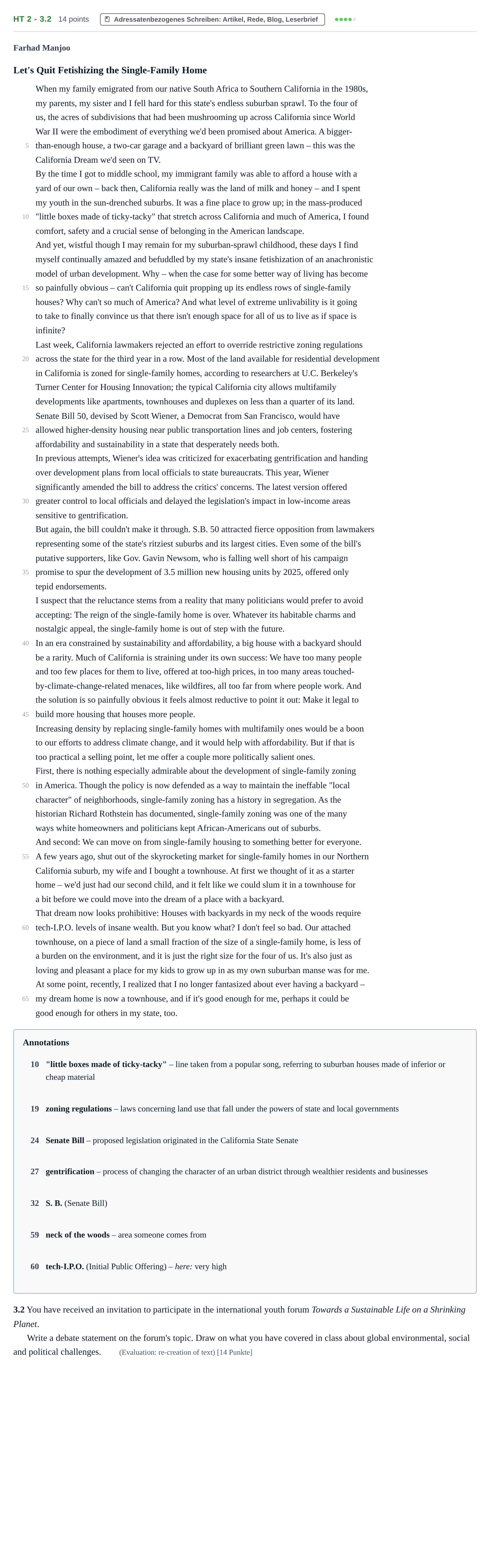
Farhad Manjoo
Let's Quit Fetishizing the Single-Family Home
When my family emigrated from our native South Africa to Southern California in the 1980s,
my parents, my sister and I fell hard for this state's endless suburban sprawl. To the four of
us, the acres of subdivisions that had been mushrooming up across California since World
War II were the embodiment of everything we'd been promised about America. A bigger-
5 than-enough house, a two-car garage and a backyard of brilliant green lawn – this was the
California Dream we'd seen on TV.
By the time I got to middle school, my immigrant family was able to afford a house with a
yard of our own – back then, California really was the land of milk and honey – and I spent
my youth in the sun-drenched suburbs. It was a fine place to grow up; in the mass-produced
10 "little boxes made of ticky-tacky" that stretch across California and much of America, I found
comfort, safety and a crucial sense of belonging in the American landscape.
And yet, wistful though I may remain for my suburban-sprawl childhood, these days I find
myself continually amazed and befuddled by my state's insane fetishization of an anachronistic
model of urban development. Why – when the case for some better way of living has become
15 so painfully obvious – can't California quit propping up its endless rows of single-family
houses? Why can't so much of America? And what level of extreme unlivability is it going
to take to finally convince us that there isn't enough space for all of us to live as if space is
infinite?
Last week, California lawmakers rejected an effort to override restrictive zoning regulations
20 across the state for the third year in a row. Most of the land available for residential development
in California is zoned for single-family homes, according to researchers at U.C. Berkeley's
Turner Center for Housing Innovation; the typical California city allows multifamily
developments like apartments, townhouses and duplexes on less than a quarter of its land.
Senate Bill 50, devised by Scott Wiener, a Democrat from San Francisco, would have
25 allowed higher-density housing near public transportation lines and job centers, fostering
affordability and sustainability in a state that desperately needs both.
In previous attempts, Wiener's idea was criticized for exacerbating gentrification and handing
over development plans from local officials to state bureaucrats. This year, Wiener
significantly amended the bill to address the critics' concerns. The latest version offered
30 greater control to local officials and delayed the legislation's impact in low-income areas
sensitive to gentrification.
But again, the bill couldn't make it through. S.B. 50 attracted fierce opposition from lawmakers
representing some of the state's ritziest suburbs and its largest cities. Even some of the bill's
putative supporters, like Gov. Gavin Newsom, who is falling well short of his campaign
35 promise to spur the development of 3.5 million new housing units by 2025, offered only
tepid endorsements.
I suspect that the reluctance stems from a reality that many politicians would prefer to avoid
accepting: The reign of the single-family home is over. Whatever its habitable charms and
nostalgic appeal, the single-family home is out of step with the future.
40 In an era constrained by sustainability and affordability, a big house with a backyard should
be a rarity. Much of California is straining under its own success: We have too many people
and too few places for them to live, offered at too-high prices, in too many areas touched-
by-climate-change-related menaces, like wildfires, all too far from where people work. And
the solution is so painfully obvious it feels almost reductive to point it out: Make it legal to
45 build more housing that houses more people.
Increasing density by replacing single-family homes with multifamily ones would be a boon
to our efforts to address climate change, and it would help with affordability. But if that is
too practical a selling point, let me offer a couple more politically salient ones.
First, there is nothing especially admirable about the development of single-family zoning
50 in America. Though the policy is now defended as a way to maintain the ineffable "local
character" of neighborhoods, single-family zoning has a history in segregation. As the
historian Richard Rothstein has documented, single-family zoning was one of the many
ways white homeowners and politicians kept African-Americans out of suburbs.
And second: We can move on from single-family housing to something better for everyone.
55 A few years ago, shut out of the skyrocketing market for single-family homes in our Northern
California suburb, my wife and I bought a townhouse. At first we thought of it as a starter
home – we'd just had our second child, and it felt like we could slum it in a townhouse for
a bit before we could move into the dream of a place with a backyard.
That dream now looks prohibitive: Houses with backyards in my neck of the woods require
60 tech-I.P.O. levels of insane wealth. But you know what? I don't feel so bad. Our attached
townhouse, on a piece of land a small fraction of the size of a single-family home, is less of
a burden on the environment, and it is just the right size for the four of us. It's also just as
loving and pleasant a place for my kids to grow up in as my own suburban manse was for me.
At some point, recently, I realized that I no longer fantasized about ever having a backyard –
65 my dream home is now a townhouse, and if it's good enough for me, perhaps it could be
good enough for others in my state, too.
Annotations
10
"little boxes made of ticky-tacky" – line taken from a popular song, referring to suburban houses made of inferior or cheap material
19
zoning regulations – laws concerning land use that fall under the powers of state and local governments
24
Senate Bill – proposed legislation originated in the California State Senate
27
gentrification – process of changing the character of an urban district through wealthier residents and businesses
32
S. B. (Senate Bill)
59
neck of the woods – area someone comes from
60
tech-I.P.O. (Initial Public Offering) – here: very high
3.2 You have received an invitation to participate in the international youth forum Towards a Sustainable Life on a Shrinking Planet.
Write a debate statement on the forum's topic. Draw on what you have covered in class about global environmental, social and political challenges. (Evaluation: re-creation of text) [14 Punkte]
Lösung
Nach den offiziellen Korrekturhinweisen
3.2 You have received an invitation to participate in the international youth forum Towards a Sustainable Life on a Shrinking Planet. Write a debate statement on the forum's topic. Draw on what you have covered in class about global environmental, social and political challenges.
Lösung: A successful debate statement includes: 1. Format and role compliance (2 points): - Opening addressing the audience/chair appropriate for an international youth forum. - Setting the thematic framework and stating a clear intention/stance. 2. Relevance and urgency of the topic (4 points): - Ecological threats caused by climate change, habitat destruction, and resource depletion. - Pressures of global population growth, migration, and urbanization. - Unsustainable consumer habits and exploitation of finite natural resources. 3. Developing a stance and proposing solutions (6 points): - Rethinking global production, trade, and transportation chains. - Transition to renewable energy and sustainable food systems. - Promoting dense, resource-efficient, and affordable urban housing. - Fostering conscious individual consumption and civic engagement. 4. Conclusion and appeal (2 points): - Memorable closing statement summarizing key takeaways. - Passionate appeal calling on youth and political leaders for immediate structural reform and mindset changes.
Die ausführliche Erklärung Schritt für Schritt (mit KI) gibt es mit Premium. Premium
Löse sie direkt hier: automatische Korrektur, Hinweise und Lösung Schritt für Schritt.
‹ Aufgabe HT 1 - 3.2 · LK · Haupttermin 2021 · Aufgabe HT 3 - 3.2 · LK · Haupttermin 2021 ›
Mehr Aufgaben zu Adressatenbezogenes Schreiben: Artikel, Rede, Blog, Leserbrief
- Aufgabe NT 2 - Aufgabe 3.2 · GK · Nachtermin · Weiterbildungskolleg 2021
- Aufgabe NT 3 - Aufgabe 3.2 · GK · Nachtermin · Weiterbildungskolleg 2021
- Aufgabe 3.2 · LK · Choudhury: The Epic City. The World 2021
- Aufgabe 3.2 · LK · Cohen: Nelson Mandela’s Stolen Spoo 2021
- Aufgabe HT 1 - 3.2 · LK · Haupttermin 2021
- Aufgabe HT 3 - 3.2 · LK · Haupttermin 2021
- Aufgabe HT 2 - Aufgabe 3.2 · LK · Haupttermin · Weiterbildungskolleg 2021
- Aufgabe HT 3 - Aufgabe 3.2 · LK · Haupttermin · Weiterbildungskolleg 2021
- Aufgabe NT 1 - Aufgabe 3.2 · LK · Nachtermin 2021
- Aufgabe NT 2 - Aufgabe 3.2 · LK · Nachtermin 2021