Aufgabe NT 3 - Teilaufgabe 3.2 · Abitur NRW Englisch GK · Nachtermin 2021
Thema: Adressatenbezogenes Schreiben: Artikel, Rede, Blog, Leserbrief · Aus der Prüfung GK · Nachtermin (2021)
Aufgabenstellung
Klausurteil A
Tristan Harris
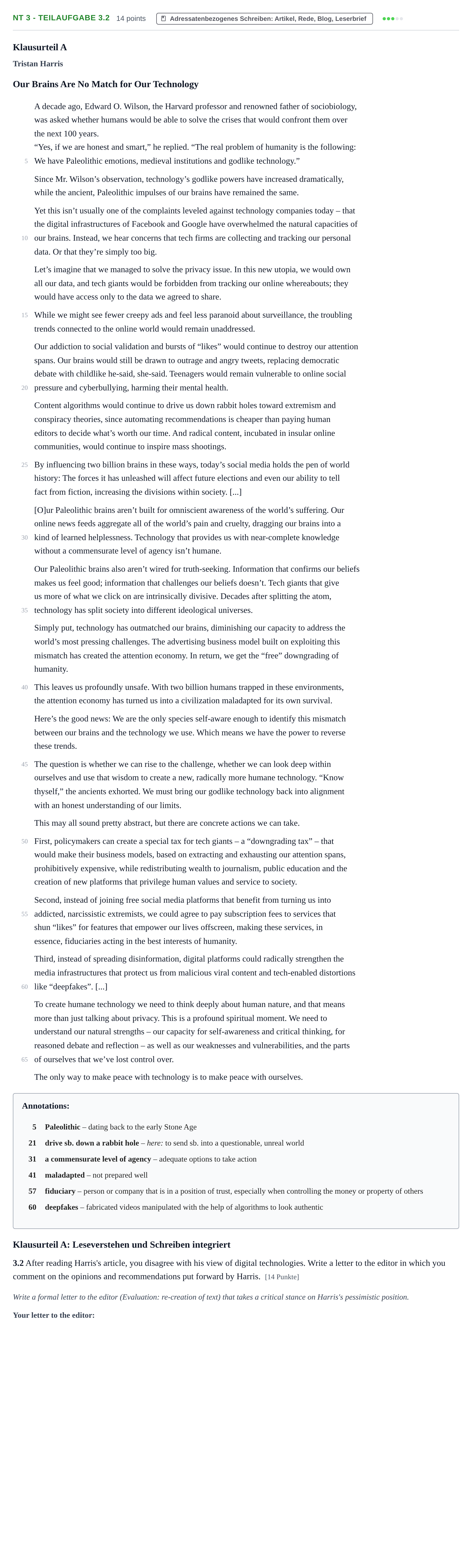
Our Brains Are No Match for Our Technology
A decade ago, Edward O. Wilson, the Harvard professor and renowned father of sociobiology,
was asked whether humans would be able to solve the crises that would confront them over
the next 100 years.
“Yes, if we are honest and smart,” he replied. “The real problem of humanity is the following:
5 We have Paleolithic emotions, medieval institutions and godlike technology.”
Since Mr. Wilson’s observation, technology’s godlike powers have increased dramatically,
while the ancient, Paleolithic impulses of our brains have remained the same.
Yet this isn’t usually one of the complaints leveled against technology companies today – that
the digital infrastructures of Facebook and Google have overwhelmed the natural capacities of
10 our brains. Instead, we hear concerns that tech firms are collecting and tracking our personal
data. Or that they’re simply too big.
Let’s imagine that we managed to solve the privacy issue. In this new utopia, we would own
all our data, and tech giants would be forbidden from tracking our online whereabouts; they
would have access only to the data we agreed to share.
15 While we might see fewer creepy ads and feel less paranoid about surveillance, the troubling
trends connected to the online world would remain unaddressed.
Our addiction to social validation and bursts of “likes” would continue to destroy our attention
spans. Our brains would still be drawn to outrage and angry tweets, replacing democratic
debate with childlike he-said, she-said. Teenagers would remain vulnerable to online social
20 pressure and cyberbullying, harming their mental health.
Content algorithms would continue to drive us down rabbit holes toward extremism and
conspiracy theories, since automating recommendations is cheaper than paying human
editors to decide what’s worth our time. And radical content, incubated in insular online
communities, would continue to inspire mass shootings.
25 By influencing two billion brains in these ways, today’s social media holds the pen of world
history: The forces it has unleashed will affect future elections and even our ability to tell
fact from fiction, increasing the divisions within society. [...]
[O]ur Paleolithic brains aren’t built for omniscient awareness of the world’s suffering. Our
online news feeds aggregate all of the world’s pain and cruelty, dragging our brains into a
30 kind of learned helplessness. Technology that provides us with near-complete knowledge
without a commensurate level of agency isn’t humane.
Our Paleolithic brains also aren’t wired for truth-seeking. Information that confirms our beliefs
makes us feel good; information that challenges our beliefs doesn’t. Tech giants that give
us more of what we click on are intrinsically divisive. Decades after splitting the atom,
35 technology has split society into different ideological universes.
Simply put, technology has outmatched our brains, diminishing our capacity to address the
world’s most pressing challenges. The advertising business model built on exploiting this
mismatch has created the attention economy. In return, we get the “free” downgrading of
humanity.
40 This leaves us profoundly unsafe. With two billion humans trapped in these environments,
the attention economy has turned us into a civilization maladapted for its own survival.
Here’s the good news: We are the only species self-aware enough to identify this mismatch
between our brains and the technology we use. Which means we have the power to reverse
these trends.
45 The question is whether we can rise to the challenge, whether we can look deep within
ourselves and use that wisdom to create a new, radically more humane technology. “Know
thyself,” the ancients exhorted. We must bring our godlike technology back into alignment
with an honest understanding of our limits.
This may all sound pretty abstract, but there are concrete actions we can take.
50 First, policymakers can create a special tax for tech giants – a “downgrading tax” – that
would make their business models, based on extracting and exhausting our attention spans,
prohibitively expensive, while redistributing wealth to journalism, public education and the
creation of new platforms that privilege human values and service to society.
Second, instead of joining free social media platforms that benefit from turning us into
55 addicted, narcissistic extremists, we could agree to pay subscription fees to services that
shun “likes” for features that empower our lives offscreen, making these services, in
essence, fiduciaries acting in the best interests of humanity.
Third, instead of spreading disinformation, digital platforms could radically strengthen the
media infrastructures that protect us from malicious viral content and tech-enabled distortions
60 like “deepfakes”. [...]
To create humane technology we need to think deeply about human nature, and that means
more than just talking about privacy. This is a profound spiritual moment. We need to
understand our natural strengths – our capacity for self-awareness and critical thinking, for
reasoned debate and reflection – as well as our weaknesses and vulnerabilities, and the parts
65 of ourselves that we’ve lost control over.
The only way to make peace with technology is to make peace with ourselves.
Annotations:
5 · Paleolithic – dating back to the early Stone Age
21 · drive sb. down a rabbit hole – here: to send sb. into a questionable, unreal world
31 · a commensurate level of agency – adequate options to take action
41 · maladapted – not prepared well
57 · fiduciary – person or company that is in a position of trust, especially when controlling the money or property of others
60 · deepfakes – fabricated videos manipulated with the help of algorithms to look authentic
Klausurteil A: Leseverstehen und Schreiben integriert
3.2 After reading Harris's article, you disagree with his view of digital technologies. Write a letter to the editor in which you comment on the opinions and recommendations put forward by Harris.
[14 Punkte]
Write a formal letter to the editor (Evaluation: re-creation of text) that takes a critical stance on Harris's pessimistic position.
Lösung
Nach den offiziellen Korrekturhinweisen
3.2 After reading Harris's article, you disagree with his view of digital technologies. Write a letter to the editor in which you comment on the opinions and recommendations put forward by Harris. (Evaluation: re-creation of text)
Lösung: Key elements of a convincing letter to the editor: 1. Formal and situational conventions: - Suitable salutation (e.g., 'Dear Editor,') and explicit reference to Tristan Harris's article 'Our Brains Are No Match for Our Technology' - Clear thesis establishing disagreement with Harris's overly negative and deterministic depiction of technology 2. Counter-arguments to Harris's one-sided assessment: - User agency and digital media literacy: users are not helpless victims; education empowers critical usage - Creative potential: digital platforms foster creative production, learning, and self-expression - Global exchange and social activism: online tools connect people worldwide, facilitate intercultural dialogue, and enable political participation (e.g., climate movements) 3. Critical response to Harris's proposed solutions: - Dangers of excessive state taxation and regulation stifling digital innovation - Free services democratize access to knowledge; subscription fees would create socio-economic barriers - Many existing apps already support offline life and mental well-being 4. Conclusion: - Well-rounded final statement summarizing the writer's position and calling for balanced technological optimism.
Die ausführliche Erklärung Schritt für Schritt (mit KI) gibt es mit Premium. Premium
Löse sie direkt hier: automatische Korrektur, Hinweise und Lösung Schritt für Schritt.
‹ Aufgabe NT 2 - Teilaufgabe 3.2 · GK · Nachtermin 2021 · Aufgabe NT 2 - Aufgabe 3.2 · GK · Nachtermin · Weiterbildungskolleg 2021 ›
Mehr Aufgaben zu Adressatenbezogenes Schreiben: Artikel, Rede, Blog, Leserbrief
- Aufgabe HT 2 - 3.2 · GK · Haupttermin · Weiterbildungskolleg 2021
- Aufgabe HT 3 - 3.2 · GK · Haupttermin · Weiterbildungskolleg 2021
- Aufgabe HT 2 - Aufgabe 3.2 · GK · Haupttermin · Weiterbildungskolleg 2021
- Aufgabe HT 3 - Aufgabe 3.2 · GK · Haupttermin · Weiterbildungskolleg 2021
- Aufgabe NT 2 - Teilaufgabe 3.2 · GK · Nachtermin 2021
- Aufgabe NT 2 - Aufgabe 3.2 · GK · Nachtermin · Weiterbildungskolleg 2021
- Aufgabe NT 3 - Aufgabe 3.2 · GK · Nachtermin · Weiterbildungskolleg 2021
- Aufgabe 3.2 · LK · Choudhury: The Epic City. The World 2021
- Aufgabe 3.2 · LK · Cohen: Nelson Mandela’s Stolen Spoo 2021
- Aufgabe HT 1 - 3.2 · LK · Haupttermin 2021