Aufgabe Vorschlag B2 - Aufgabe 2 · Abitur Hessen Englisch GK 2021
Thema: Analyse nicht-literarischer Texte (Communicative strategies) · Aus der Prüfung GK (2021)
Aufgabenstellung
Material
Martin Luther King, Jr.: Why we can’t wait (1964)
The following text is taken from the introduction of a 1964 book by African American civil rights activist Martin Luther King, Jr. It deals with the nonviolent protests of 1963 during the heyday of the Civil Rights Movement.
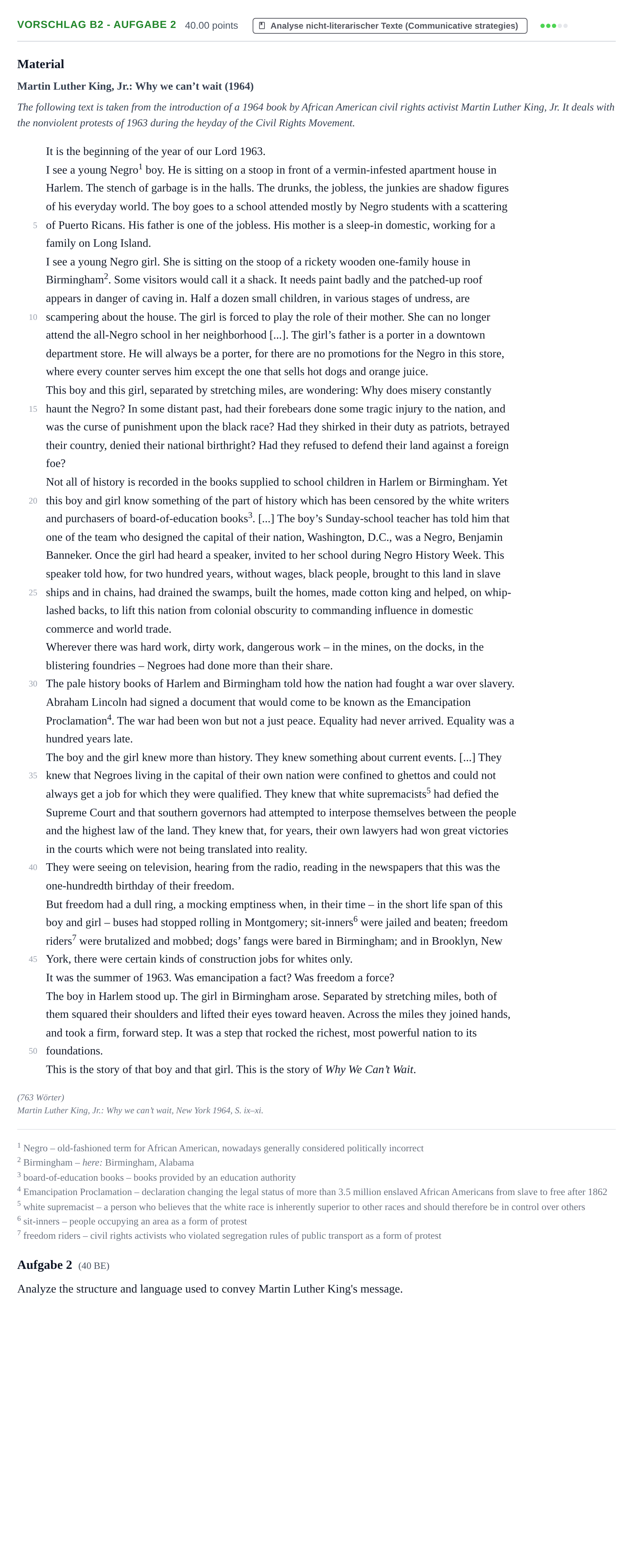
It is the beginning of the year of our Lord 1963.
I see a young Negro 1 boy. He is sitting on a stoop in front of a vermin-infested apartment house in
Harlem. The stench of garbage is in the halls. The drunks, the jobless, the junkies are shadow figures
of his everyday world. The boy goes to a school attended mostly by Negro students with a scattering
5 of Puerto Ricans. His father is one of the jobless. His mother is a sleep-in domestic, working for a
family on Long Island.
I see a young Negro girl. She is sitting on the stoop of a rickety wooden one-family house in
Birmingham 2. Some visitors would call it a shack. It needs paint badly and the patched-up roof
appears in danger of caving in. Half a dozen small children, in various stages of undress, are
10 scampering about the house. The girl is forced to play the role of their mother. She can no longer
attend the all-Negro school in her neighborhood [...]. The girl’s father is a porter in a downtown
department store. He will always be a porter, for there are no promotions for the Negro in this store,
where every counter serves him except the one that sells hot dogs and orange juice.
This boy and this girl, separated by stretching miles, are wondering: Why does misery constantly
15 haunt the Negro? In some distant past, had their forebears done some tragic injury to the nation, and
was the curse of punishment upon the black race? Had they shirked in their duty as patriots, betrayed
their country, denied their national birthright? Had they refused to defend their land against a foreign
foe?
Not all of history is recorded in the books supplied to school children in Harlem or Birmingham. Yet
20 this boy and girl know something of the part of history which has been censored by the white writers
and purchasers of board-of-education books 3. [...] The boy’s Sunday-school teacher has told him that
one of the team who designed the capital of their nation, Washington, D.C., was a Negro, Benjamin
Banneker. Once the girl had heard a speaker, invited to her school during Negro History Week. This
speaker told how, for two hundred years, without wages, black people, brought to this land in slave
25 ships and in chains, had drained the swamps, built the homes, made cotton king and helped, on whip-
lashed backs, to lift this nation from colonial obscurity to commanding influence in domestic
commerce and world trade.
Wherever there was hard work, dirty work, dangerous work – in the mines, on the docks, in the
blistering foundries – Negroes had done more than their share.
30 The pale history books of Harlem and Birmingham told how the nation had fought a war over slavery.
Abraham Lincoln had signed a document that would come to be known as the Emancipation
Proclamation 4. The war had been won but not a just peace. Equality had never arrived. Equality was a
hundred years late.
The boy and the girl knew more than history. They knew something about current events. [...] They
35 knew that Negroes living in the capital of their own nation were confined to ghettos and could not
always get a job for which they were qualified. They knew that white supremacists 5 had defied the
Supreme Court and that southern governors had attempted to interpose themselves between the people
and the highest law of the land. They knew that, for years, their own lawyers had won great victories
in the courts which were not being translated into reality.
40 They were seeing on television, hearing from the radio, reading in the newspapers that this was the
one-hundredth birthday of their freedom.
But freedom had a dull ring, a mocking emptiness when, in their time – in the short life span of this
boy and girl – buses had stopped rolling in Montgomery; sit-inners 6 were jailed and beaten; freedom
riders 7 were brutalized and mobbed; dogs’ fangs were bared in Birmingham; and in Brooklyn, New
45 York, there were certain kinds of construction jobs for whites only.
It was the summer of 1963. Was emancipation a fact? Was freedom a force?
The boy in Harlem stood up. The girl in Birmingham arose. Separated by stretching miles, both of
them squared their shoulders and lifted their eyes toward heaven. Across the miles they joined hands,
and took a firm, forward step. It was a step that rocked the richest, most powerful nation to its
50 foundations.
This is the story of that boy and that girl. This is the story of Why We Can’t Wait.
(763 Wörter)
Martin Luther King, Jr.: Why we can’t wait, New York 1964, S. ix–xi.
1 Negro – old-fashioned term for African American, nowadays generally considered politically incorrect
2 Birmingham – here: Birmingham, Alabama
3 board-of-education books – books provided by an education authority
4 Emancipation Proclamation – declaration changing the legal status of more than 3.5 million enslaved African Americans from slave to free after 1862
5 white supremacist – a person who believes that the white race is inherently superior to other races and should therefore be in control over others
6 sit-inners – people occupying an area as a form of protest
7 freedom riders – civil rights activists who violated segregation rules of public transport as a form of protest
Aufgabe 2 (40 BE)
Analyze the structure and language used to convey Martin Luther King's message.
Lösung
Nach den offiziellen Korrekturhinweisen
Analyze the structure and language used to convey Martin Luther King's message.
Lösung: Structure: The text frames general social problems around concrete individuals (a boy in Harlem and a girl in Birmingham) to create empathy and emotional appeal; it moves from their desperate situation to historical injustice, current hypocrisy, and culminates in a call to direct action / solidarity. Language: Words with negative connotations ("vermin-infested", "stench of garbage", "whip-lashed backs") underscore hardship; enumerations highlight widespread oppression; rhetorical questions emphasize injustice despite African Americans' loyalty; metaphors ("step that rocked the richest, most powerful nation to its foundations") visualize empowerment; parataxis conveys urgency and clarity.
Die ausführliche Erklärung Schritt für Schritt (mit KI) gibt es mit Premium. Premium
Löse sie direkt hier: automatische Korrektur, Hinweise und Lösung Schritt für Schritt.
‹ Aufgabe Vorschlag B1 - 3.2 · GK 2022 · Aufgabe Vorschlag B3 - Aufgabe 2 · LK 2021 ›